Home
Class 12
PHYSICS
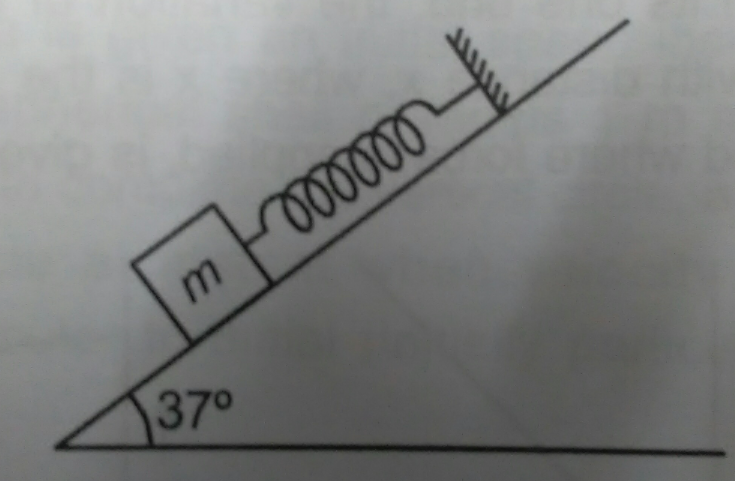
If extension in the spring at equilibriu...

If extension in the spring at equilibrium position is 6 cm then acceleration of block if it is released by further stretching 4 cm.

A

`4 m/S^2`

B

`1 m/S^2`

C

`6 m/S^2`

D

`2 m/S^2`

Text Solution

Verified by Experts

Promotional Banner

Similar Questions

Explore conceptually related problems

A block tied between two identical springs is in equilibrium. If upper spring is cut then the acceleration of the block just after cut is 6m//s^(2) downwards. Now, if instead of upper spring, lower spring is being cut then the acceleration of the block just after the cut will be.

A block of mass m is suddenly released from the top of a spring of stiffness constant k. a. Find the acceleration of block just after release. b. What is the compression in the spring at equilibrium. c. What is the maximum compression in the spring. d. Find the acceleration of block at maximum compression in the spring.

Consider the situation shown in figure. Mass of block A is m and that of blcok B is 2m. The force constant of string is k. Friction is absent everywhere. System is released from rest with the spring unstretched. Find (a) The maximum extension of the spring x_(m) (b) The speed of block A when the extension in the springt is x=(x_(m))/(2) (c ) The net acceleration of block B when extension in the spring is x=(x_(m))/(4).

The block of mass m_1 shown in figure is fastened to the spring and the block of mass m_2 is placed asgainst ilt. A. Find the compression of the spring in the equilibrium position. b.The blocks are pushed a further distance (2/k)(m_1+m_2)gsintheta against the spring and released. Find the position where the two blocks separate. c. What is the common speed of blocks at the time of separation?

A rectangular tank having base 15 cm xx 20 cm is filled with water (density rho = 1000 kg//m^(2)) up to 20 cm and force constant K = 280 N//m is fixed to the bottom of the tank so that the spring remains vertical. This sysytem is in an elevator moving downwards with acceleration a = 2 m//s^(2) . A cubical block of side l = 10 cm and mass m = 2 kg is gently placed over the spring and released gradually, as shown in the figure. a. Calculate compression of the spring in equilibrium position. b. If the block is slightly pushed down from equilibrium position and released, calculate frequency of its vertical oscillations.

A block of mass m is released from rest onto a spring. A having stiffness k_A=mg//2h as shown in figure. If the block compresses spring B through a distance h, find the: a. stiffness of the spring B b. equilibrium position of the block c. maximum velocity of the block d. maximum acceleration of the block

The given arrangement is released from rest when spring is in natural length. Maximum extension in spring during the motion is x_(0). a_(1),a_(2) and a_(3) are accelerations of the blocks. Make the correct options

The acceleration of a particle executing SHM at a distance of 3 cm from equilibrium position is 5 cm//s^(2) . Its acceleration at a distance of 2 cm from equilibrium position is

A 5-kg block rests on a smooth inclined plane of inclination 37^(@) as shown in the diagram if the extension of spring is 6cm, find (a) the spring constant (b). If the block is pulled dow the incline 4 cm from its equilibrium position and released, find the initial acceleration of the block.

On suspending a heavy block of 2 kg from a massless spring, an extension of 5 cm is produced in the spring. If the block is further pulled down by 10 cm and then released then find the kinetic energy of oscillation of the spring.

