Home
Class 12
PHYSICS
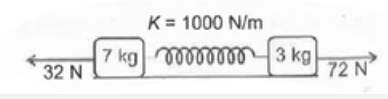
If both the blocks moving with constant ...

If both the blocks moving with constant accelerattion then extension in spring.

A

6 cm

B

12 cm

C

3 cm

D

2 cm

Text Solution

Verified by Experts

Promotional Banner

Similar Questions

Explore conceptually related problems

Two blocks each of mass m are joined together using an ideal spring of force constant K and natural length l_(0) . The blocks are touching each other when the system is released from rest on a rough horizontal surface. Both the blocks come to rest simultaneously when the extension in the spring is (l_(0))/4 . The coefficient of friction between each block and the surface (assuming it to be same between any of the blocks and the surface) is :

One end of a spring of force constant k_1 is attached to the ceiling of an elevator. A block of mass 1.5kg is attached to the other end. Another spring of force constant k_2 is attached to the bottom of the mass and to the floor of the elevator as shown in figure. At equilibrium, the deformation in both the spring is equal and is 40cm . If the elevator moves with constant acceleration upward, the additional deformation in both the spring is 8cm . Find the elevator's accelerationn ( g=10ms^-2 ).

Initially spring is in natural length and both blocks are in rest condition. Then deter mine maximum extension in spring . K = 20 N/M

Force constant of a spring is 100 N//m . If a 10kg block attached with the spring is at rest, then find extension in the spring. ( g= 10 m//s^(2) )

An ideal spring with spring constant k is hung from the ceiling and a block of mass M is attached to its lower end. The mass is released with the spring initially unstretched. Then the maximum extension in the spring is

A block of mass m attached with a an ideal spring of force constant k is placed on a rough inclined plane having inclination theta with the horizontal and coefficient of friction mu=1//2 tan theta , Initially the block is held stationary with the spring in its relaxed state, find the maximum extension in the spring if the block is released.

If the two blocks moves with a constant uniform speed then find coefficient of fricition between the surface of the block B and the table. The spring is massless and the pulley is fricitionless.

Consider the situation as shown. Initially the spring is unstretched when the block of mass m is released from rest assuming the pulley frictionless and light the spring and string massless. Find the extension of sprinig when the block is in equilibrium also find the maximum extension of the spring.

