

Home
Class 10
BIOLOGY
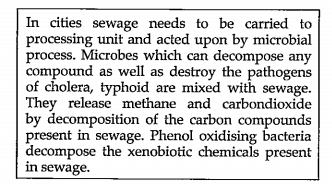
Paragraph based questions. Read the para...

Paragraph based questions. Read the paragraph and answer the following questions:

Where is sewage in cities disposed off?

Promotional Banner

Topper's Solved these Questions

  • Heredity and Evolution

    CHETANA PUBLICATION|Exercise EXERCISE|120 Videos
  • Life processes in Living Organisms -2

    CHETANA PUBLICATION|Exercise EXERCISE|180 Videos

Similar Questions

Explore conceptually related problems

Answer the following questions : Where is this microscope used ?

Diagram based question: Observe the diagram and answer the following questions: What type of waste is used in this method?

Paragraph based Questions : Read the paragraph and answer the questions given below : Remediation is the process of removing dangerous or poisonous substances from the environment, or limiting the effect that they have on it. When any biological organism is used for remediation, it is called bioremediation. When plant species are used for the purpose of remediation, it is called phytoremediation. When any microbes are used then it is named as microbial remediation. The methods of such remediation have helped to clean the environment from toxic effluents, especially sewage and crude oi]. Dr. Anand Chakraborty, a scientist of Indian origin, has worked on Pseudomonas aeruginosa which have reduced the crude oil films into carbon dioxide and water. Which environmental pollutant is mainly removed through bioremediation processes?

Paragraph based Questions : Read the paragraph and answer the questions given below : Remediation is the process of removing dangerous or poisonous substances from the environment, or limiting the effect that they have on it. When any biological organism is used for remediation, it is called bioremediation. When plant species are used for the purpose of remediation, it is called phytoremediation. When any microbes are used then it is named as microbial remediation. The methods of such remediation have helped to clean the environment from toxic effluents, especially sewage and crude oil Dr. Anand Chakraborty, a scientist of Indian origin, has worked on Pseudomonas aeruginosa which have reduced the crude oil films into carbon dioxide and water. Why Dr. Anand Chakraborty’s work phenomenal?

Paragraph based Questions : Read the paragraph and answer the questions given below : Remediation is the process of removing dangerous or poisonous substances from the environment, or limiting the effect that they have on it. When any biological organism is used for remediation, it is called bioremediation. When plant species are used for the purpose of remediation, it is called phytoremediation. When any microbes are used then it is named as microbial remediation. The methods of such remediation have helped to clean the environment from toxic effluents, especially sewage and crude oi]. Dr. Anand Chakraborty, a scientist of Indian origin, has worked on Pseudomonas aeruginosa which have reduced the crude oil films into carbon dioxide and water. What is the meaning of remediation?

Paragraph based Questions : Read the paragraph and answer the questions given below : Remediation is the process of removing dangerous or poisonous substances from the environment, or limiting the effect that they have on it. When any biological organism is used for remediation, it is called bioremediation. When plant species are used for the purpose of remediation, it is called phytoremediation. When any microbes are used then it is named as microbial remediation. The methods of such remediation have helped to clean the environment from toxic effluents, especially sewage and crude oi]. Dr. Anand Chakraborty, a scientist of Indian origin, has worked on Pseudomonas aeruginosa which have reduced the crude oil films into carbon dioxide and water. What is the difference between phytoremediation and microbial remediation?

Paragraph based Questions : Read the paragraph and answer the questions given below : Remediation is the process of removing dangerous or poisonous substances from the environment, or limiting the effect that they have on it. When any biological organism is used for remediation, it is called bioremediation. When plant species are used for the purpose of remediation, it is called phytoremediation. When any microbes are used then it is named as microbial remediation. The methods of such remediation have helped to clean the environment from toxic effluents, especially sewage and crude oill. Dr. Anand Chakraborty, a scientist of Indian origin, has worked on Pseudomonas aeruginosa which have reduced the crude oil films into carbon dioxide and water. What is the role of Pseudomonas aeruginosa?

Paragraph based questions : Read the following paragraph and answer, the questions based on it. The presence or absence of organs is the first, criterion for classification of plants. The presence or absence of separate conducting tissues for conduction of water and food is the next consideration for classification. Do the plants bear seeds? If they do then, whether the seeds are enclosed in a fruit or not is also an important criterion for classification. Finally, plants are grouped depending upon the number of cotyledons in the seeds. In 1883, Eichler, a botanist, classified the Kingdom Plantae into two sub-kingdoms. As a result, two sub-kingdoms, cryptogams and phanerogams were considered for plant classification. What are the two groups based on the criteria of whether the seeds are enclosed in a fruit or not?

Paragraph based questions : Read the following paragraph and answer, the questions based on it. The presence or absence of organs is the first, criterion for classification of plants. The presence or absence of separate conducting tissues for conduction of water and food is the next consideration for classification. Do the plants bear seeds? If they do then, whether the seeds are enclosed in a fruit or not is also an important criterion for classification. Finally, plants are grouped depending upon the number of cotyledons in the seeds. In 1883, Eichler, a botanist, classified the Kingdom Plantae into two sub-kingdoms. As a result, two sub-kingdoms, cryptogams and phanerogams were considered for plant classification. What are the groups of plants classified according to the number of cotyledons?

Paragraph based questions : Read the following paragraph and answer, the questions based on it. The presence or absence of organs is the first criterion for classification of plants. The presence or absence of separate conducting tissues for conduction of water and food is the next consideration for classification. Do the plants bear seeds? If they do then, whether the seeds are enclosed in a fruit or not is also an important criterion for classification. Finally, plants are grouped depending upon the number of cotyledons in the seeds. In 1883, Eichler, a botanist, classified the Kingdom Plantae into two sub-kingdoms. As a result, two sub-kingdoms, cryptogams and phanerogams were considered for plant classification. Which criteria are taken into account while classifying the lower groups of the plants?

CHETANA PUBLICATION-Introduction to Microbiology-EXERCISE
  1. Explain the process of Land - filling site with a neat labelled diagra...

    Text Solution

    |

  2. How the sewage generated in your house or apartment is disposed off ?

    Text Solution

    |

  3. Paragraph based questions. Read the paragraph and answer the following...

    Text Solution

    |

  4. Which disease pathogens are destroyed by microbes?

    Text Solution

    |

  5. Which gases are released by decompostion of carbon compounds?

    Text Solution

    |

  6. What is the role of Phenol oxidising bacteria?

    Text Solution

    |

  7. Give a heading to the paragraph.

    Text Solution

    |

  8. Most appropriate method of disposal of dry waste is .

    Text Solution

    |

  9. bateria present in Root nodules of leguminous plants help in nitrogen ...

    Text Solution

    |

  10. Say True or False: Microbes ferment sugar into liquid fuel.

    Text Solution

    |

  11. Find the odd word out: Penicillin, erythromycin, gentamycin, acetic ...

    Text Solution

    |

  12. Yoghurt : Bacteria in Milk :: Cheese: ""

    Text Solution

    |

  13. Write any four uses of Probiotics.

    Text Solution

    |

  14. Complete the chart.

    Text Solution

    |

  15. Give scientific reasons: Milk is pasteurized at the beginning.

    Text Solution

    |

  16. What is role of microbes in compost production ?

    Text Solution

    |

  17. Explain the importance of biopesticides in organic farming.

    Text Solution

    |

  18. Explain the role of microbes in chemical pollution.

    Text Solution

    |

  19. Explain biofuel production with the help of a diagram

    Text Solution

    |

  20. Explain the process of Land - filling site with a neat labelled diagra...

    Text Solution

    |