

Home
Class 8
MATHS
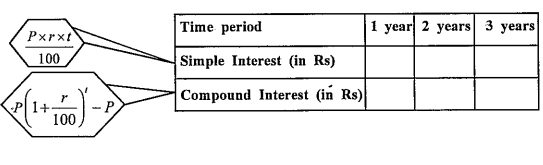
Principal = Rs 1000, Rate = 8% per annum...

Principal = Rs 1000, Rate = 8% per annum. Fill in the following table find which type of interest (simple or compound) changes in direct proportion with time period.

Promotional Banner

Topper's Solved these Questions

  • Data Handling

    ASHOK PUBLICATION ASSAM|Exercise EXAMPLE|64 Videos
  • Exponents and Powers

    ASHOK PUBLICATION ASSAM|Exercise EXAMPLE|62 Videos

Similar Questions

Explore conceptually related problems

Arif took a loan of Rs 80,000 from a bank. If the rate of interest is 10% per annum, find the difference in amounts he would be paying after 1frac(1)(2) years if the interest is (i) compounded annually and (ii) compounded half yearly.

Arif took a loan of Rs 80,000 from a bank. If the rate of interest is 10% per annum, find the difference in amounts he would be paying after 1frac(1)(2) years if the interest is (i) compounded annually and (ii) compounded half yearly.

Find the amount to be paid: At the end of 2 year on Rs 2400 at 5% per annum compound annually.

Find the amount and the compound interest on Rs 10,000 for 1 and a half years at 10% per annum, componded half yearly. Would his interest be more than the interest he would get if it was compounded annually?

I borrowed Rs 12,000 from Jamshed at 6% per annum simple interest for 2 years. Had I borrowed this sum at 6% per annum compound interest, what extra amount would I have to pay?

If we fix time period and the rate of interest, simple interest changes proportionally with principal. Would there be a similar relationship for compound interest? Why?

Find the amount to be paid: At the end of 1 year on Rs. 1,800 at 8% annum compounded quarterly.

Fabina borrows Rs 12,500 at 12% per annum for 3 years at simple interest and Radha borrows the same amount for the same period at 10% per annum, compounded annually, Who pays more interest and by how much?

Maria invested Rs 8,000 in a business. She would be paid interest at 5% per annum compounded annually. Find (i) The amount credited against her name at the end of the second year. (ii)The interest for the 3rd year.

Find the time period and rate for each: A sum is taken for 2 years at 4% per annum is compounded half yearly.

ASHOK PUBLICATION ASSAM-Direct and Inverse Proportions-EXAMPLE
  1. Two persons could fit new windows in a house in 3 days. One of the p...

    Text Solution

    |

  2. Two persons could fit new windows in a house in 3 days. How many per...

    Text Solution

    |

  3. A school has 8 periods a day each of 45 minutes duration. How long wou...

    Text Solution

    |

  4. Observe the following tables and find if x and y are directly proporti...

    Text Solution

    |

  5. Observe the following tables and find if x and y are directly proporti...

    Text Solution

    |

  6. Observe the following tables and find if x and y are directly proporti...

    Text Solution

    |

  7. Principal = Rs 1000, Rate = 8% per annum. Fill in the following table ...

    Text Solution

    |

  8. If we fix time period and the rate of interest, simple interest chang...

    Text Solution

    |

  9. On a squared paper, draw five squares of different sides. Write the fo...

    Text Solution

    |

  10. On a squared paper, draw five squares of different sides. Write the fo...

    Text Solution

    |

  11. The following ingredients are required to make halwa for 5 persons : S...

    Text Solution

    |

  12. Take a squared paper and arrange 48 counters on it in different number...

    Text Solution

    |

  13. Take a squared paper and arrange 48 counters on it in different number...

    Text Solution

    |

  14. Observe the following tables and find which pair of variables (here x ...

    Text Solution

    |

  15. Observe the following tables and find which pair of variables (here x ...

    Text Solution

    |

  16. Observe the following tables and find which pair of variables (here x ...

    Text Solution

    |

  17. If frac(a)(b) = frac(c ) (d), show tha ad = bc

    Text Solution

    |

  18. If frac(a)(b) = frac(c )(d), show that frac(a+b)(b) = frac(c+d)(d)

    Text Solution

    |

  19. What is the inverse ratio of m:n?

    Text Solution

    |

  20. Find the ratio of 1 cm and 1 m.

    Text Solution

    |