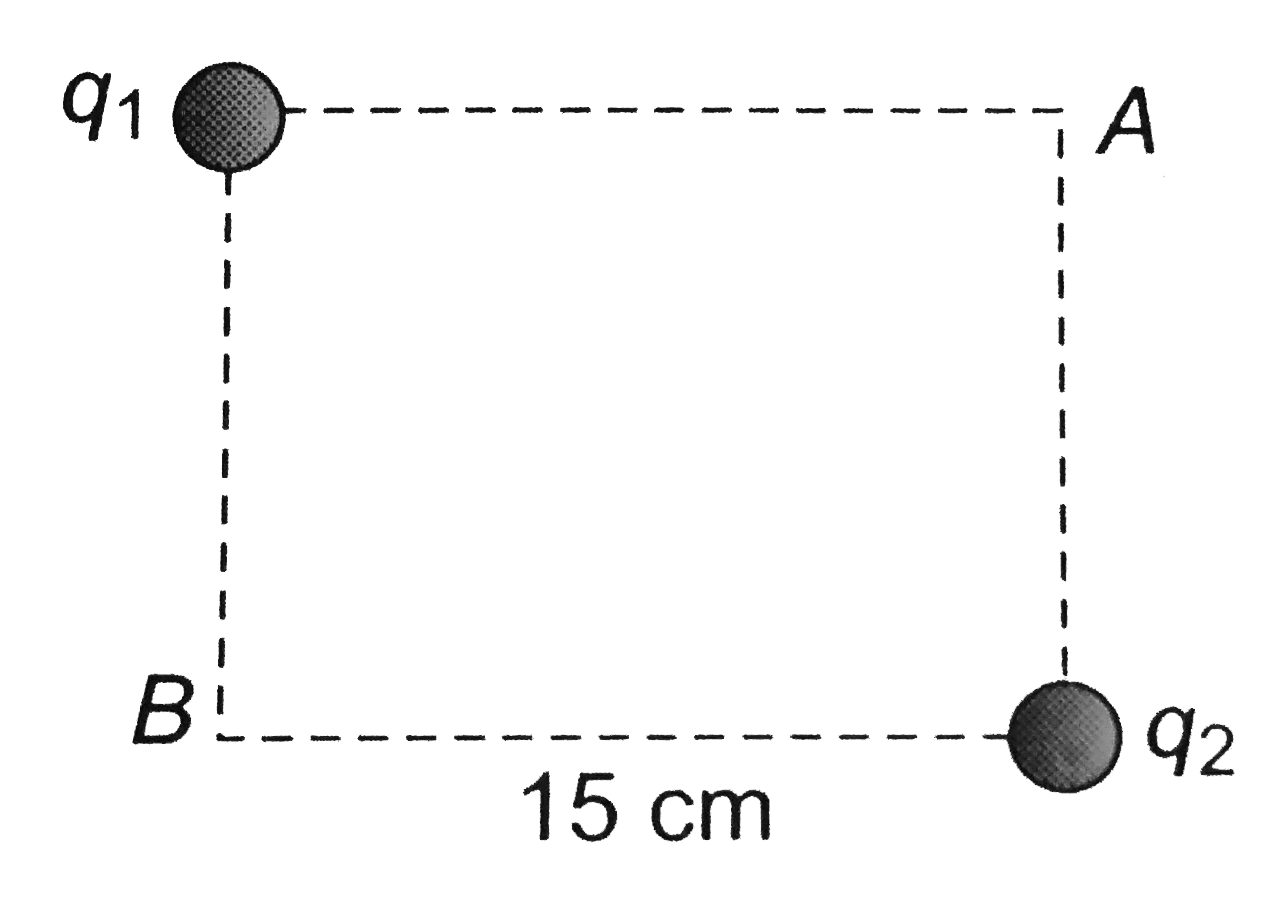
A
B
C
D
Text Solution
Verified by Experts



Topper's Solved these Questions
ELECTROSTATICS
ERRORLESS |Exercise Ordinary Thinking Objective Questions (Electric Dipole)|38 VideosELECTROSTATICS
ERRORLESS |Exercise Ordinary Thinking Objective Questions (Electric Flux and Gauss.s Law)|28 VideosELECTROSTATICS
ERRORLESS |Exercise Ordinary Thinking Objective Questions (Electric Flux and Gauss.s Law)|28 VideosELECTRONICS
ERRORLESS |Exercise Selv Evaluation Test|23 VideosHEATING AND CHEMICAL EFFECT OF CURRENT
ERRORLESS |Exercise Self Evaluation Test|14 Videos
Similar Questions
Explore conceptually related problems
ERRORLESS -ELECTROSTATICS -Ordinary Thinking Objective Questions (Electric Field and Potential)
- The radius of a soap bubble whose potential is 16V is doubled. The new...
Text Solution
|
- The dimensions of 1/2 epsilon(0)E^(2) (epsilon(0)= permittivity of fre...
Text Solution
|
- In the rectangle, shown below, the two corners have charges q(1) = - 5...
Text Solution
|
- A cube of a metal is given a positive charge Q. For the above system, ...
Text Solution
|
- If q is the charge per unit area on the surface of a conductor, then t...
Text Solution
|
- A hollow conducting sphere of radius R has a charge (+Q) on its surfac...
Text Solution
|
- A spherical conductor of radius 2 m is charged to a potential of 120 V...
Text Solution
|
- A charge (-q) and another charge (Q) are kept at two points A and B re...
Text Solution
|
- A particle of mass 'm' and charge 'q' is accelerated through a potenti...
Text Solution
|
- Two spheres A and B of radius 'a' and 'b' respectively are at same ele...
Text Solution
|
- Potential at a point x-distance from the centre inside the conducting ...
Text Solution
|
- Electric field intensity at a point in between two parallel sheets wit...
Text Solution
|
- In an hydrogen atom, the electron revolves around the nucles in an orb...
Text Solution
|
- Consider two point charges of equal magnitude and opposite sign separa...
Text Solution
|
- Two small spherical balls each carrying a charge Q= 10 mu C( 10 micro=...
Text Solution
|
- A ball of mass 1g and charge 10^(-8) C moves from a point A. Where pot...
Text Solution
|
- An electron is accelerated in an electric field of 40V cm^(-1). If e//...
Text Solution
|
- Three charges Q, (+q) and (+q) are placed at the vertices of an equila...
Text Solution
|
- A positively charge particle moving along x-axis with a certain veloci...
Text Solution
|
- Electric potential at any point is V = - 5 x + 3y + sqrt(15) z, then t...
Text Solution
|