Home
Class 12
PHYSICS
q(1),q(2),q(3) and q(4) are point charge...

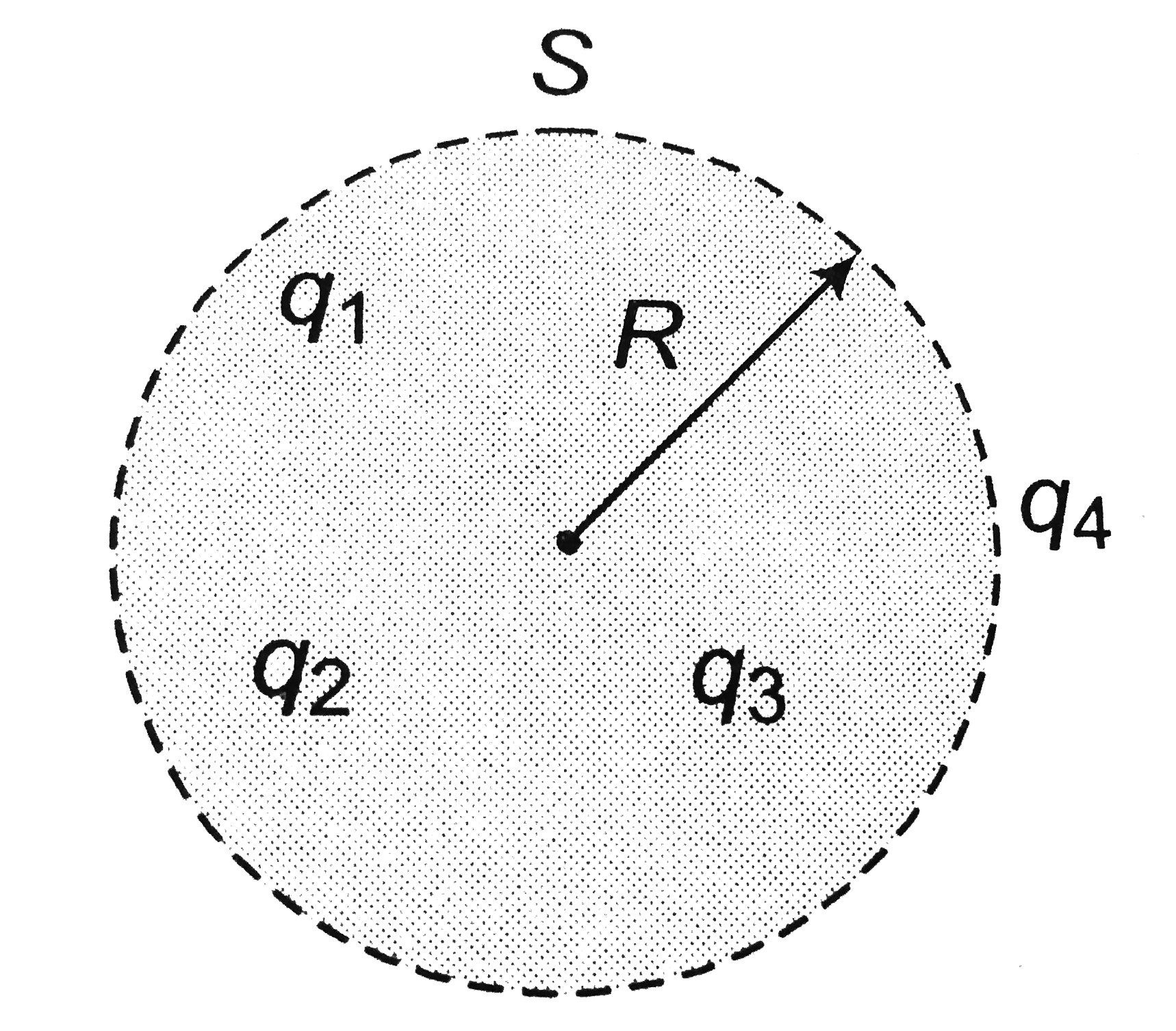
`q_(1),q_(2),q_(3)` and `q_(4)` are point charges located at point as shown in the figure and `s` is a spherical Gaussian surface of radius `R`. Which of the following is true according to the Gauss's law

A

`oint_(s)(vecE_(1)+vecE_(2)+vecE_(3)).dvecA=(q_(1)+q_(2)+q_(3))/(2in_(0))`

B

`oint_(s)(vecE_(1)+vecE_(2)+vecE_(3)).dvecA=((q_(1)+q_(2)+q_(3)))/(in_(0))`

C

`oint_(s)(vecE_(1)+vecE_(2)+vecE_(3)).dvecA=((q_(1)+q_(2)+q_(3)+q_(4)))/(in_(0))`

D

None of the above

Text Solution

Verified by Experts

The correct Answer is:

C
Promotional Banner

Topper's Solved these Questions

  • ELECTROSTATICS

    ERRORLESS |Exercise Ordinary Thinking Objective Questions (Electric Dipole)|38 Videos
  • ELECTRONICS

    ERRORLESS |Exercise Selv Evaluation Test|23 Videos
  • HEATING AND CHEMICAL EFFECT OF CURRENT

    ERRORLESS |Exercise Self Evaluation Test|14 Videos

Similar Questions

Explore conceptually related problems

The value of charge q_1 ,q_2 and q_3 as shown in the figure are

A point charge +Q is place just outside an imaginary hemispherical surface of radius R as shown in the figure. Which of the following statements is/are correct ?

five charge q_(1),q_(2),q_(3),q_(4) and q_(5) are fixed at their positions as shown in figure . s is Gaussian surface .The Gauss's law is given by ointvec(E).vec(ds)=(q)/(epsilon_(0)) Which of the following statement is correct?

Refer to the arrangement of charges in Fig and a Gaussian surface of radius R with Q at the centre. Then

A charge Q is enclosed by a Gaussian spherical surface of radius R . If the radius is doubled, then the outward electric flux will

Consider Gauss's law oint vecE * vecd s = q/epsilon_0 Then, for the situation shown in figure at the Gaussian surface

Three charges -q_(1), +q_(2) and -q_(3) are placed as shown in the figure. The x -component of the force on -q_(1) is proportional to

Three charges +q, +q, +2q are arranged as shown in figure. What is the field at point P (center of side AC)

ERRORLESS -ELECTROSTATICS -Ordinary Thinking Objective Questions (Electric Flux and Gauss.s Law)
  1. A charge q is placed at the centre of the open end of a cylindrical ve...

    Text Solution

    |

  2. It is not convenient to use a spherical Gaussian surface to find the e...

    Text Solution

    |

  3. In case of infinite long wire electric field is proportional to

    Text Solution

    |

  4. Electric charge is uniformly distributed along a long straight wire of...

    Text Solution

    |

  5. The SI unit of electric flux is

    Text Solution

    |

  6. q(1),q(2),q(3) and q(4) are point charges located at point as shown in...

    Text Solution

    |

  7. Gauss’s law should be invalid if

    Text Solution

    |

  8. The inward and outward electric flux for a closed surface unit of N-m^...

    Text Solution

    |

  9. If a point charge q is placed at the centre of a cube, then find out f...

    Text Solution

    |

  10. If a spherical conductor comes out from the closed surface of the sphe...

    Text Solution

    |

  11. If the electric flux entering and leaving an enclosed surface respecti...

    Text Solution

    |

  12. A charge q is located at the centre of a cube. The electric flux throu...

    Text Solution

    |

  13. Shown below is a distribution of charges. The flux of electric field d...

    Text Solution

    |

  14. Consider the charge configuration and a spherical Gaussian surface as ...

    Text Solution

    |

  15. Gauss's law is true only if force due to a charge varies as

    Text Solution

    |

  16. An electric dipole is put in north-south direction in sphere filled wi...

    Text Solution

    |

  17. Two infinite plane parallel sheets, separated by a distance d have equ...

    Text Solution

    |

  18. The electric flux for Gaussian surface A that enclose the charge parti...

    Text Solution

    |

  19. The electric intensity due to a uniformly charged infinite cylinder of...

    Text Solution

    |

  20. A sphere of radius R has a uniform distribution of electric charge in ...

    Text Solution

    |
