

Home
Class 12
PHYSICS
The diagram shows four slabs of differen...

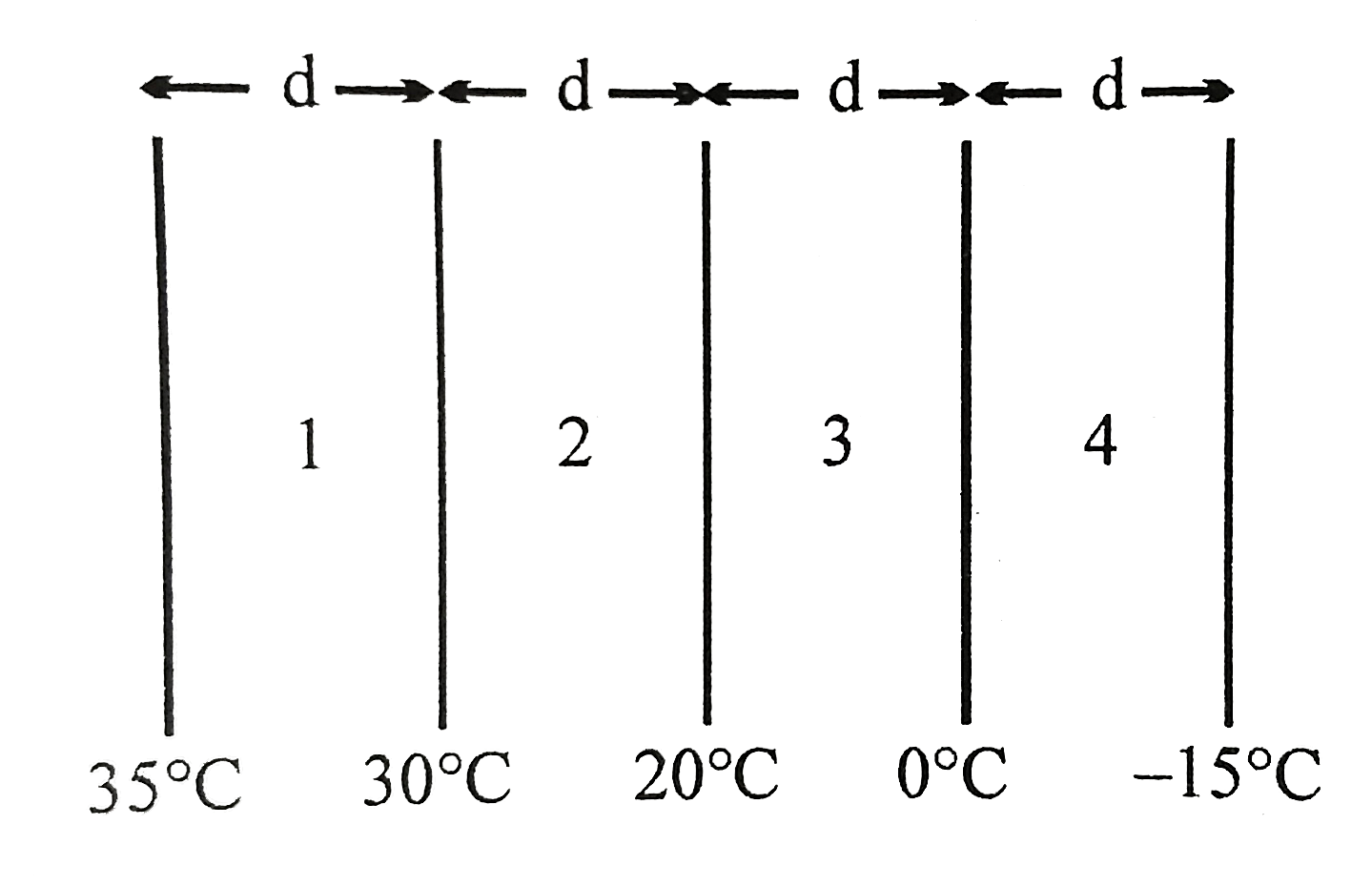
The diagram shows four slabs of different materials with equal thickness, placed side by side. Heat flows from left to right and the steady-state temperatures of the interfaces are given. Rank the materials according to their thermal conductivities, smallest to largest.

Promotional Banner

Similar Questions

Explore conceptually related problems

The figure shows the face and interface temperatures of a composite slab consisting of four materials, of identical thickness, through which the heat transfer is steady. Rank the materials according to their thermal conductivities, greatest first.

A partition wall has two layers A and B, in contact, each made of a different material. They have the same thickness but the thermal conductivity of layer A is twice that of layer B. If the steady state temperature difference across the wall is 60 K, then the corresponding difference across the layer A is

The figure here shows four rectangular metal plates, with sides of , L , 2L or 3L. They are all made of the same material , and their temperature is to be increased by the same amount , Rank the plates according to the expected increase in (a) their vertical heights and (b) their areas , greatest first.

Two identical rods are made of different materials whose thermal conductivities are K_(1) and K_(2) . They are placed end to end between two heat reservoirs at temperatures theta_(1) and theta_(2) . The temperature of the junction of the rod is

The end of two rods of different materials with their thermal conductivities, area of cross-section and lengths all in the ratio 1:2 are maintained at the same temperature difference. If the rate of flow of heat in the first rod is 4 cal//s . Then, in the second rod rate of heat flow in cal//s will be

Consider a compound slab consisting of two different material having equal thickness and thermal conductivities K and 2K respectively. The equivalent thermal conductivity of the slab is

A composite slab consists of two slabs A and B of different materials but of the same thickness placed one on top of the other. The thermal conductivities of A and B are k_(1) and K_(2) respectively. A steady temperature difference of 12^(@)C is maintained across the composite slab. If k_(1) = K_(2)//2 , the temperature difference across slab A will be:

A wall has two layers A and B, each made of different materials. Both layers are of same thickness. But, the thermal conductivity of material A is twice that of B. If, in the steady state, the temperature difference across the wall is 24^(@)C , then the temperature difference across the layer B is :

If two conducting slabs of thickness d_1 and d_2 , and thermal conductivity K_1 and K_2 are placed together face to face as shown in figure in the steady state temperature of outer surfaces are theta_1 and theta_2 . The temperature of common surface is-