Home
Class 10
MATHS
In Delta ABC, ray BD bisects angleABC. A...

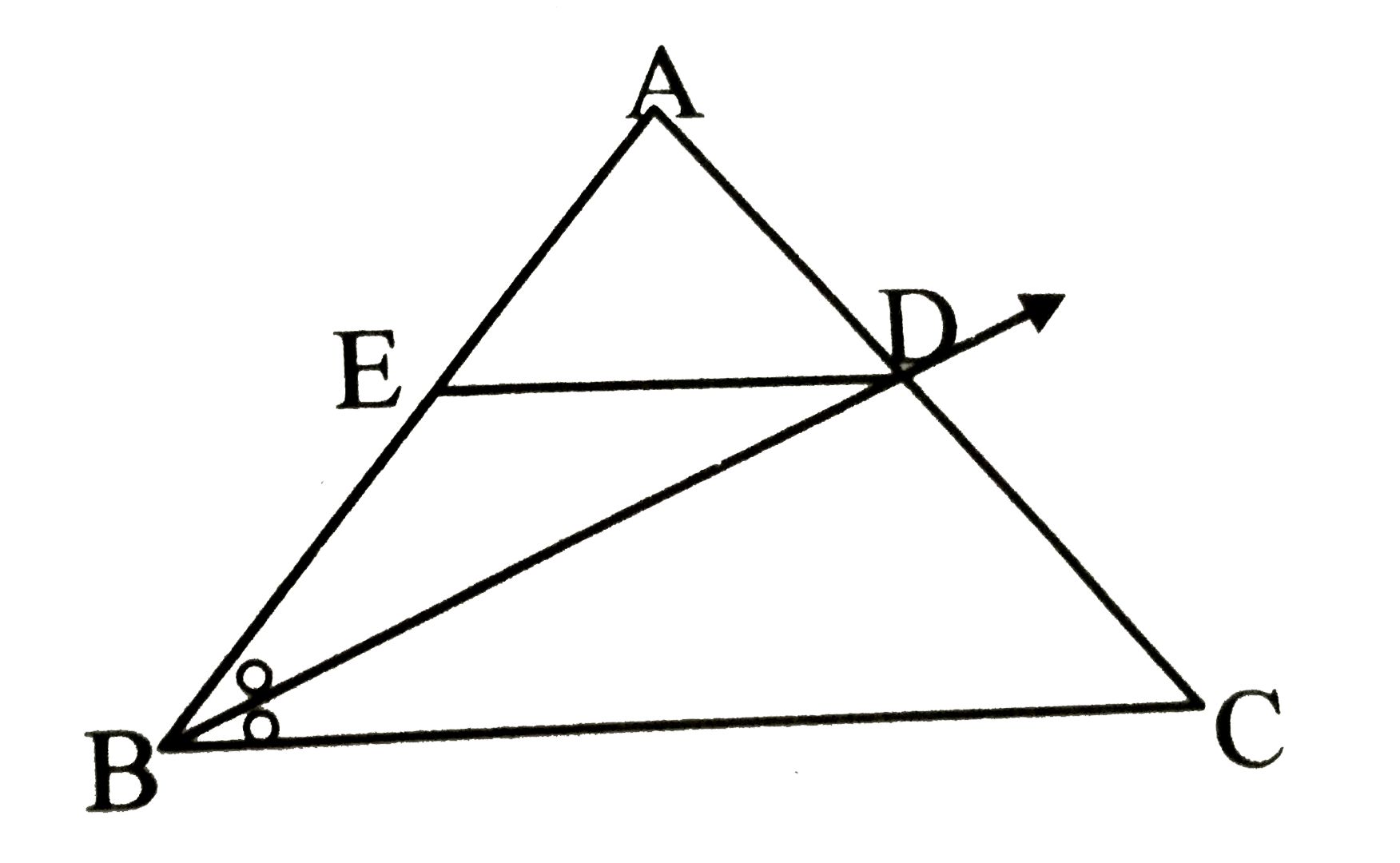
In `Delta ABC`, ray BD bisects `angleABC`. `A-D-C`, `side DEabs()side BC`, `A-E-B`,
then prove that `(AB)/(BC) = (AE)/(EB)`.

Text Solution

Verified by Experts

The correct Answer is:

`therefore " " (AB)/(BC) = (AE)/(EB)`
Promotional Banner

Topper's Solved these Questions

  • SIMILARITY

    TARGET PUBLICATION|Exercise Practice Set 1.1|8 Videos
  • SIMILARITY

    TARGET PUBLICATION|Exercise Practice Set 1.2|11 Videos
  • SIMILARITY

    TARGET PUBLICATION|Exercise Chapter Assessment|17 Videos
  • QUESTION FROM STD. IX

    TARGET PUBLICATION|Exercise Statistics|11 Videos
  • STATISTICS

    TARGET PUBLICATION|Exercise Problem Set-6|5 Videos

Similar Questions

Explore conceptually related problems

In DeltaABC , ray BD bisects /_ABC . A-D-C , side DE|| side BC , A-E-B . Prove that, (AB)/(BC)=(AE)/(EB) . Complete the activity by filling the boxes. In DeltaABC , ray BD is the bisector of /_ABC :.(AB)/(BC)=square ....... (I) (By angle bisector theorem) In DeltaABC , seg DE|| side BC :.(AE)/(EB)=(AD)/(DC) ........ (II) square :.(AB)/(square)=(square)/(EB) .......[From (I) and (II) ]

In DeltaABC ,ray BD bisects angleABC and ray CE bisects angleACB . If seg AB cong seg AC, then prove that ED abs() BC.

In triangle ABC , seg AD_|_side BC , B-D-C. Prove that AB^2+CD^2=BD^2+AC^2

In the adjoining figure,seg DE abs() side AC and seg DC abs() side AP. Prove that (BE)/(EC) = (BC)/(CP) .

In DeltaABC Seg BD bisects /_ABC . If AB=x, BC=x+5, AD=x-2, DC=x+2 , then find the value of x .

In an equilateral triangle ABC,the side BC is trisected at D.Prove that: 9AD^2=7AB^2 .

In triangle ABC , line PQ||side BC ,AP=3,BP=6,AQ=5 then the value of QC is………..

In the adjoining figure, bisector of angleBAC intersects BC at point D. Prove that AB gt BD .

In the given figure, ray AE || ray BD, ray AF is the bisector of angleEAB and ray BC is the bisector of angleABD . Prove that lineAF || line BC.

In DeltaABC , B - D - C and BD = 7, BC = 20 , then find the ratio (A(DeltaABD))/(A(DeltaABC))
