Home
Class 10
CHEMISTRY
The elements in the third period, namely...

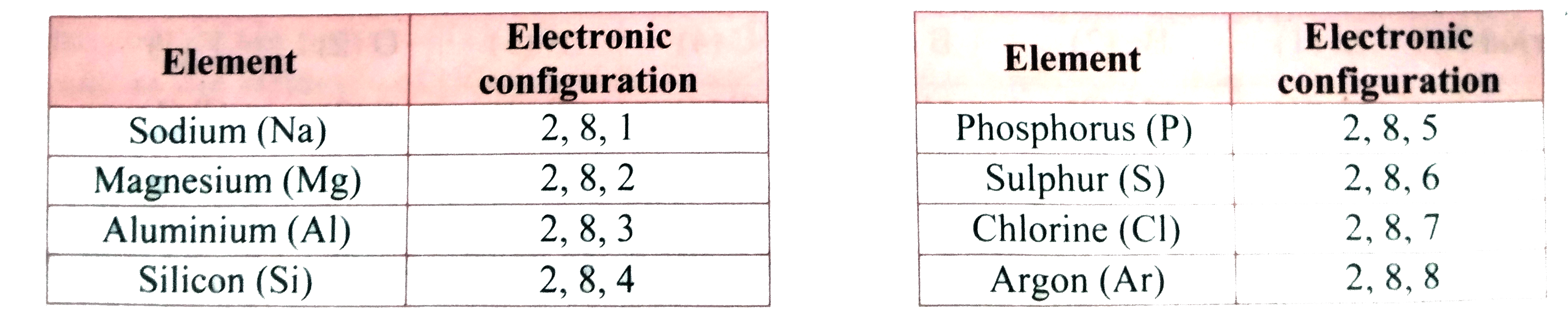
The elements in the third period, namely, Na, Mg, AI, Si, P, S, CI and Ar have electrons in the three shells: K, L and M. Write down the electronic configuration of these elements and confirm.

Text Solution

Verified by Experts
Promotional Banner

Topper's Solved these Questions

  • PERIODIC CLASSIFICATION OF ELEMENTS

    TARGET PUBLICATION|Exercise Chapter Assessment|16 Videos
  • PERIODIC CLASSIFICATION OF ELEMENTS

    TARGET PUBLICATION|Exercise Questions based on paragraph|15 Videos
  • METALLURGY

    TARGET PUBLICATION|Exercise CHAPTER ASSESSMENT|12 Videos

Similar Questions

Explore conceptually related problems

Answer the following questions: The elements in the third period , namely, Na, Mg,Al,Si,P,S,Cl and Ar have electrons in the three shells, K,L,M . Write down the electronic configuration of these elements.

Answer the following questions: The elements in the second period :Li, Be, B,C,N,O,F and Ne have electrons in the two shells K and L . Write down the electronic configuration of these elements.

The period with electrons in the shells K, L and M

Write the general electronic configuration of all the elements of p-block ?

Write the general outer electronic configuration of s-, p-, d- and f- block elements.

Name the following: The elements in periods 2 and 3 having stable electronic configuration.

The elements 'X' has electronic configuration 4s^2 , 4p^1 . The element 'X' is

How does the valence shell electronic configuration of elements vary in the p block of periodic table.

The element having electronic configuration [Ar], 3d^5 , 4s^2 belongs to

Study the below given periodic table in which four elements are indicated by alphabets A,B,C and D Identify element 'D' and wrtie its electronic configuration Also write the electronic configuration of the elements above and below 'D' in the same group

TARGET PUBLICATION-PERIODIC CLASSIFICATION OF ELEMENTS -Apply your knowledge
  1. On going through the Modern periodic table (fig. 2.1) it is seen that ...

    Text Solution

    |

  2. On going through the Modern periodic table (fig. 2.1) it is seen that ...

    Text Solution

    |

  3. The elements in the third period, namely, Na, Mg, AI, Si, P, S, CI and...

    Text Solution

    |

  4. What are thevalues of 'n' for the shells K,L and M?

    Text Solution

    |

  5. What is the maximum number of electrons that can be accommodated in a ...

    Text Solution

    |

  6. Deduce the maximum electron capacity of the shells K, L and M?

    Text Solution

    |

  7. What is the relationship between the electronic configuration of an el...

    Text Solution

    |

  8. The atomic number of beryllium is 4 while that of oxygen is 8. Write d...

    Text Solution

    |

  9. The table on Textbook page no. 25 is made on the basis of the modern p...

    Text Solution

    |

  10. What is the periodic trend in the variation of valency while going fro...

    Text Solution

    |

  11. What is the periodic trend in the variation of valency while going dow...

    Text Solution

    |

  12. By referring to the modern periodic table, find out the periods to whi...

    Text Solution

    |

  13. State the period to which the above elements belong.

    Text Solution

    |

  14. Arrange the above elements in a decreasing order of their atomic radii...

    Text Solution

    |

  15. Does this arrangement match with the pattern of the second period of t...

    Text Solution

    |

  16. Why this arrangement of elements is similar to the above period of the...

    Text Solution

    |

  17. Which of the above elements have the biggest and the smallest atom?

    Text Solution

    |

  18. By referring to the modern periodic table, find out the group to which...

    Text Solution

    |

  19. Arrange the above elements vertically downwards in an increasing order...

    Text Solution

    |

  20. Does this arrangement match with the pattern of the group 1 of the mod...

    Text Solution

    |

