Home
Class 10
PHYSICS
In an experiment, the path of a ray of l...

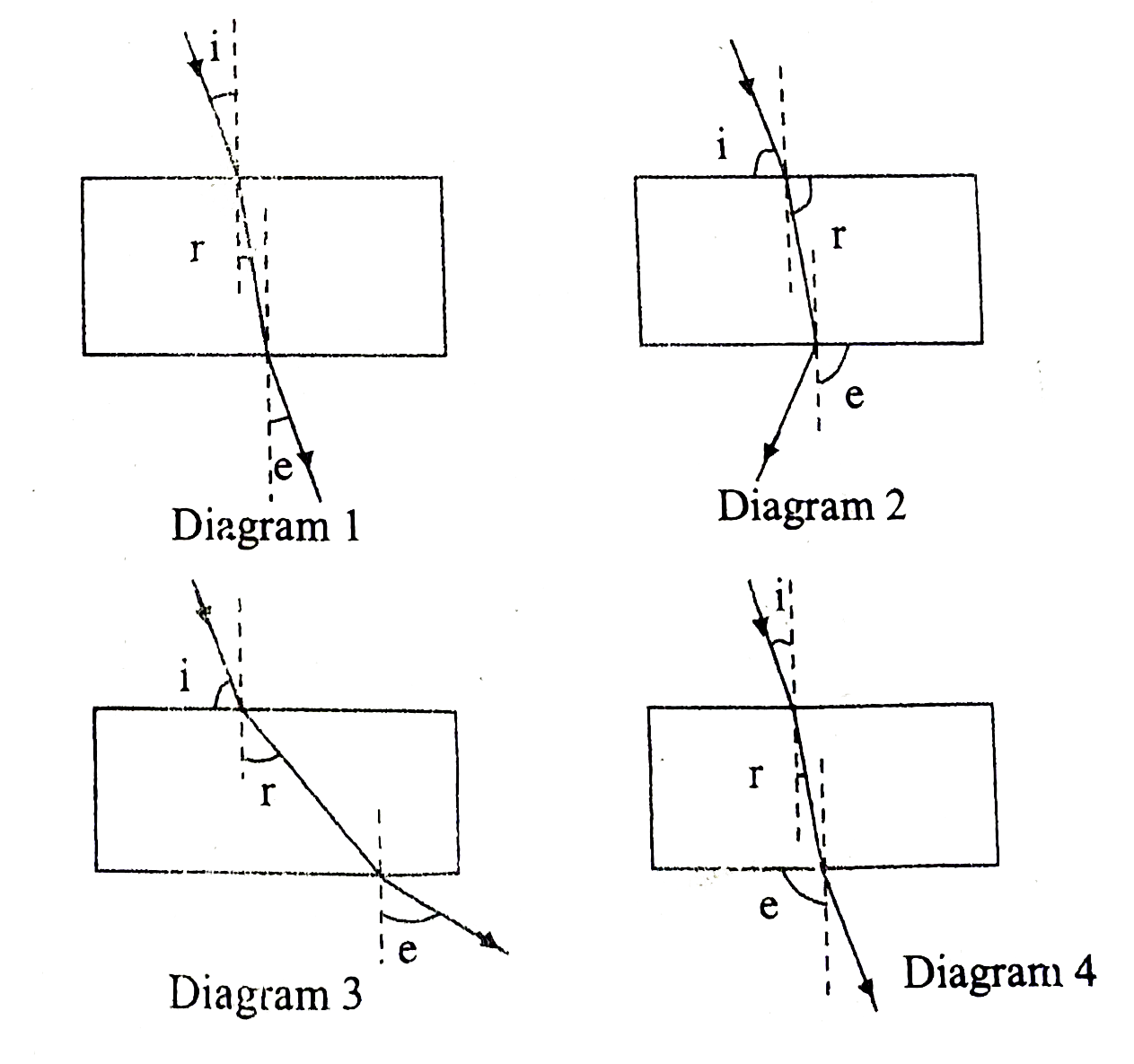
In an experiment, the path of a ray of light passing through a rectangular glass slab was traced by a student. Which of the following diagram shows correct measurement of angle of incidence (i), refraction (r ), and emergence (e ) ?

A

Diagram 1

B

Diagram 2

C

Diagram 3

D

Diagram 4

Text Solution

Verified by Experts

Promotional Banner

Similar Questions

Explore conceptually related problems

Amol performed an experiment on tracing the path of a ray of light passing through a rectangular glass slab. When ray of light enters from air to glass slab, he observed angle I =45^(@) . The angle of refraction must be

When a ray of light passes through glass slab, refraction of light occurs___

When unpolarized light is incident on a plane glass plate at Brewster’s angle, then which of the following statements is correct?

Rakesh performs the experiments on tracing The path of a ray light passing through a rectangular glass slab for different angles of incidence .He observes than in all cases ∠i >∠r but ∠i =∠e ∠i ∠e but ∠i =∠r ∠i < ∠e but ∠i = ∠r

One student is doing experiment to draw the path of light rays passing through a glass. For this, he measured the angle of refraction and angle of emergence for every angle of incidence. In all the cases he found that

Refraction of light passing through a glass slab. what is the relation between angle of incidence and angle of emergent? and which rays are parallel ?

A ray of light travelling inside a rectangular galss block of refractive index sqrt2 is incident glass-air suface at an angle of incidence of 45^@ . The refractive index of air is one. Under these conditions, the ray

A ray of light falls on a glass slab at an incident angle of 45^(@) and refracted at angle of 30^(@) . What is the measure of the angle of emergence 'e' ?

A ray of light travelling through rarer medium is incident at very small angle i on a glass slab and after refraction its velocity is reduced by 20%. The angle of deviation

A monochromatic ray of light travels through an equilateral prism such that angle of deviation is 30^(@) . If the difference between angles of incidence and emergence is 10^(@) , then I and r respectively are

