Explain the following sentence with neat diagram.
A tree far away from us can get hidden behind a book held very close to our eyes.
Explain the following sentence with neat diagram.
A tree far away from us can get hidden behind a book held very close to our eyes.
A tree far away from us can get hidden behind a book held very close to our eyes.
Text Solution
Verified by Experts
i. Every object placed in front of our eyes subtends an angle with the eye.
ii. The apparent size of the object depends on the angle subtended by that object with our eye.
iii. As shown in the figure, the tree even though large in size being far away (at point P') subtends smaller angle `(beta)` with the eye.
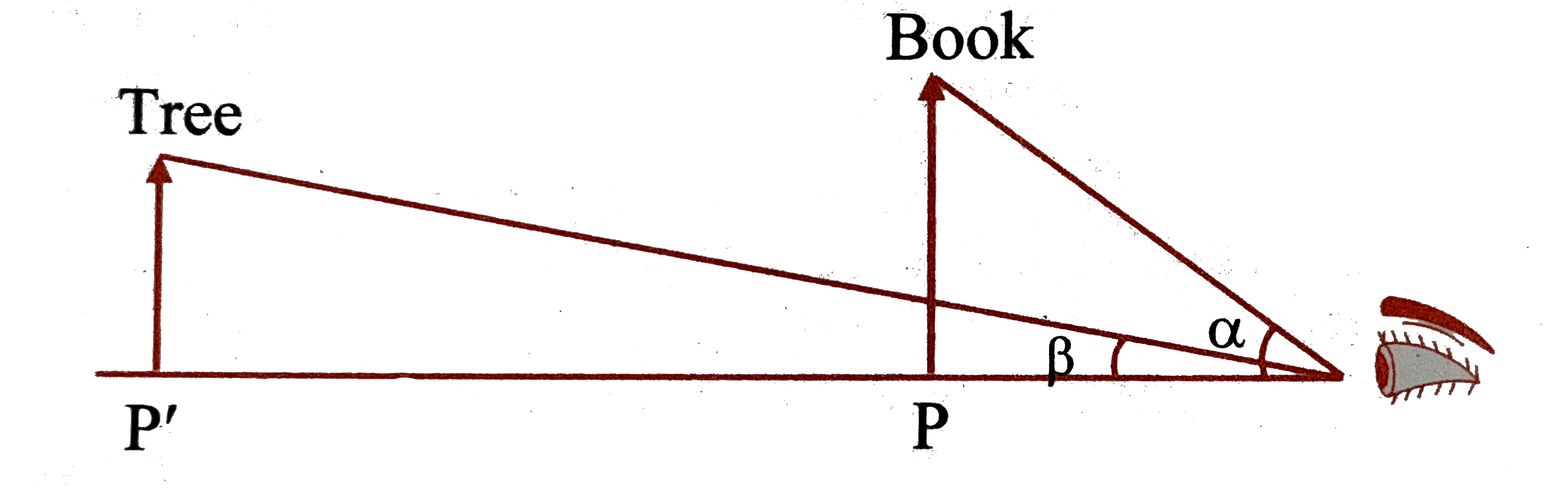
iv. Whereas, if we hold a book very close to eye, i.e., at point P, then the book subtends larger angle `(alpha)` with the eye.
v. As `alpha` is greater than `beta`, the apparent size of the book is bigger than that of tree. In this way, a tree far away from us can get hidden behind a book held very close to our eyes.
ii. The apparent size of the object depends on the angle subtended by that object with our eye.
iii. As shown in the figure, the tree even though large in size being far away (at point P') subtends smaller angle `(beta)` with the eye.
iv. Whereas, if we hold a book very close to eye, i.e., at point P, then the book subtends larger angle `(alpha)` with the eye.
v. As `alpha` is greater than `beta`, the apparent size of the book is bigger than that of tree. In this way, a tree far away from us can get hidden behind a book held very close to our eyes.



Similar Questions
Explore conceptually related problems
Try this. i. Try to read a book keeping it very far from your eyes. ii. Try to read a book keeping it very close to your eyes. iii. Try to read a book keeping it at a distance of 25 cm from your eyes. At which time you see the alphabets clearly? Why?
Answer the following questions : Draw a neat labelled diagram of Hope's apparatus. Explain how is apparatus can be used to demonstrate anomalous behaviour of water. Draw a graph of temperature of water against time.
Read the following paragraph and answer the following questions given below it : Construction of a compound microscope : (i) Acompound microscope consists of a metal tube fitted with two convex lenses at the two ends. These lenses are called the objective lens ( the lens directed towards the object ) and the eyepiece ( the lens directed towards the eye ). Both the lenses are small in size , but the cross section of the objective lens has a short focal length . the focal length of the eyepiece is more than that of the objective lens . (ii) The metal tube is mounted on a stand . thr principal axes of the objective lens and the eyepiece are along the same line . The distance between the object and objective lens can be changed with a screw . It is possible to change the distance between the objective lens and the eyepiece. Working : (i) The object to be observed is illuminated and placed in front of the objective lens. slightly beyond the focal length of the objective lens. it's real , inverted and enlarged image is formed by the objective lens on the other side. (ii) This intermediate image lies with in the focal length of the eyepiece. It serves as an object for the eyepiece. The eyepiece works as a simple microscope . the final image is virtual, highly enlarged and inverted with respect to the original object . It can be formed at the minimum distance of distinct vision from the eyepiece . The final image is observed by keeping the eye close to the eyepiece. Use: This microscope is used to observe blood cells , microorganisms , etc. State the use of a compound microscope ?
Read the following paragraph and answer the following questions given below it : Construction of a compound microscope : (i) Acompound microscope consists of a metal tube fitted with two convex lenses at the two ends. These lenses are called the objective lens ( the lens directed towards the object ) and the eyepiece ( the lens directed towards the eye ). Both the lenses are small in size , but the cross section of the objective lens has a short focal length . the focal length of the eyepiece is more than that of the objective lens . (ii) The metal tube is mounted on a stand . thr principal axes of the objective lens and the eyepiece are along the same line . The distance between the object and objective lens can be changed with a screw . It is possible to change the distance between the objective lens and the eyepiece. Working : (i) The object to be observed is illuminated and placed in front of the objective lens. slightly beyond the focal length of the objective lens. it's real , inverted and enlarged image is formed by the objective lens on the other side. (ii) This intermediate image lies with in the focal length of the eyepiece. It serves as an object for the eyepiece. The eyepiece works as a simple microscope . the final image is virtual, highly enlarged and inverted with respect to the original object . It can be formed at the minimum distance of distinct vision from the eyepiece . The final image is observed by keeping the eye close to the eyepiece. Use: This microscope is used to observe blood cells , microorganisms , etc. In a compound microscope , which lens has greater focal length ?
Read the following paragraph and answer the following questions given below it : Construction of a compound microscope : (i) Acompound microscope consists of a metal tube fitted with two convex lenses at the two ends. These lenses are called the objective lens ( the lens directed towards the object ) and the eyepiece ( the lens directed towards the eye ). Both the lenses are small in size , but the cross section of the objective lens has a short focal length . the focal length of the eyepiece is more than that of the objective lens . (ii) The metal tube is mounted on a stand . thr principal axes of the objective lens and the eyepiece are along the same line . The distance between the object and objective lens can be changed with a screw . It is possible to change the distance between the objective lens and the eyepiece. Working : (i) The object to be observed is illuminated and placed in front of the objective lens. slightly beyond the focal length of the objective lens. it's real , inverted and enlarged image is formed by the objective lens on the other side. (ii) This intermediate image lies with in the focal length of the eyepiece. It serves as an object for the eyepiece. The eyepiece works as a simple microscope . the final image is virtual, highly enlarged and inverted with respect to the original object . It can be formed at the minimum distance of distinct vision from the eyepiece . The final image is observed by keeping the eye close to the eyepiece. Use: This microscope is used to observe blood cells , microorganisms , etc. Where do you place the object to be observed with a compound microscope ?
Read the following paragraph and answer the following questions given below it : Construction of a compound microscope : (i) Acompound microscope consists of a metal tube fitted with two convex lenses at the two ends. These lenses are called the objective lens ( the lens directed towards the object ) and the eyepiece ( the lens directed towards the eye ). Both the lenses are small in size , but the cross section of the objective lens has a short focal length . the focal length of the eyepiece is more than that of the objective lens . (ii) The metal tube is mounted on a stand . thr principal axes of the objective lens and the eyepiece are along the same line . The distance between the object and objective lens can be changed with a screw . It is possible to change the distance between the objective lens and the eyepiece. Working : (i) The object to be observed is illuminated and placed in front of the objective lens. slightly beyond the focal length of the objective lens. it's real , inverted and enlarged image is formed by the objective lens on the other side. (ii) This intermediate image lies with in the focal length of the eyepiece. It serves as an object for the eyepiece. The eyepiece works as a simple microscope . the final image is virtual, highly enlarged and inverted with respect to the original object . It can be formed at the minimum distance of distinct vision from the eyepiece . The final image is observed by keeping the eye close to the eyepiece. Use: This microscope is used to observe blood cells , microorganisms , etc. State which distance is adjusted to observe the object with a compound microscope ?
Read the following paragraph and answer the following questions given below it : Construction of a compound microscope : (i) Acompound microscope consists of a metal tube fitted with two convex lenses at the two ends. These lenses are called the objective lens ( the lens directed towards the object ) and the eyepiece ( the lens directed towards the eye ). Both the lenses are small in size , but the cross section of the objective lens has a short focal length . the focal length of the eyepiece is more than that of the objective lens . (ii) The metal tube is mounted on a stand . thr principal axes of the objective lens and the eyepiece are along the same line . The distance between the object and objective lens can be changed with a screw . It is possible to change the distance between the objective lens and the eyepiece. Working : (i) The object to be observed is illuminated and placed in front of the objective lens. slightly beyond the focal length of the objective lens. it's real , inverted and enlarged image is formed by the objective lens on the other side. (ii) This intermediate image lies with in the focal length of the eyepiece. It serves as an object for the eyepiece. The eyepiece works as a simple microscope . the final image is virtual, highly enlarged and inverted with respect to the original object . It can be formed at the minimum distance of distinct vision from the eyepiece . The final image is observed by keeping the eye close to the eyepiece. Use: This microscope is used to observe blood cells , microorganisms , etc. State the nature of the final image in a compound microscope relative to the object ?
Recommended Questions
- Explain the following sentence with neat diagram. A tree far away fr...
Text Solution
|
- बहुत दूर - स्थिर जो तारे आँख से दिखाई नहीं देते वे दूरदर्शी में दिखाई ...
Text Solution
|
- Explain the following sentence with neat diagram. A tree far away from...
Text Solution
|
- Try this. i. Try to read a book keeping it very far from your eyes. ...
Text Solution
|
- एक व्यक्ति आँख से 50 मीटर दूर तक स्थित वस्तु को ही स्पष्ट रूप से देख प...
Text Solution
|
- एक व्यक्ति को पुस्तक पढ़ने के लिए पुस्तक को आंख से 35 सेमी दूर रखना पड...
Text Solution
|
- Draw a neat and labelled diagram of human eye.
Text Solution
|
- With a neat labelled diagram explain the use of Electrostatic precipit...
Text Solution
|
- An eye defect that can see objects up close and an object far away
Text Solution
|