Home
Class 11
PHYSICS
An object is located 4 m from the first ...

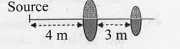
An object is located 4 m from the first of two thin converging lenses of focal lengths 2 m and T m respectively. The lenses are separated by 3 m. The final image formed by the second lens is located from the source at a distance of

A

8.0 cm

B

7.5 m

C

6.0 m

D

6.5 m

Text Solution

Verified by Experts

The correct Answer is:

B
Promotional Banner

Topper's Solved these Questions

  • RAY OPTICS

    TARGET PUBLICATION|Exercise EVALUATION TEST|16 Videos
  • RAY OPTICS

    TARGET PUBLICATION|Exercise CRITICALTHINKING|38 Videos
  • OPTICS

    TARGET PUBLICATION|Exercise EXERCISE|447 Videos
  • REFRACTION OF LIGHT

    TARGET PUBLICATION|Exercise EVALUATION TEST|15 Videos

Similar Questions

Explore conceptually related problems

A point object is held above a thin equiconvex lens at its focus. The focal length is 0.1 m and the lens rests on a horizontal thin plane mirror. The final image will be formed at

A point object is placed on the axis of a thin convex lens of focal length 0.05 m at a distance of 0.2 m from the lens and its image is formed on the axis. If the object is now made to oscillate along the axis with a small amplitude of A cm, then what is the amplitude of oscillation of the image? [you may assume, frac(1)(1 + x ~~ 1 - x , where x << 1]

An object is kept at 0.2m from a convex lens of focal length 0.15 m. Find the position of the image produced.

5 cm high object is placed at a distance of 25 cm from a converging lens of focal length 10 cm. Determine the position ,size and type or the image.

The focal length of objective and eye-piece of astronomical telescope are 2 m and 5 cm respectively. The magnifying power of telescope when final image is formed at infinity is

An astronomical telesope has objective and eyepiece of focal lengths 40cm and 4 cm respectively. To view an object 200cm away from the objective, the lenses must be separated by a distance :

In a potentiometer experiment balancing for the first cell and second cell are 2.5 m and 2 m, respectively, when cells are used separately. Hence, E_1/E_2 is

Read the following paragraph and answer the following questions given below it : Construction of a compound microscope : (i) Acompound microscope consists of a metal tube fitted with two convex lenses at the two ends. These lenses are called the objective lens ( the lens directed towards the object ) and the eyepiece ( the lens directed towards the eye ). Both the lenses are small in size , but the cross section of the objective lens has a short focal length . the focal length of the eyepiece is more than that of the objective lens . (ii) The metal tube is mounted on a stand . thr principal axes of the objective lens and the eyepiece are along the same line . The distance between the object and objective lens can be changed with a screw . It is possible to change the distance between the objective lens and the eyepiece. Working : (i) The object to be observed is illuminated and placed in front of the objective lens. slightly beyond the focal length of the objective lens. it's real , inverted and enlarged image is formed by the objective lens on the other side. (ii) This intermediate image lies with in the focal length of the eyepiece. It serves as an object for the eyepiece. The eyepiece works as a simple microscope . the final image is virtual, highly enlarged and inverted with respect to the original object . It can be formed at the minimum distance of distinct vision from the eyepiece . The final image is observed by keeping the eye close to the eyepiece. Use: This microscope is used to observe blood cells , microorganisms , etc. State the nature of the final image in a compound microscope relative to the object ?

Read the following paragraph and answer the following questions given below it : Construction of a compound microscope : (i) Acompound microscope consists of a metal tube fitted with two convex lenses at the two ends. These lenses are called the objective lens ( the lens directed towards the object ) and the eyepiece ( the lens directed towards the eye ). Both the lenses are small in size , but the cross section of the objective lens has a short focal length . the focal length of the eyepiece is more than that of the objective lens . (ii) The metal tube is mounted on a stand . thr principal axes of the objective lens and the eyepiece are along the same line . The distance between the object and objective lens can be changed with a screw . It is possible to change the distance between the objective lens and the eyepiece. Working : (i) The object to be observed is illuminated and placed in front of the objective lens. slightly beyond the focal length of the objective lens. it's real , inverted and enlarged image is formed by the objective lens on the other side. (ii) This intermediate image lies with in the focal length of the eyepiece. It serves as an object for the eyepiece. The eyepiece works as a simple microscope . the final image is virtual, highly enlarged and inverted with respect to the original object . It can be formed at the minimum distance of distinct vision from the eyepiece . The final image is observed by keeping the eye close to the eyepiece. Use: This microscope is used to observe blood cells , microorganisms , etc. In a compound microscope , which lens has greater focal length ?

Read the following paragraph and answer the following questions given below it : Construction of a compound microscope : (i) Acompound microscope consists of a metal tube fitted with two convex lenses at the two ends. These lenses are called the objective lens ( the lens directed towards the object ) and the eyepiece ( the lens directed towards the eye ). Both the lenses are small in size , but the cross section of the objective lens has a short focal length . the focal length of the eyepiece is more than that of the objective lens . (ii) The metal tube is mounted on a stand . thr principal axes of the objective lens and the eyepiece are along the same line . The distance between the object and objective lens can be changed with a screw . It is possible to change the distance between the objective lens and the eyepiece. Working : (i) The object to be observed is illuminated and placed in front of the objective lens. slightly beyond the focal length of the objective lens. it's real , inverted and enlarged image is formed by the objective lens on the other side. (ii) This intermediate image lies with in the focal length of the eyepiece. It serves as an object for the eyepiece. The eyepiece works as a simple microscope . the final image is virtual, highly enlarged and inverted with respect to the original object . It can be formed at the minimum distance of distinct vision from the eyepiece . The final image is observed by keeping the eye close to the eyepiece. Use: This microscope is used to observe blood cells , microorganisms , etc. State which distance is adjusted to observe the object with a compound microscope ?

TARGET PUBLICATION-RAY OPTICS-COMPETITIVE THINKING
  1. Graph of position of image vs position of point object from a convex l...

    Text Solution

    |

  2. Calculate the focal length of a reading glass of a person, if the dist...

    Text Solution

    |

  3. An object is located 4 m from the first of two thin converging lenses ...

    Text Solution

    |

  4. A beam of parallel rays is brought to focus by a planoconvex lens. A t...

    Text Solution

    |

  5. A plano-convex lens fits exactly into a plano-concave lens. Their plan...

    Text Solution

    |

  6. A plano-convex lens fits exactly into plano-concave lens as shown in t...

    Text Solution

    |

  7. Two lenses of power +12 and -2 dioptres are placed in contact. The com...

    Text Solution

    |

  8. A comvex lens and a concave lens are placed in contact. The ratio of m...

    Text Solution

    |

  9. Two identical glass (mu(g)=3//2) equiconvex lenses of focal length f a...

    Text Solution

    |

  10. Two identical equiconvex lenses, each of focal length 'f' are placed s...

    Text Solution

    |

  11. A bi-convex lens is formed with two thin plano convex lenses as shown ...

    Text Solution

    |

  12. Two convex lenses of focal length f1 and f2 are mounted coaxially sepa...

    Text Solution

    |

  13. A diverging lens with magnitude of focal length 25 cm is placed at a d...

    Text Solution

    |

  14. A convex lens of focal length 12.5 cm is used as a simple microscope. ...

    Text Solution

    |

  15. Least distance of distinct vision is 25 cm . Magnifying power of simpl...

    Text Solution

    |

  16. In compound microscope, the focal length and aperture of the objective...

    Text Solution

    |

  17. In a compound microscope, the intermediate image is

    Text Solution

    |

  18. A compound micrscope consists of an objective of focal length 1.0 cm ...

    Text Solution

    |

  19. An obsever looks at a distant tree of height 10m with a telescope of m...

    Text Solution

    |

  20. An astronomical telescope has an angular magnification of magnitude 5 ...

    Text Solution

    |
