Home
Class 12
PHYSICS
A (non-rotating) star collapses onto its...

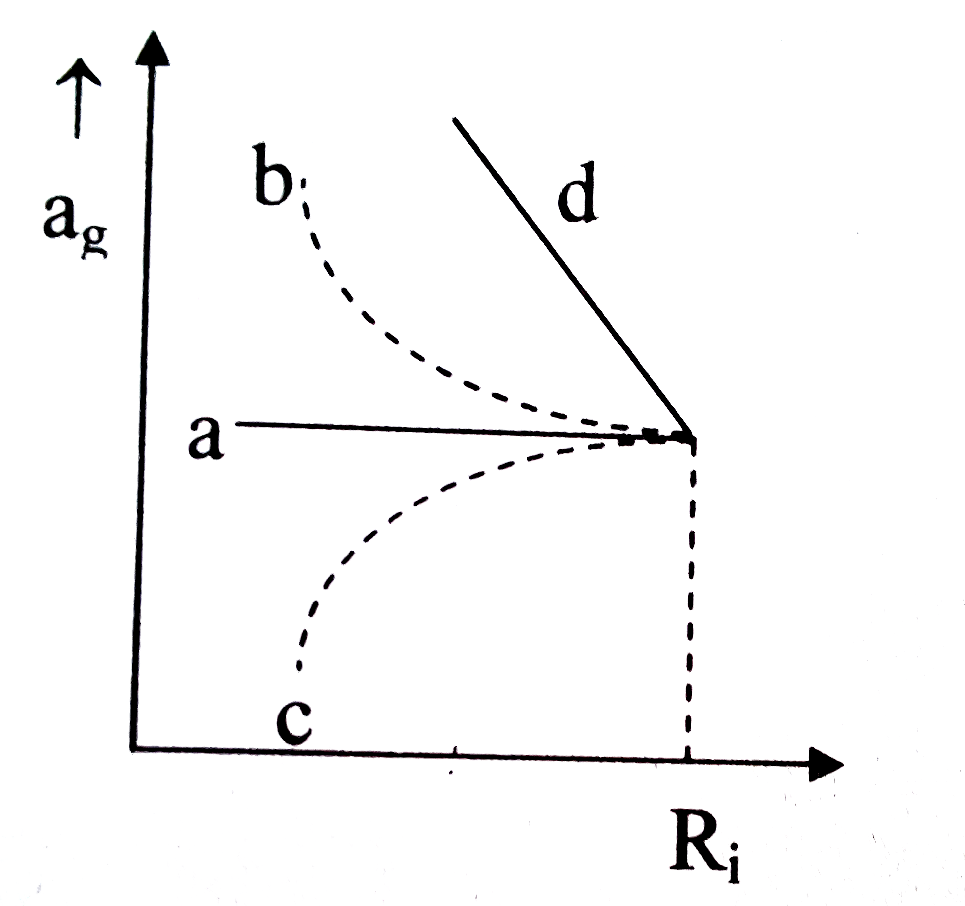
A (non-rotating) star collapses onto itself from an initial radius R, its mass remaining unchanged. Which curve in the figure best gives the gravitational acceleration ag on the surface of the star as a function of radius of star during collapse?

A

a

B

b

C

c

D

d

Text Solution

Verified by Experts

The correct Answer is:

B
Promotional Banner

Similar Questions

Explore conceptually related problems

A (non-rotating) star collapses onto itself from an initial radius R_i , its mass remaining unchanged. Which curve in the figure best gives the gravitational acceleration a_g , on the surface of the star as a function of radius of star during collapse?

Discuss the variation of g with depth and derive the necessary formula. OR Show that the gravitational acceleration due to the earth at a depth d from its surface is g_d= g[1- frac(d)(R)] , where R is the radius of the earth and g is the gravitional acceleration at the earth's surface. OR Discus the variation of acceleration due to gravity with depth 'd' below the surface of the earth OR Derive an expression for acceleration due to gravity at depth 'd' below the surface of earth

An extremely small and dense neutron star of mass M and radius R is rotating with angular velocity omega . If an object is placed at its equator, then it will remain stuck to it due to gravity, if

Assuming that the gravitational potential energy of an object at infinity is zero, the change in potential energy (final-initial) of an object of mass m, when taken to a height h from the surface of earth (of radius R), is given by,

A satellite of mass m is orbiting the earth (of radius R ) at a height h from its surface. The total energy of the satellite in terms of g_(0) , the value of acceleration due to gravity at the earth's surface,

The acceleration due to gravity on the surface of the earth is g. If a body of mass m is raised from the surface of the earth to a height equal to the radius R of the earth, then the gain in its potential energy is given by

A body of mass m is raised to a height 10 R from the surface of the earth, where R is the radius of the earth. Find the increase in potential energy. (G = universal constant of gravitational, M = mass of the earth and g= acceleration due to gravity)

The mass density of a spherical galaxy varies as K/r over a large distance 'r' from its centre. In that region, a small star is in a circular orbit of radius R. Then the period of revolution, T depends on R as:

The angular velocity of rotation of a planet of mass M and radius R, at which the matter start to escape from its equator is

The angular velocity of rotation of star (of mass M and radius R ) at which the matter start to escape from its equator will be
