Home
Class 12
PHYSICS
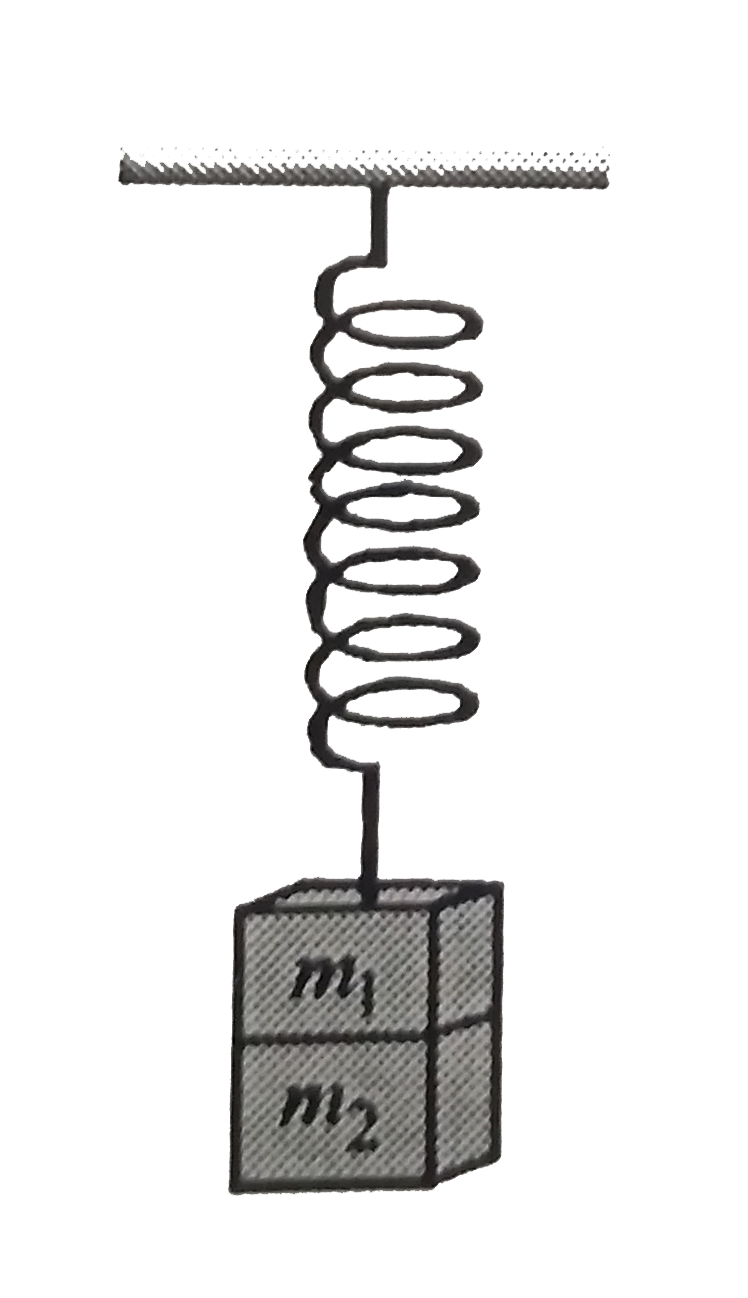
Two masses m1 and m2 are suspended toget...

Two masses m1 and m2 are suspended together by a massless spring of constant k. When the masses are in equilibrium, m1 is removed without disturbing the system. The amplitude of oscillations is

A

`(m_1g)/k`

B

`(m_2g)/k`

C

`((m_1+m_2)g)/k`

D

`((m_1-m_2)g)/k`

Text Solution

Verified by Experts

The correct Answer is:

A
Promotional Banner

Similar Questions

Explore conceptually related problems

The period of oscillation of a mass M, hanging from a spring of force constant k is T. When additional mass m is attached to the spring, the period of oscillation becomes 5T/4. m/M =

Two blocks A and B of masses 3m and m respectively are connected by a massless and inextensible string. The whole system is suspended by a massless spring as shown in figure. The magnitudes of acceleration of A and B immediately after the string is cut, are respectively

The period of oscillation of a body of mass m_1 suspended from a lightspring is T. When the body of mass m_2 , is tied to the first body and the system is made to oscillate, the period is 2T. Compare the masses m_1 and m_2 .

Two bodies of masses m_(1) and m_(2) have same kinetic energy. The ratio of their momentum is

A pendulum consisting of a small sphere of mass m, suspended by an inextensible and massless string of length 1, is made to swing in a vertical plane. If the breaking strength of the string is 2 mg, then the maximum angular amplitude of the displacement from the vertical can be

A body of mass m is attached to the lower end of a spring whose upper end is fixed. The spring has negligible mass. When the mass m is slightly pulled down and released, it oscillates with a time period of 3s. When the mass m is increased by 1 kg , the time period of oscillations becomes 5s. The value of m in kg is

Two stars of mass m_(1) and m_(2) are parts of a binary star system. The radii of their orbits are r_(1) and r_(2) respectivey, measured from the centre of mass of the system. The magnitude of gravitational force m_(1) exerts on m_(2) is

The mass M shown in the figure oscillates in simple harmonic motion with amplitude A. The amplitude of the point P is

One end of a long mettalic wire of length L is tied to the ceiling. The other end is tied to massless spring of spring constant K. A mass M hangs freely from the free end of the spring. The area of cross-section and Young's modulus of the wire are A and Y respectively. If the mass is slightly pulled down and released, it will oscillate with a time period T equal to
