Home
Class 12
BIOLOGY
The events of the menstrual cycle are re...

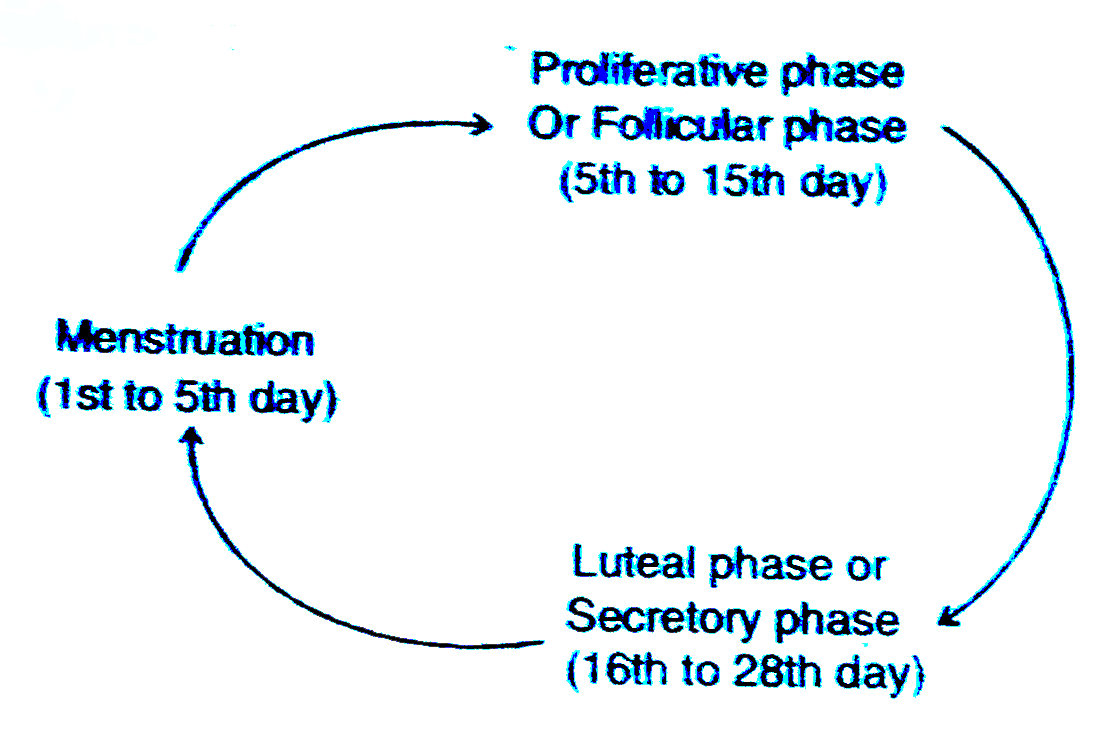
The events of the menstrual cycle are represented below. Answer the questions following the diagram.
(i)State the levels of FSH , LH and Progesterone simply by mentioning high or low , around 13th and 14th day and 21st to 23 rd day .
(ii)In which of the above mentioned phases does the egg travel to the fallopian tube ?
(iii)Why is there no menstruation upon fertilization ?

Text Solution

Verified by Experts

(i)FSH and LH High and Progesterone low , FSH and LH Low and Progesterone high , (ii)Luteal phase , (iii)Uterine wall and blood vessels help maintain implanted embryo
Promotional Banner

Topper's Solved these Questions

  • REPRODUCTION

    TRUEMEN BIOLOGY ENGLISH|Exercise SECTION-D|27 Videos
  • REPRODUCTION

    TRUEMEN BIOLOGY ENGLISH|Exercise SECTION-B|39 Videos
  • Protista

    TRUEMEN BIOLOGY ENGLISH|Exercise ASSERTION AND REASON|6 Videos
  • Reproduction In Organisms

    TRUEMEN BIOLOGY ENGLISH|Exercise MULTIPLE CHOICE QUESTION|131 Videos

Similar Questions

Explore conceptually related problems

The diagram given below represents the location and structure of an endocrine gland. Study the same and answer the questions that follow: (i) Name the endocrine gland shown in the diagram. (ii) Name the secretion of the gland which regulates basal metabolism (iii) Name the mineral element required for the synthesis of the above mentioned hormone. (iv) Name the disease caused due to undersecretion of the above mentioned hormone in children. (v) Name the disease caused due to hypersecretion of the above mentioned hormone .

The diagram given below is that of a structure present in a human kidney. Study the same and answer the questions that follows : (i) Name the structure represented in the diagram. (ii) What is the liquid entering part T called? Name two substances present in this liquid that are reabsorbed in the tubule. (iii) What is the fluid that comes to part '2' called? Name the main nitrogenous waste in it. (iv) Mention the three main steps involved in the formation of the fluid mentioned in (iii) above. (v) Name the substance which may be present in the fluid part '11 if a person suffer from diabetes mellitus.

(a) The diagram given below is that of a developing human foetus in the womb. Study the same and then answer the questions that follow : (i) Name the parts '1' and '5' indicated by guidelines. (ii) What term is given to the period of development of the foetus in the womb ? (iii) How many days does the foetus take to be fully developed ? (iv) Mention two functions of the part labelled 2 other than its endocrine function. (v) Name the hormone (any one) produce by the part labelled 2 (vi) What is the function of the part marked 3 ? (b) Give the exact location of amnion. [ICSE 2011, 2014]

The diagram given below represents an endocrine gland in the human body. Study the diagram and answer the following questions : (i) Identify the endocrine gland. Where is it located? (ii) Why is the above gland referred to as the 'Master gland' ? (iii) Name the hormone which in deficiency causes Diabetes Insipidus. How does this disorder differ from Diabetes Mellitus ? (iv) Explain the term 'Hormone'. What is the role of Tropic hormones in the human body? (v) Which lobe of the above gland secretes: 1. Oxytocin 2. ACTH 3. Growth hormone.

Which of these phases of the menstrual cycle is correctly is correctly matched with its period? (i) Menstrual phase : 1^(st) - 4^(th) day (ii) Proliferative phase: 5^(th)_13^(th) day (iii) Ovulatory phase: 14^(th) day (iv) Luteal phase: 15^(th)-28^(th) Day

Two clocks A and B being tested against a standard clock located in the national laboratory At 10.00 AM by the standard clock, the readings of the two clocks are shown in following table {:("Day","Clock A","Clock B"),(I^("st"),10:00:06,8:15:00),(II^("nd"),10:01:13,8:15:0.1),(III^("rd"),9:59:0.8,8:15:04),(IV^("th"),10:02:15,8:14:58),(V^("th"),9:58:10,8:15:02):} If you are doing an experiment that requires precision time interval measurements, which of the two clocks will you prefer ?

TRUEMEN BIOLOGY ENGLISH-REPRODUCTION-SECTION -C
  1. In the adjacent figure of a typical dicot embryo, label the parts (1),...

    Text Solution

    |

  2. (a) In which part of the human female reproductive system do the follo...

    Text Solution

    |

  3. The events of the menstrual cycle are represented below. Answer the qu...

    Text Solution

    |

  4. Draw a labelled diagram of a sectional view of humen seminiferous tub...

    Text Solution

    |

  5. With the help of labelled diagrams, depict the stages of a microspore ...

    Text Solution

    |

  6. In an angiosperm the embryo sac is haploid , zygote is diploid and end...

    Text Solution

    |

  7. Draw a longitudinal section of a post-pollinated pistil showing entry ...

    Text Solution

    |

  8. (i ) Write the characteristics features of anther, pollen and stigma o...

    Text Solution

    |

  9. (a) Mention any four strategies adopted by flowering plants to prevent...

    Text Solution

    |

  10. Explain the process of artificial hybridisation to get improved crop, ...

    Text Solution

    |

  11. Differentiate between perisperm and endosperm giving one example of ea...

    Text Solution

    |

  12. Fertilization is essential for the production of seed, but in some ang...

    Text Solution

    |

  13. Write the function of each one of the following : (a) (Oviducal) Fi...

    Text Solution

    |

  14. Write the function of each of the following : (a) Middle piece in hu...

    Text Solution

    |

  15. Write the function of each of the following : (a) Seminal vesicle ...

    Text Solution

    |

  16. Read the graph given above and correlate the uterine events that take ...

    Text Solution

    |

  17. Expand the following and explain any one of them. (i) IVF (ii) ZIFT...

    Text Solution

    |

  18. Draw the following diagrams related to human reproduction and label th...

    Text Solution

    |

  19. Suggest and explain any three Assisted Reproductive Technologies (ART)...

    Text Solution

    |

  20. a) Describe the endosperm development in coconut. b) Why is tender c...

    Text Solution

    |
