Home
Class 12
BIOLOGY
Explain the different stages of oogenesi...

Explain the different stages of oogenesis in human starting from life till its completion. When and where in the body is oogenesis completed?

Text Solution

Verified by Experts
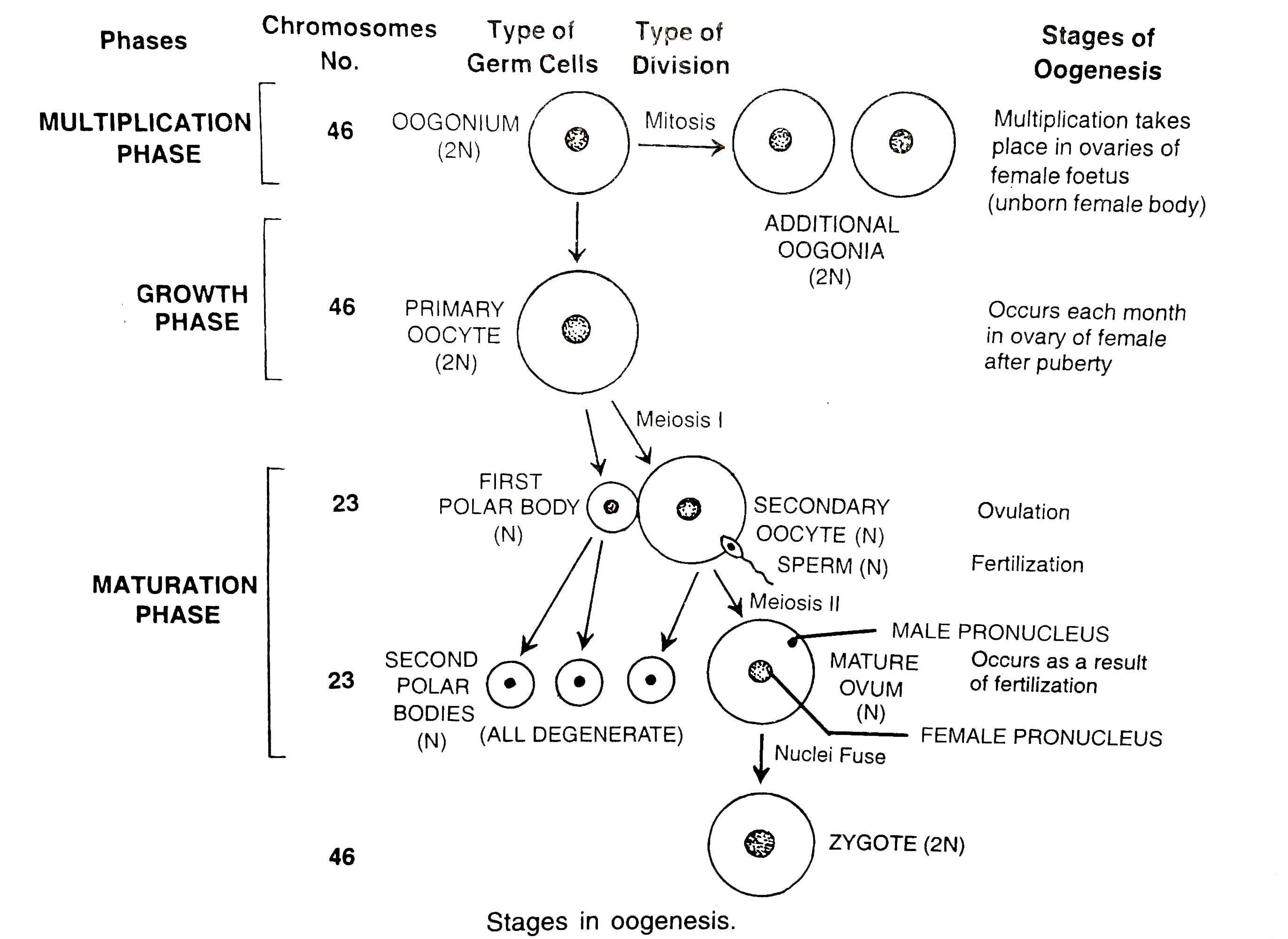
Oogenesis. The process of formation of a mature female gamete ovum) called oogenesis. It occurs in the ovaries (female gonads). It consists of the phases: multiplication, growth and maturation.

(a) Multiplication phase. In the foetal development, certain cells in the germinal epithelium of the ovary of the foetus are larger than others. These cells divide by mitosis, producing a couple of million egg mother cells or oogonia in each ovary of the foetus. No more oogonia are formed or added after birth. The oogonia multiply by mitotic divisions forming the primary oocytes.
(b) Growth phase. This phase of the primary oocyte is very long. It may extend over many years. The oogonium grows into a large primary oocyte by taking food from the surrounding follicle cells. It happens after puberty.
(c) Maturation phase. Like a primary spermatocyte, each primary oocyte undergoes two maturation divisions, first meiotic and the second meiotic. The results of maturation divisions in oogenesis are, however, very different from those in spermatogenesis. In the first, meiotic division. the primary oocyte divides into two very unequal haploid daughter cells- a large secondary oocyte and a very small first polar body or polocyte In the second maturation division, the first polar body may divide to form two second polar bodies. The secondary oocyte again divides into unequal daughter cells, a large cod and a very small second polar body. The ootid grows into a functional haploid ovum. Thus from one oogonium, one ovum and three polar bodies are formed. The ovum, is the actual female gamete. The polar bodies take no part in reproduction and hence, soon degenerate In human beings, ovum is released from the ovary in the secondary oocyte stage. The maturation of secondary oocyte is completed in the mother's oviduct Fallopian tube usually after the sperm has entered the secondary oocyte for fertilization
Promotional Banner

Topper's Solved these Questions

  • REPRODUCTION

    TRUEMEN BIOLOGY ENGLISH|Exercise SECTION -C|22 Videos
  • Protista

    TRUEMEN BIOLOGY ENGLISH|Exercise ASSERTION AND REASON|6 Videos
  • Reproduction In Organisms

    TRUEMEN BIOLOGY ENGLISH|Exercise MULTIPLE CHOICE QUESTION|131 Videos

Similar Questions

Explore conceptually related problems

Explain the process of oogenesis in humans.

Oogenesis in a human female starts

Second meiotic division during oogenesis is completed in

At what stage of life is oogenesis initiated in a human female?

At what stage of life is oogenesis initiated in a human female?

What promotes completion of second meiotic division in oogenesis?

(a)Give a schematic representation of spermatogenesis in humans . (b) At which stage of life does gametogenesis begin in human male and female respectively ? (c )Name the organs where gametogensis gets completed in male and female respectively.

(a)Give a schematic representation of spermatogenesis in humans . (b) At which stage of life does gametogenesis begin in human male and female respectively ? (c )Name the organs where gametogensis gets completed in male and female respectively.

At which stage of life is oogenesis initiated in human female? When does the oocyte complete oogenesis?

(a) Draw a labelled diagram of sectional view of human ovary showing different stages of oogenesis. (b) Where is morula formed in humans? Explain the process of its development from the zygote.

TRUEMEN BIOLOGY ENGLISH-REPRODUCTION-SECTION-D
  1. Explain with the help of a diagram the development of a mature embryo ...

    Text Solution

    |

  2. Study the flow chart given below . Name the hormones involved at each ...

    Text Solution

    |

  3. Explain the different stages of oogenesis in human starting from life ...

    Text Solution

    |

  4. (a) When and how does placenta develop in human female? (b) How is ...

    Text Solution

    |

  5. Give reasons why: (i) Most zygotes in angiosperms divide only afte...

    Text Solution

    |

  6. Describe in sequence the events that lead to the development of a 3-ce...

    Text Solution

    |

  7. (a ) Trace the development of megaspore mother cell up to the formatio...

    Text Solution

    |

  8. (a ) Draw a labelled longitudinal view of an albuminous 'seed'· (b)...

    Text Solution

    |

  9. Describe the post-zygotic events leading to implantation and placenta ...

    Text Solution

    |

  10. Although sexual reproduction is a long drawn, energy-intensive complex...

    Text Solution

    |

  11. Embryo sacs of some apomitic species appear normal but contain diploid...

    Text Solution

    |

  12. Meiotic division during oogenesis is different from that in spermatoge...

    Text Solution

    |

  13. Enumerate and describe any five reasons for introducing sex education ...

    Text Solution

    |

  14. The following is the illustration of the sequence of ovarian events (a...

    Text Solution

    |

  15. (a) Draw a schematic labelled diagram of a fertilised embryo sac of an...

    Text Solution

    |

  16. (a) Draw a labelled diagram of sectional view of human ovary showing d...

    Text Solution

    |

  17. (a) Draw a labelled diagram of the sectional view of a typical anatrop...

    Text Solution

    |

  18. (a) Draw a diagrammatic sectional view of a mature anatropous ovule an...

    Text Solution

    |

  19. (a) Draw a diagrammatic sectional view of the female reproductive syst...

    Text Solution

    |

  20. (a) Draw a labelled schematic diagram of the transverse section of a m...

    Text Solution

    |

