Home
Class 12
BIOLOGY
(a) Draw a schematic labelled diagram of...

(a) Draw a schematic labelled diagram of a fertilised embryo sac of an Angiosperm.
(b) Describe the stage in embryo development in a dicot plant.

Text Solution

Verified by Experts
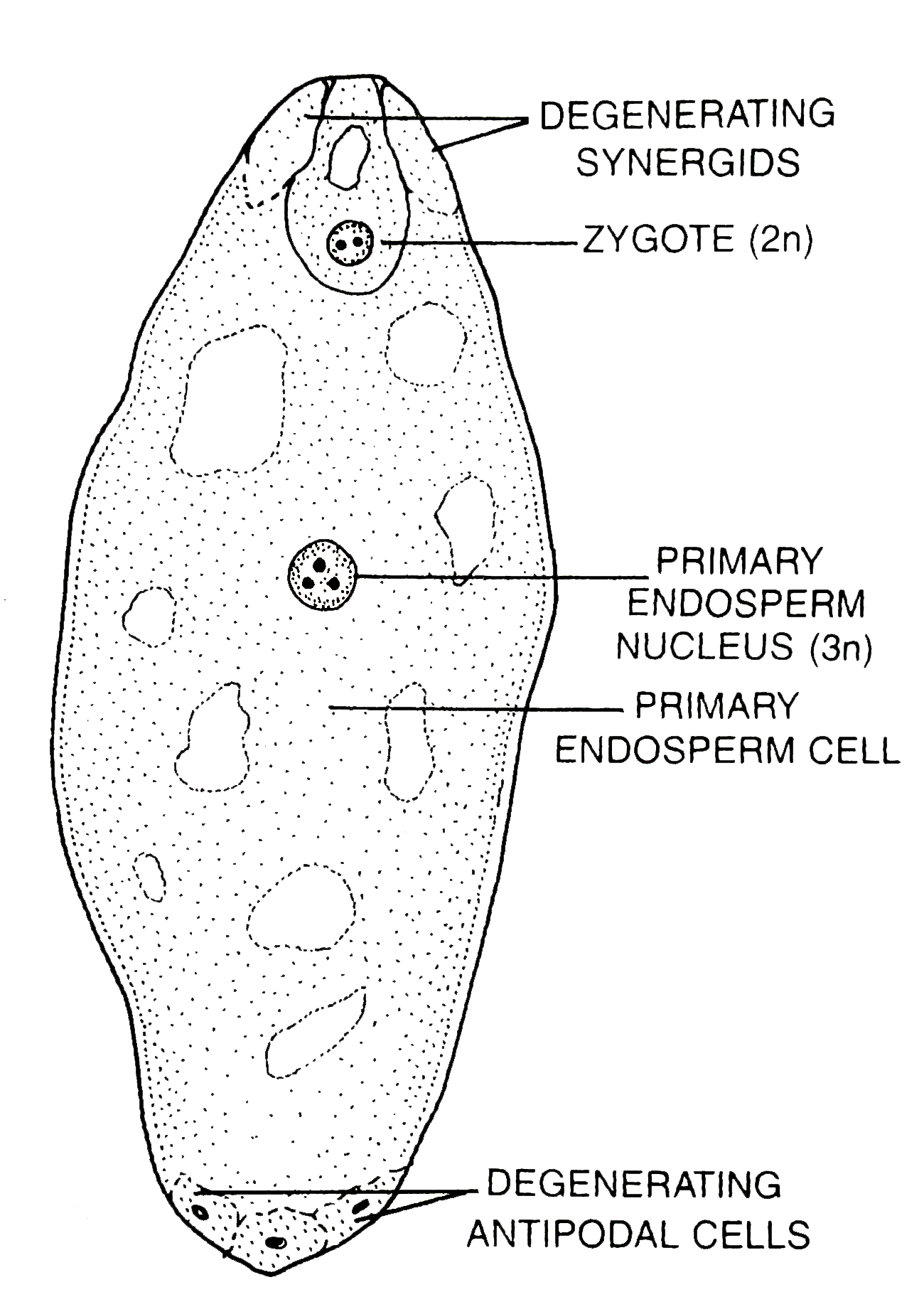

(b) Embryogeny in Dicots. In a typical dicot the zygote elongates and then divides by a transverse wall into two unequal cells. The larger basal cell is called suspensor cell. The other towards the antipodal end is termed as terminal cell or embryo cell. The suspensor cell divides transversely a few times to produce a filamentous suspensor of 6-10 cells. The suspensor helps In pushing the embryo in the endosperm. The first cell of the suspensor towards the micropylar end becomes swollen and functions as a haustorium. The haustorium has wall ingrowths similar to transfer cells. The last cell of the suspensor at the end adjacent to the embryo is known as hypophysis Hypophysis later gives rise to the radicle and root cap.
The embryo cell undergoes two vertical divisions (quadrant stage) and one transverse division to form eight cells arranged in two tiers (octant stage epibasal terminal and hypobasal (near the suspensor). The epibasal cells eventually form the two cotyledons and the plumule. The hypobasal cells produce the hypocotyl except its tip The eight embryonic cells or octants divide periclinally to produce an outer layer of protoderm or dermatogen. The inner cells differentiate further into procambium ( plerome) and ground meristem (= periblem. Protein forms epidermis, procambium gives rise to stele or vascular strand and ground meristem produces cortex and pith Initially the embryo is globular and undifferentiated. Early embryo with radial symmetry is called proembryo. It is transformed into embryo with the development of radicle, plumule and cotyledons. Two cotyledons differentiate from the sides with a faint plumule in the centre. At this time the embryo becomes heart-shaped. The rate of growth of the cotyledons is very high so that they elongate tremendously while the plumule remains as a small mound of undifferentiated tissue
Promotional Banner

Topper's Solved these Questions

  • REPRODUCTION

    TRUEMEN BIOLOGY ENGLISH|Exercise SECTION -C|22 Videos
  • Protista

    TRUEMEN BIOLOGY ENGLISH|Exercise ASSERTION AND REASON|6 Videos
  • Reproduction In Organisms

    TRUEMEN BIOLOGY ENGLISH|Exercise MULTIPLE CHOICE QUESTION|131 Videos

Similar Questions

Explore conceptually related problems

(a) Draw a schematic labelled diagram of a fertilised embryo sac of an Angiosperm. (b) Describe the stage in embryo development in a dicto plant.

Draw a labelled diagram of the mature embryo sac of angiosperms.

Embryo sac of angiosperms contains

The embryo sac of an angiosperm is made up of :

The embryo sac of an angiosperms is made up of

The embryo sac of an angiosperms is made up of

Draw a labelled diagram of I.S of an embryo of grass

(a) Draw a labelled diagram of the sectional view of microsporangium of an angiosperm. (b) Explain the development of male gametophyte in the microsporangium.

Briefly describe the mechanism of development of a dicot embryo.

Starting with the zygote, draw the diagrams of the different stages of embryo development in a dicot.

TRUEMEN BIOLOGY ENGLISH-REPRODUCTION-SECTION-D
  1. Explain the different stages of oogenesis in human starting from life ...

    Text Solution

    |

  2. (a) When and how does placenta develop in human female? (b) How is ...

    Text Solution

    |

  3. Give reasons why: (i) Most zygotes in angiosperms divide only afte...

    Text Solution

    |

  4. Describe in sequence the events that lead to the development of a 3-ce...

    Text Solution

    |

  5. (a ) Trace the development of megaspore mother cell up to the formatio...

    Text Solution

    |

  6. (a ) Draw a labelled longitudinal view of an albuminous 'seed'· (b)...

    Text Solution

    |

  7. Describe the post-zygotic events leading to implantation and placenta ...

    Text Solution

    |

  8. Although sexual reproduction is a long drawn, energy-intensive complex...

    Text Solution

    |

  9. Embryo sacs of some apomitic species appear normal but contain diploid...

    Text Solution

    |

  10. Meiotic division during oogenesis is different from that in spermatoge...

    Text Solution

    |

  11. Enumerate and describe any five reasons for introducing sex education ...

    Text Solution

    |

  12. The following is the illustration of the sequence of ovarian events (a...

    Text Solution

    |

  13. (a) Draw a schematic labelled diagram of a fertilised embryo sac of an...

    Text Solution

    |

  14. (a) Draw a labelled diagram of sectional view of human ovary showing d...

    Text Solution

    |

  15. (a) Draw a labelled diagram of the sectional view of a typical anatrop...

    Text Solution

    |

  16. (a) Draw a diagrammatic sectional view of a mature anatropous ovule an...

    Text Solution

    |

  17. (a) Draw a diagrammatic sectional view of the female reproductive syst...

    Text Solution

    |

  18. (a) Draw a labelled schematic diagram of the transverse section of a m...

    Text Solution

    |

  19. Write two differences between spermtogenesis and oogenesis

    Text Solution

    |

  20. (a) Draw a diagram of a mature embryo sac of an angiosperm and label t...

    Text Solution

    |

