Home
Class 12
BIOLOGY
The graph shows the relation between lig...

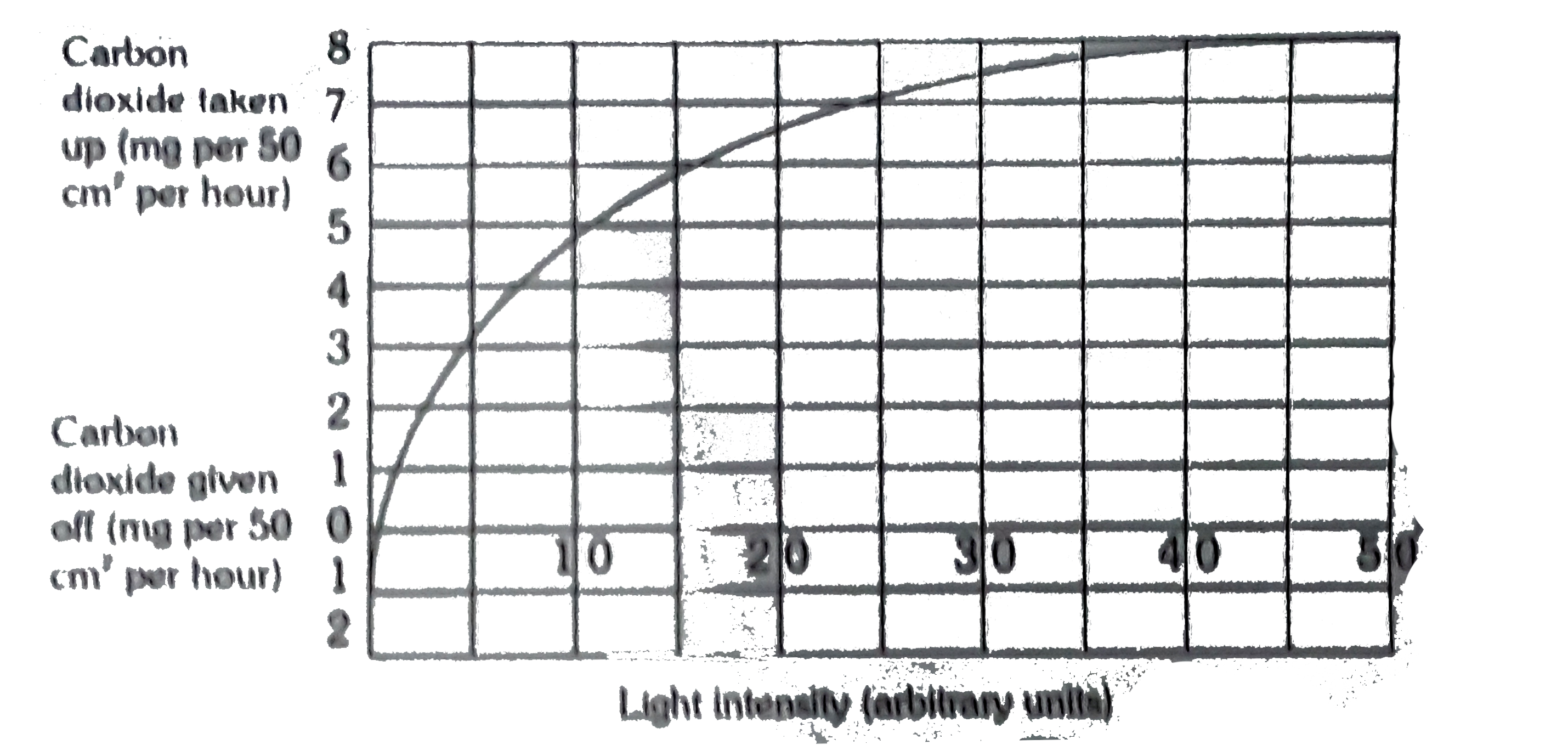
The graph shows the relation between light intensity and the giving off and taking up of carbon dioxide by the leaves of a plant. Why is most carbon dioxide given off when the light intensity is zero units.

A

because it is just the start of the experiment

B

only respiration is taking place at this intensity of light

C

the rate of photosynthesis is equivalent to the rate of respiration

D

the rate of photosynthesis is more than the rate of respiration

Text Solution

Verified by Experts

The correct Answer is:

B
Promotional Banner

Topper's Solved these Questions

  • REPRODUCTIVE HEALTH

    TRUEMEN BIOLOGY ENGLISH|Exercise Multiple Choice Questions|114 Videos
  • SEXUAL REPRODUCTION IN FLOWERING PLANTS

    TRUEMEN BIOLOGY ENGLISH|Exercise MULTIPLE CHOICE QUESTIONS|199 Videos

Similar Questions

Explore conceptually related problems

Study the given graph showing the efect of light intensity on the rate of photosynthesis. Which of the following statemetns regarding this is correct?

Observe the given graph carefully and choose the correct statements for labelled points, (A to E) "gt Points:- (A)- There is a linear relationship between incident light and CO_(2) fixation rates. (B)- It is a transition poit where limiting factor changes. (C)- At this region light intensity is not showing detrimental effect on rate of photosynthesis. (D)- It shows light saturation point sunlight except for plants in shade or in dense forests. (E)- This point show maximum rate of photosynthesis at optimum presence of various parameters.

Which of the following plants give higher yields. when they are allowed to grow in carbon dioxide enriched atmosphere?

(a) Explain, using a suitable diagram, how unpolarized light gets linearly polarized by scattering. (b) Describe briefly the variation of the intensity of transmitted light when a polaroid sheet kept between two crossed polaroids is rotated. Draw the graph depicting the variation of intensity with the angle of rotation. How many maxima and minima would be observed when theta vaeries from 0 to pi ?

Thin films, including soap bubbles and oil show patterns of alternative dark and bright regions resulting from interference among the reflected ligth waves. If two waves are in phase, their crests and troughs will coincide. The interference will be cosntructive and the amlitude of resultant wave will be greater then either of constituent waves. If the two wave are not of phase by half a wavelength (180^(@)) , the crests of one wave will coincide width the troughs of the other wave. The interference will be destructive and the ampliutde of the resultant wave will be less than that of either consituent wave. 1. When incident light I, reaches the surface at point a, some of the ligth is reflected as ray R_(a) and some is refracted following the path ab to the back of the film. 2. At point b, some of the light is refracted out of the film and part is reflected back through the film along path bc. At point c, some of the light is reflected back into the film and part is reflected out of the film as ray R_(c) . R_(a) and R_(c) are parallel. However, R_(c) has travelled the extra distance within the film fo abc. If the angle of incidence is small, then abc is approxmately twice the film's thickness . If R_(a) and R_(c) are in phase, they will undergo constructive interference and the region ac will be bright. If R_(a) and R_(c) are out of phase, they will undergo destructive interference and the region ac will be dark. I. Refraction at an interface never changes the phase of the wave. II. For reflection at the interfere between two media 1 and 2, if n_(1) gt n_(2) , the reflected wave will change phase. If n_(1) lt n_(2) , the reflected wave will not undergo a phase change. For reference, n_(air) = 1.00 . III. If the waves are in phase after reflection at all intensities, then the effects of path length in the film are: Constrictive interference occurs when 2 t = m lambda // n, m = 0, 1,2,3 ,... Destrcutive interference occurs when 2 t = (m + (1)/(2)) (lambda)/(n) , m = 0, 1, 2, 3 ,... If the waves are 180^(@) out of the phase after reflection at all interference, then the effects of path length in the film ara: Constructive interference occurs when 2 t = (m + (1)/(2)) (lambda)/(n), m = 0, 1, 2, 3 ,... Destructive interference occurs when 2 t = (m lambda)/(n) , m = 0, 1, 2, 3 ,... The average human eye sees colors with wavelength between 430 nm to 680 nm. For what visible wavelength (s) will a 350 nm thick (n = 1.35) soap film produce maximum destructive interference?

(i) Write a balanced chemical equation for process of photosynthesis. (ii)When do desert plants take up carbon dioxide and perform photosynthesis? Answer.

What is meant by a linearly polarised light? Which type of waves can be polarised? Briefly explain a method for producing polarised light. Two polaroids are placed at 90^(@) to each other and the intensity of transmitted light is zero. What will be the intensity of transmitted light when one more polaroid is placed between these two bisecting the angle between them ? Take intensity of unpolarised light as I_(0)

When two plants L and M were exposed to different light intensities and temperature they showed changes in their rates of photosynthesis. Which have been represented in the following graph. The graph indicates that

(a) What is plane polarised light? Two polaroid sare placed at 90^(@) to each other and the transmitted intensity is zero. What happens when one more polaroid is placed between these two, bisecting the angle between them? How will the intensity of transmitted light vary on further rotating the third polaroid? (b) If a light beam shows no intensity variation when transmitted through a polaroid which is rotated, does it mean that the light is un-polarised? Explain briefly.

The given diagram shows a blood capillary in close contact with structure Y. The relative concentration (in units) of carbon dioxide (CO_(2)) and oxygen (O_(2)) are given at three different sites. Which of the following statements is correct ?

TRUEMEN BIOLOGY ENGLISH-RESPIRATION IN PLANTS-MULTIPLE CHOICE QUESTIONS
  1. The production of ATP by oxidative phosphorylation is driven by energy...

    Text Solution

    |

  2. Both mitochondria and chloroplasts

    Text Solution

    |

  3. The graph shows the relation between light intensity and the giving of...

    Text Solution

    |

  4. Chemiosmosis is

    Text Solution

    |

  5. Which of the following process makes direct use of oxygen ?

    Text Solution

    |

  6. Ganong's respiroscope is used to demonstrate…………………

    Text Solution

    |

  7. During which stage in the complete oxidation of glucose are the greate...

    Text Solution

    |

  8. In glycolysis ultimately (or end product of glycolysis is)

    Text Solution

    |

  9. Choose the correct combination of labelling the number of carbon compo...

    Text Solution

    |

  10. Which is not true for glycolysis

    Text Solution

    |

  11. How many ATP molecules could maximally be generated from one molecule ...

    Text Solution

    |

  12. All enzymes of TCA cycle are located in the mitochondrial matrix excep...

    Text Solution

    |

  13. Which one of the following mammalian cells is not capable of metabolis...

    Text Solution

    |

  14. The overall goal of glycolysis, Krebs cycle and the electron transport...

    Text Solution

    |

  15. A competitive inhibitor of succinic dehydrogenase is

    Text Solution

    |

  16. In Krebs cycle, the following reactions are involved in the production...

    Text Solution

    |

  17. Carbon monoxide inhibits mitochondrial electron transport by

    Text Solution

    |

  18. Out of the following, which is the rate limiting enzyme in glycolysis?

    Text Solution

    |

  19. Match List-I (Compound oxidized during Kreb's cycle) with List-II (Com...

    Text Solution

    |

  20. If glucose-fed yeast cells are transferred from aerobic environment to...

    Text Solution

    |
