Home
Class 12
BIOLOGY
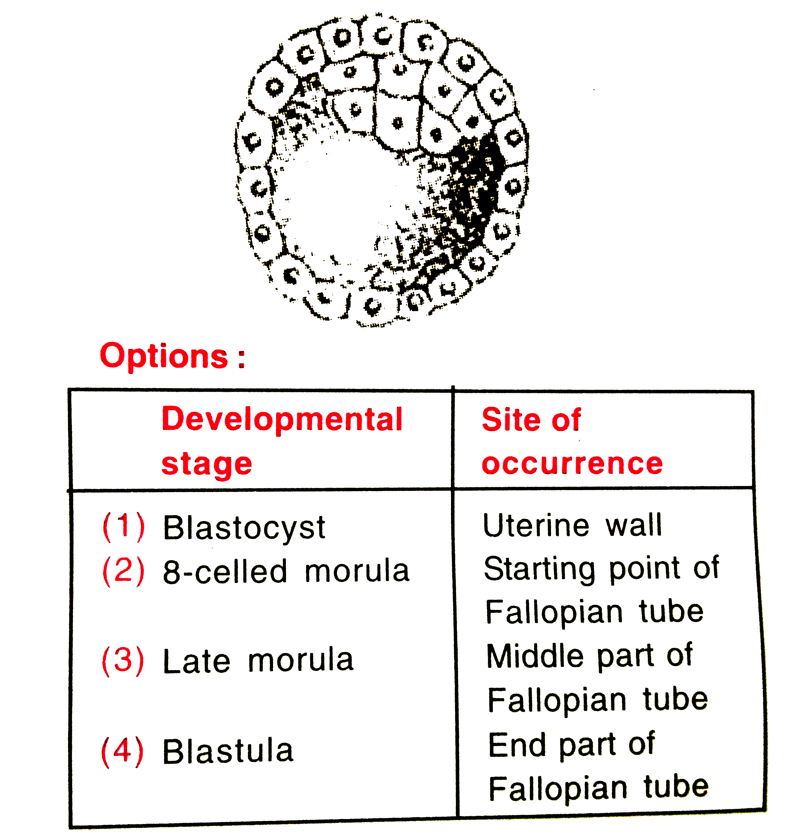
Identify the human development stage sho...

Identify the human development stage shown below as well as the related right place of its occurrence in a normal pregnant woman, and select the right option for the two together.
.

A

Developmental stage-Blastocyst, Site of occurrence-Uterine wall

B

Developmental stage-8celled morula, Site of occurrence-Starting point of fallopian tube

C

Developmental stage-Late morula, Site of occurrence-Middle part of Fallopian tube

D

Developmental stage-Blastula, Site of occurrenec-End part of fallopian tube

Text Solution

Verified by Experts

The correct Answer is:

A

The embryo with 8-16 blastomeres is called a morula, and is present in the end part of fallopian tube. Morula forms the blastocyst as it reaches the uterine cavity and them blastocyst implants in the endometrium. Thus, the options (2), (3) and (4) are wrong.
Promotional Banner

Topper's Solved these Questions

  • HUMAN HEALTH AND DISEASE

    TRUEMEN BIOLOGY ENGLISH|Exercise MULTIPLE CHOICE QUESTIONS|209 Videos
  • KINGDOM MONERA - KINGDOM OF PROKARYOTES

    TRUEMEN BIOLOGY ENGLISH|Exercise Multiple choice question|150 Videos

Similar Questions

Explore conceptually related problems

Identify the human development stage show below as well as the related right place of its occurrence in a normal pregnant woman, and select the right option for the two together :-

Identify the human developmental stage shown as well as the related right place of its occurrence in a normal pregnant woman and select the right options for the two, together.

Ifdentify the human developmental stage shown in the figure as well as the related right place of its occurrence in a normal pregnant woman. Select the right option for the two together.

Identify the given below tissue with its type and select the right option for the two together

Identify the molecule (a) and (b) shown below and select the right option giving their name and occurrence.

Identify the molecules (A) and (B) shown below and select the right option giving their source and use.

Identify the glands (A) and (B) shown below and select the right option for location and function :-

Given below is the diagram of the transverse section of monocot stem. Identify the parts labelled A, B, C and D and select the right option about the

TRUEMEN BIOLOGY ENGLISH-HUMAN REPRODUCTION-Multiple Choice Questions
  1. About which day in a normal human menstrual cycle does rapid secretion...

    Text Solution

    |

  2. The secretory phase in the human menstrual cycle is also called:

    Text Solution

    |

  3. Identify the human development stage shown below as well as the relate...

    Text Solution

    |

  4. Bartholin's glands are situated:

    Text Solution

    |

  5. Placenta in human beings is formed by :

    Text Solution

    |

  6. Which gland secretes alkaline mucus in urethra to neutralise the acidi...

    Text Solution

    |

  7. A temporary endocrine gland in humans is

    Text Solution

    |

  8. Braxton Hicks contractione occur during

    Text Solution

    |

  9. Correct sequence of human embryonic development is

    Text Solution

    |

  10. Onset of menstrual cycle in female anthrapoid primates is

    Text Solution

    |

  11. Thick yellow,high protein fluid produced by mammary glands of a woman ...

    Text Solution

    |

  12. Which hormones is produced in women during pregnancy?

    Text Solution

    |

  13. Menstrual phase is followed by

    Text Solution

    |

  14. Which layer of uterus undergoes cyclic changes during menstrual cycle

    Text Solution

    |

  15. Which type of germ cells contain 23 chromosomes

    Text Solution

    |

  16. In human females, menstrual cycle ceases around 50 years of age. It is...

    Text Solution

    |

  17. Which hormone is mainly secreted by corpus luteum ?

    Text Solution

    |

  18. Thei internal cavity commonly formed by ell division prior to gastrula...

    Text Solution

    |

  19. Number of autosomes in human primary spermatocyte is

    Text Solution

    |

  20. Which of the following organs is devoid of glands?

    Text Solution

    |
