Home
Class 12
CHEMISTRY
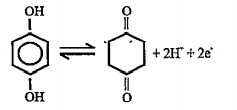
AtpH=2,E("Quinhydrone")^@ =1.30V,E("Quin...

`AtpH=2,E_("Quinhydrone")^@ =1.30V,E_("Quinhydrone")` will be:

A

1.36V

B

1.30V

C

1.42V

D

1.20V

Text Solution

Verified by Experts

The correct Answer is:

C
Promotional Banner

Topper's Solved these Questions

  • COORDINATION COMPOUNDS

    MBD PUBLICATION|Exercise QUESTION BANK|914 Videos
  • ENVIRONMENTAL CHEMISTRY

    MBD PUBLICATION|Exercise QUESTION BANK|299 Videos

Similar Questions

Explore conceptually related problems

At pH=2,E_("Quinhydrone")^@ =1.30V,E_("Quinhydrone") will be:

Calculate the cell emf and Delta_(r ) G^(@) for the cell reation at 25^(@)C . Zn(s) | Zn^(@+) ( 0.1 M )|| Cd^(2+) ( 0.01M) | Cd(s) Given, E_(Zn^(2+) //Zn)^(@) = - 0.763V , E_(Cd^(2+) //Cd) ^(@) = - 0.403 V 1F = 96500 C "mol"^(-1) R = 8.314 JK^(-1) "mol"^(-1) ], Find E_("cell")^(@) = E_("cathode")^(@) - E_("anode")^(@) then Delta _(r ) G^(@) by using formula, Delta _(r ) G^(@) = - n FE_("cell")^(@)

For the cell prepared from electrode A and B: Electrode A:Cr_2O_7^(2-)|Cr^(3+),E_(red)^@ =+1.33 V and Electrode B:Fe^(3+) / Fe^(2+),E_(red)^@=0.77 V. Which of the following statements are correct :

Write the Nernst equation and emf of the following cell at 298 K. (i) Mg(s) |Mg^(2+) ( 0.001 M) || Cu^(2+) ( 0.0001M ) | Cu(s) (ii) Fe(s) | Fe^(2+) ( 0.001M) || H^(+) ( 1M) | H_(2)(g) (1 "bar") | Pt(s) Given that, E_(Mg^(2+) //Mg)^(@) = - 2.36V , E_(Cu^(2+) Cu)^(@) = 0.34V, E_(Fe^(2+)Fe)^(@) = -0.44V

Find the equilibrium constant for the reaction, Cu^(2+) + ln^(@) hArr Cu^(+) + ln ^(3+) Given that, E_(Cu^(2+)//Cu^(+)) = 0.15V , E_(ln^(2+) //ln^(+))^(@) = -0.4 V, E_(ln^(3+) //ln)^(@) = 0.42V

Calculate the equilibrium constant for the reaction. Fe(s) + Cd^(2+) (aq) hArr Fe^(2+)(aq) + Cd(s) [ Given, E_(Cd^(2+) //Cd)^(@) = - 0.40V , E_(Fe^(2+)//Fe)^(@) = - 0.44 V ]

Two metals A and B have E_(RP)^0 = -0.76V and E_(RP)^0 =+0.80V respectively. Which metal will diplace H_2 from dilute H_2SO_4 ?

Consider the standard potential of the following cells, (i) Mg^(2+) +2e rarr Mg,E^@=-2.37V (ii) Zn^(2+) + 2erarrZn,E^@ =-0.76V (iii) Ni^(2+) +2e rarrNi,E^@=-0.25V (iv) Fe^(3+) + 3e rarrFe, E_0=-0.04 V find the strongest reducing agent :

MBD PUBLICATION-ELECTROCHEMISTRY-QUESTION BANK
  1. A solution containing one mole per litre each of Cu(NO3)2, AgNO3, Hg2(...

    Text Solution

    |

  2. In a galvanic cell energy changes occurs as:

    Text Solution

    |

  3. AtpH=2,E("Quinhydrone")^@ =1.30V,E("Quinhydrone") will be:

    Text Solution

    |

  4. The passage of electricity in the Daniell cell when Zn and Cu electrod...

    Text Solution

    |

  5. A correct electrochemical series can be obtained from K,Ca,Na,Al,Mg,Zn...

    Text Solution

    |

  6. Indicator electrode is :

    Text Solution

    |

  7. When Zn piece is kept inCuSO4 solution copper gets prectipitated becau...

    Text Solution

    |

  8. The standard oxidation potentials of Zn and Ag in water at 25^@ C are....

    Text Solution

    |

  9. The standard reduction potentials of the elemtnts A, B.Care +2.37V,-1....

    Text Solution

    |

  10. Is the reaction, 2Al +3Fe^(2+)rarr2Al^(3+) +3Fe possible?

    Text Solution

    |

  11. Whether tin can displace lead from aqueous lead bromide solution:

    Text Solution

    |

  12. Faraday is equal to :

    Text Solution

    |

  13. More electropositive elements have :

    Text Solution

    |

  14. Based on the data given below , the correct order of reducing power is...

    Text Solution

    |

  15. Galvanised iron sheets have coating of :

    Text Solution

    |

  16. The electrochemical that is easiest to be reduced is :

    Text Solution

    |

  17. An electrochemical cell consists of :

    Text Solution

    |

  18. The correct order of chemical reactivity with water according to elect...

    Text Solution

    |

  19. Which graph correctly correlates E(cell) as a function of concentratio...

    Text Solution

    |

  20. Faraday.s laws hold good at:

    Text Solution

    |
