Home
Class 11
PHYSICS
An equiconvex lens is cut into two halve...

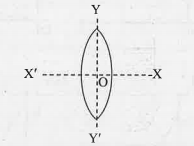
An equiconvex lens is cut into two halves along (i) XOX' and (ii) YOY' as shown in the figure. Let f, f ', f " be the focal lengths of the complete lens, of each half in case (i), and of each half in case (ii), respectively.

Choose the correct statement form the following.

A

f' = 2f, f' = f

B

f' = f, f'' = f

C

f ' = 2f, f'' = 2f

D

f' = f, f'' = 2f

Text Solution

Verified by Experts

Promotional Banner

Topper's Solved these Questions

  • Motion in a plane

    TARGET PUBLICATION|Exercise Exercise|340 Videos
  • RAY OPTICS

    TARGET PUBLICATION|Exercise EVALUATION TEST|16 Videos

Similar Questions

Explore conceptually related problems

The equiconvex lens has focal length f. If is cut perpendicular to the principal axis passing through optical centre, then focal length of each half is

Two identical equiconvex lenses, each of focal length 'f' are placed side by side in contact with each other with a layer of water in between them as shown in the figure. If refractive index of the material of the lenses is greater than that of water, how the combined focal length 'F' is related of 'f'?

If a convex lens of focal length 20 cm and a concave lens of focal length 30 cm are kept in contact with each other . (i) What will be the focal length of the combination ? (ii) What will be the power of the combination ? (iii) What will be the behaviour of the combination ?

Read the following paragraph and answer the following questions given below it : Construction of a compound microscope : (i) Acompound microscope consists of a metal tube fitted with two convex lenses at the two ends. These lenses are called the objective lens ( the lens directed towards the object ) and the eyepiece ( the lens directed towards the eye ). Both the lenses are small in size , but the cross section of the objective lens has a short focal length . the focal length of the eyepiece is more than that of the objective lens . (ii) The metal tube is mounted on a stand . thr principal axes of the objective lens and the eyepiece are along the same line . The distance between the object and objective lens can be changed with a screw . It is possible to change the distance between the objective lens and the eyepiece. Working : (i) The object to be observed is illuminated and placed in front of the objective lens. slightly beyond the focal length of the objective lens. it's real , inverted and enlarged image is formed by the objective lens on the other side. (ii) This intermediate image lies with in the focal length of the eyepiece. It serves as an object for the eyepiece. The eyepiece works as a simple microscope . the final image is virtual, highly enlarged and inverted with respect to the original object . It can be formed at the minimum distance of distinct vision from the eyepiece . The final image is observed by keeping the eye close to the eyepiece. Use: This microscope is used to observe blood cells , microorganisms , etc. In a compound microscope , which lens has greater focal length ?

Read the following paragraph and answer the following questions given below it : Construction of a compound microscope : (i) Acompound microscope consists of a metal tube fitted with two convex lenses at the two ends. These lenses are called the objective lens ( the lens directed towards the object ) and the eyepiece ( the lens directed towards the eye ). Both the lenses are small in size , but the cross section of the objective lens has a short focal length . the focal length of the eyepiece is more than that of the objective lens . (ii) The metal tube is mounted on a stand . thr principal axes of the objective lens and the eyepiece are along the same line . The distance between the object and objective lens can be changed with a screw . It is possible to change the distance between the objective lens and the eyepiece. Working : (i) The object to be observed is illuminated and placed in front of the objective lens. slightly beyond the focal length of the objective lens. it's real , inverted and enlarged image is formed by the objective lens on the other side. (ii) This intermediate image lies with in the focal length of the eyepiece. It serves as an object for the eyepiece. The eyepiece works as a simple microscope . the final image is virtual, highly enlarged and inverted with respect to the original object . It can be formed at the minimum distance of distinct vision from the eyepiece . The final image is observed by keeping the eye close to the eyepiece. Use: This microscope is used to observe blood cells , microorganisms , etc. Where do you place the object to be observed with a compound microscope ?

Read the following paragraph and answer the following questions given below it : Construction of a compound microscope : (i) Acompound microscope consists of a metal tube fitted with two convex lenses at the two ends. These lenses are called the objective lens ( the lens directed towards the object ) and the eyepiece ( the lens directed towards the eye ). Both the lenses are small in size , but the cross section of the objective lens has a short focal length . the focal length of the eyepiece is more than that of the objective lens . (ii) The metal tube is mounted on a stand . thr principal axes of the objective lens and the eyepiece are along the same line . The distance between the object and objective lens can be changed with a screw . It is possible to change the distance between the objective lens and the eyepiece. Working : (i) The object to be observed is illuminated and placed in front of the objective lens. slightly beyond the focal length of the objective lens. it's real , inverted and enlarged image is formed by the objective lens on the other side. (ii) This intermediate image lies with in the focal length of the eyepiece. It serves as an object for the eyepiece. The eyepiece works as a simple microscope . the final image is virtual, highly enlarged and inverted with respect to the original object . It can be formed at the minimum distance of distinct vision from the eyepiece . The final image is observed by keeping the eye close to the eyepiece. Use: This microscope is used to observe blood cells , microorganisms , etc. State which distance is adjusted to observe the object with a compound microscope ?

Read the following paragraph and answer the following questions given below it : Construction of a compound microscope : (i) Acompound microscope consists of a metal tube fitted with two convex lenses at the two ends. These lenses are called the objective lens ( the lens directed towards the object ) and the eyepiece ( the lens directed towards the eye ). Both the lenses are small in size , but the cross section of the objective lens has a short focal length . the focal length of the eyepiece is more than that of the objective lens . (ii) The metal tube is mounted on a stand . thr principal axes of the objective lens and the eyepiece are along the same line . The distance between the object and objective lens can be changed with a screw . It is possible to change the distance between the objective lens and the eyepiece. Working : (i) The object to be observed is illuminated and placed in front of the objective lens. slightly beyond the focal length of the objective lens. it's real , inverted and enlarged image is formed by the objective lens on the other side. (ii) This intermediate image lies with in the focal length of the eyepiece. It serves as an object for the eyepiece. The eyepiece works as a simple microscope . the final image is virtual, highly enlarged and inverted with respect to the original object . It can be formed at the minimum distance of distinct vision from the eyepiece . The final image is observed by keeping the eye close to the eyepiece. Use: This microscope is used to observe blood cells , microorganisms , etc. State the nature of the final image in a compound microscope relative to the object ?

Read the following paragraph and answer the following questions given below it : Construction of a compound microscope : (i) Acompound microscope consists of a metal tube fitted with two convex lenses at the two ends. These lenses are called the objective lens ( the lens directed towards the object ) and the eyepiece ( the lens directed towards the eye ). Both the lenses are small in size , but the cross section of the objective lens has a short focal length . the focal length of the eyepiece is more than that of the objective lens . (ii) The metal tube is mounted on a stand . thr principal axes of the objective lens and the eyepiece are along the same line . The distance between the object and objective lens can be changed with a screw . It is possible to change the distance between the objective lens and the eyepiece. Working : (i) The object to be observed is illuminated and placed in front of the objective lens. slightly beyond the focal length of the objective lens. it's real , inverted and enlarged image is formed by the objective lens on the other side. (ii) This intermediate image lies with in the focal length of the eyepiece. It serves as an object for the eyepiece. The eyepiece works as a simple microscope . the final image is virtual, highly enlarged and inverted with respect to the original object . It can be formed at the minimum distance of distinct vision from the eyepiece . The final image is observed by keeping the eye close to the eyepiece. Use: This microscope is used to observe blood cells , microorganisms , etc. State the use of a compound microscope ?

If a concave lens of focal length 12 cm and a convex lens of focal length 20 cm are kept in contact with each other . (i) Find be the focal length of the combination ? (ii) What will be the behaviour of the combination ?

TARGET PUBLICATION-OPTICS-EXERCISE
  1. A virtual cannot be caought on a screen, Yet when we see a virtual ima...

    Text Solution

    |

  2. If two power of a thick lense is P(1) and that of a thin lens is P(2)...

    Text Solution

    |

  3. An equiconvex lens is cut into two halves along (i) XOX' and (ii) YOY'...

    Text Solution

    |

  4. The lens shown in the figure drawn below is made of two different mate...

    Text Solution

    |

  5. An object is placed at a distance of (f)/(2) from a convex lens of foc...

    Text Solution

    |

  6. In an optics experiment, with the position of the object fixed, a stud...

    Text Solution

    |

  7. A student measures the focal length of a convex lens by keeping an obj...

    Text Solution

    |

  8. Graph of position of image vs position of point object from a convex l...

    Text Solution

    |

  9. The distance between an object and the screen is 75 cm. When a convex ...

    Text Solution

    |

  10. Convex lens made up of glass (mu(g)=1.5) and radius of curvature R is ...

    Text Solution

    |

  11. A double convex thin lens made of glass (refractive index mu=1.5) has ...

    Text Solution

    |

  12. A convex lens of glass (mu=1.5) has a focal length of 8 cm when placed...

    Text Solution

    |

  13. The power of a thin convex lens (""(a) mu(g)=1.5) is +5.0 D. When it i...

    Text Solution

    |

  14. Figure given below shows a beam of light converging at point P. When a...

    Text Solution

    |

  15. When two thin lenses are kept in contanct, the focal length of the com...

    Text Solution

    |

  16. In the figure an air less of raddi of curvature 10 cm (R1 = R2 = 10 cm...

    Text Solution

    |

  17. The ray diagram could be correct.

    Text Solution

    |

  18. How does the magnification (m) of the real image formed by a lens vary...

    Text Solution

    |

  19. As shown in the figure, the liquids L1, L2 and L3 have refractive indi...

    Text Solution

    |

  20. Twon similar plano-covexlenses are combined together in three differen...

    Text Solution

    |

