Home
Class 11
PHYSICS
Four double convex lenses with following...

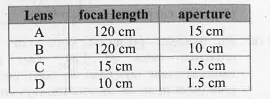
Four double convex lenses with following specifications are available

Which of the given four lenses should be selected as objective and eyepiece respectively to construct an astronomical telescope?

A

A and C

B

B and D

C

A and D

D

B and C

Text Solution

Verified by Experts

Promotional Banner

Topper's Solved these Questions

  • Motion in a plane

    TARGET PUBLICATION|Exercise Exercise|340 Videos
  • RAY OPTICS

    TARGET PUBLICATION|Exercise EVALUATION TEST|16 Videos

Similar Questions

Explore conceptually related problems

Read the following paragraph and answer the following questions given below it : Construction of a compound microscope : (i) Acompound microscope consists of a metal tube fitted with two convex lenses at the two ends. These lenses are called the objective lens ( the lens directed towards the object ) and the eyepiece ( the lens directed towards the eye ). Both the lenses are small in size , but the cross section of the objective lens has a short focal length . the focal length of the eyepiece is more than that of the objective lens . (ii) The metal tube is mounted on a stand . thr principal axes of the objective lens and the eyepiece are along the same line . The distance between the object and objective lens can be changed with a screw . It is possible to change the distance between the objective lens and the eyepiece. Working : (i) The object to be observed is illuminated and placed in front of the objective lens. slightly beyond the focal length of the objective lens. it's real , inverted and enlarged image is formed by the objective lens on the other side. (ii) This intermediate image lies with in the focal length of the eyepiece. It serves as an object for the eyepiece. The eyepiece works as a simple microscope . the final image is virtual, highly enlarged and inverted with respect to the original object . It can be formed at the minimum distance of distinct vision from the eyepiece . The final image is observed by keeping the eye close to the eyepiece. Use: This microscope is used to observe blood cells , microorganisms , etc. State which distance is adjusted to observe the object with a compound microscope ?

Read the following paragraph and answer the following questions given below it : Construction of a compound microscope : (i) Acompound microscope consists of a metal tube fitted with two convex lenses at the two ends. These lenses are called the objective lens ( the lens directed towards the object ) and the eyepiece ( the lens directed towards the eye ). Both the lenses are small in size , but the cross section of the objective lens has a short focal length . the focal length of the eyepiece is more than that of the objective lens . (ii) The metal tube is mounted on a stand . thr principal axes of the objective lens and the eyepiece are along the same line . The distance between the object and objective lens can be changed with a screw . It is possible to change the distance between the objective lens and the eyepiece. Working : (i) The object to be observed is illuminated and placed in front of the objective lens. slightly beyond the focal length of the objective lens. it's real , inverted and enlarged image is formed by the objective lens on the other side. (ii) This intermediate image lies with in the focal length of the eyepiece. It serves as an object for the eyepiece. The eyepiece works as a simple microscope . the final image is virtual, highly enlarged and inverted with respect to the original object . It can be formed at the minimum distance of distinct vision from the eyepiece . The final image is observed by keeping the eye close to the eyepiece. Use: This microscope is used to observe blood cells , microorganisms , etc. In a compound microscope , which lens has greater focal length ?

Read the following paragraph and answer the following questions given below it : Construction of a compound microscope : (i) Acompound microscope consists of a metal tube fitted with two convex lenses at the two ends. These lenses are called the objective lens ( the lens directed towards the object ) and the eyepiece ( the lens directed towards the eye ). Both the lenses are small in size , but the cross section of the objective lens has a short focal length . the focal length of the eyepiece is more than that of the objective lens . (ii) The metal tube is mounted on a stand . thr principal axes of the objective lens and the eyepiece are along the same line . The distance between the object and objective lens can be changed with a screw . It is possible to change the distance between the objective lens and the eyepiece. Working : (i) The object to be observed is illuminated and placed in front of the objective lens. slightly beyond the focal length of the objective lens. it's real , inverted and enlarged image is formed by the objective lens on the other side. (ii) This intermediate image lies with in the focal length of the eyepiece. It serves as an object for the eyepiece. The eyepiece works as a simple microscope . the final image is virtual, highly enlarged and inverted with respect to the original object . It can be formed at the minimum distance of distinct vision from the eyepiece . The final image is observed by keeping the eye close to the eyepiece. Use: This microscope is used to observe blood cells , microorganisms , etc. Where do you place the object to be observed with a compound microscope ?

Read the following paragraph and answer the following questions given below it : Construction of a compound microscope : (i) Acompound microscope consists of a metal tube fitted with two convex lenses at the two ends. These lenses are called the objective lens ( the lens directed towards the object ) and the eyepiece ( the lens directed towards the eye ). Both the lenses are small in size , but the cross section of the objective lens has a short focal length . the focal length of the eyepiece is more than that of the objective lens . (ii) The metal tube is mounted on a stand . thr principal axes of the objective lens and the eyepiece are along the same line . The distance between the object and objective lens can be changed with a screw . It is possible to change the distance between the objective lens and the eyepiece. Working : (i) The object to be observed is illuminated and placed in front of the objective lens. slightly beyond the focal length of the objective lens. it's real , inverted and enlarged image is formed by the objective lens on the other side. (ii) This intermediate image lies with in the focal length of the eyepiece. It serves as an object for the eyepiece. The eyepiece works as a simple microscope . the final image is virtual, highly enlarged and inverted with respect to the original object . It can be formed at the minimum distance of distinct vision from the eyepiece . The final image is observed by keeping the eye close to the eyepiece. Use: This microscope is used to observe blood cells , microorganisms , etc. State the nature of the final image in a compound microscope relative to the object ?

Read the following paragraph and answer the following questions given below it : Construction of a compound microscope : (i) Acompound microscope consists of a metal tube fitted with two convex lenses at the two ends. These lenses are called the objective lens ( the lens directed towards the object ) and the eyepiece ( the lens directed towards the eye ). Both the lenses are small in size , but the cross section of the objective lens has a short focal length . the focal length of the eyepiece is more than that of the objective lens . (ii) The metal tube is mounted on a stand . thr principal axes of the objective lens and the eyepiece are along the same line . The distance between the object and objective lens can be changed with a screw . It is possible to change the distance between the objective lens and the eyepiece. Working : (i) The object to be observed is illuminated and placed in front of the objective lens. slightly beyond the focal length of the objective lens. it's real , inverted and enlarged image is formed by the objective lens on the other side. (ii) This intermediate image lies with in the focal length of the eyepiece. It serves as an object for the eyepiece. The eyepiece works as a simple microscope . the final image is virtual, highly enlarged and inverted with respect to the original object . It can be formed at the minimum distance of distinct vision from the eyepiece . The final image is observed by keeping the eye close to the eyepiece. Use: This microscope is used to observe blood cells , microorganisms , etc. State the use of a compound microscope ?

For observing fainter distance objects and for high resolving power which of the following telescope should be used ?

Which of the following can be concluded from the given graph plotted for four wires of same material and same thickness.

Given below are four statements along with their respective duals. Which dual statement is not correct?

Select and write the correct answer from the given alternatives in each of the following:The angle between the hour hand and the minute hand of a clock at half past four is

TARGET PUBLICATION-OPTICS-EXERCISE
  1. The objectiveof a telescope A has diameter 3 times thatof the objectiv...

    Text Solution

    |

  2. The focal lengths of the objective and eye-piece of a telescop are res...

    Text Solution

    |

  3. Four double convex lenses with following specifications are available ...

    Text Solution

    |

  4. If astronomical telescope of length 1.53m has magnifying powerof magni...

    Text Solution

    |

  5. On heating a liquid, the refractive index generally

    Text Solution

    |

  6. The fine powder of a coloured glass is seen as

    Text Solution

    |

  7. A circular disc of which 2//3 part is coated with yellow and 1//3 part...

    Text Solution

    |

  8. Light enters at an angles of incidence in a transparent rod of refract...

    Text Solution

    |

  9. A glass prism (mu = 1.5) is dipped in water (mu = 4//3) as shown in fi...

    Text Solution

    |

  10. An isosceles prism of angle 120^(@) has a refractive index of 1.44. Tw...

    Text Solution

    |

  11. When light is incident on a medium at angle i and refracted into a sec...

    Text Solution

    |

  12. Immixable transparent liquids A,B,C,D and E are placed in a rectangula...

    Text Solution

    |

  13. A fish at a depth of sqrt(7) cm bleow the surface of water sees the ou...

    Text Solution

    |

  14. A ray of light is incident normally on one of the faces of a prism of ...

    Text Solution

    |

  15. The convex surface of a thin concavo-convex lens of glass of refractiv...

    Text Solution

    |

  16. A, B, C in the diagram represent rays of light incident upon a face of...

    Text Solution

    |

  17. In the given figure, the principal section of a glass prism is an isos...

    Text Solution

    |

  18. The critical angle between an equilateral prism and air is 45^@. If th...

    Text Solution

    |

  19. If the critical angle for the material of a prism is C and the angle o...

    Text Solution

    |

  20. When the wavelenght of the light used is increased, the focal length o...

    Text Solution

    |

