Home
Class 11
CHEMISTRY
In the conversion of alkyne to trans -al...

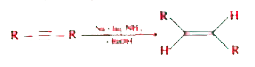
In the conversion of alkyne to trans -alkene by birch reduction using alkali metals (such as Na or K) in liquid `NH_3` and alcohol (MeOH or EtOH),

The mechanism takes place in the formation of intermediate species in the following sequence:

A

Radical anion `to` vinylic radical `to` Trans-vinylic anion `to` trans-alkene

B

Radical anion `to` trans-vinylic anion `to` vinylic radical `to` trans-alkene

C

Vinylic radical `to` Radical anion Trans `to` vinylic anion `to` trans-alkene

D

Vinylic radical `to` trans-vinylic anion `to` Radical anion `to` trans-alkene

Text Solution

Verified by Experts

The correct Answer is:

A

Radical anion ` to ` vinylic radical ` to` Trans-vinylic anion ` to` trans-alkene
Promotional Banner

Similar Questions

Explore conceptually related problems

When sodium metal is dropped in liquid NH_3 it forms Na^(+) and gets ammoniated. Which of the following forces are responsible for the formation of ammoniated sodium ion.

When a salt reacts with water to form acidic (or ) basic solution the process is called salt hydrolysis. The P^(H) of salt solution can be calculated using the following relation P^(H) =(1)/(2) [P^(k_w) +P^(Ka) + log C ] for salt of weak acid and strong base. P^(H) =(1)/(2) [P^(K_w) -P^(K_a) -log C ] for salt of weak base and strong acid , P^(H) =(1)/(2) [P^(K_w) +P^(K_a) - P^(K_b) ] For a salt of weak acid and weak base where .c. represents the concentration of salt . When a weak acid (or) a weak base is not completly neatralised by strong base (or ) strong acid respectively, then formation of buffer takes places. The P^(H) of buffer solution can be calculated using the following relation P^(H) =P^(Ka) +log "" ((["salt")])/(["Acid "]) , P^(OH) =P^(Kb) +log ""(["salt"])/(["base"]) Answer the following questions using the following data pK_a (CH_3COOH) =4.7447 , pK_b (NH_4OH) =4.7447 , P^(K_W) =14. 0.001 M NH_4 Cl aqueous solution has P^(H)

When a salt reacts with water to form acidic (or ) basic solution the process is called salt hydrolysis. The P^(H) of salt solution can be calculated using the following relation P^(H) =(1)/(2) [P^(k_w) +P^(Ka) + log C ] for salt of weak acid and strong base. P^(H) =(1)/(2) [P^(K_w) -P^(K_a) -log C ] for salt of weak base and strong acid , P^(H) =(1)/(2) [P^(K_w) +P^(K_a) - P^(K_b) ] For a salt of weak acid and weak base where .c. represents the concentration of salt . When a weak acid (or) a weak base is not completly neatralised by strong base (or ) strong acid respectively, then formation of buffer takes places. The P^(H) of buffer solution can be calculated using the following relation P^(H) =P^(Ka) +log "" ((["salt")])/(["Acid "]) , P^(OH) =P^(Kb) +log ""(["salt"])/(["base"]) Answer the following questions using the following data pK_a (CH_3COOH) =4.7447 , pK_b (NH_4OH) =4.7447 , P^(K_W) =14. One mole CH_3 COOH and one mole CH_3 COONa are dissolved in water one litre aqueous solution The P^(H) of the resulting solution will be

1) The -=C-H unit of an alkyne is more acidic than a C – H unit of an alkene or alkane, allowing acetylene and terminal alkynes to be converted to their conjugate bases -= C . 2) Unlike alkenes, alkynes are reduced by metals, especially Li, Na and K. 3) Unlike alkenes, alkynes can undergo nucleophilic as well as electrophilic addition. Which of the following best describes what happens in the first step in the mechanism of the reaction shown? CH_3 CH_2CH_2CHBr_2 + 3NaNH_2 overset(NH_3)to CH_3CH_2C -=CNa +2NaBr +3NH_3

1) The -=C-H unit of an alkyne is more acidic than a C – H unit of an alkene or alkane, allowing acetylene and terminal alkynes to be converted to their conjugate bases -= C . 2) Unlike alkenes, alkynes are reduced by metals, especially Li, Na and K. 3) Unlike alkenes, alkynes can undergo nucleophilic as well as electrophilic addition. Which of the following best describes what happens in the first step in the mechanism of the hydrogen - deuterium exchange reaction shown? CH_3 -= CD underset(NH_3)overset(NaNH_2)to CH_3C -= CH
