

Home
Class 11
PHYSICS
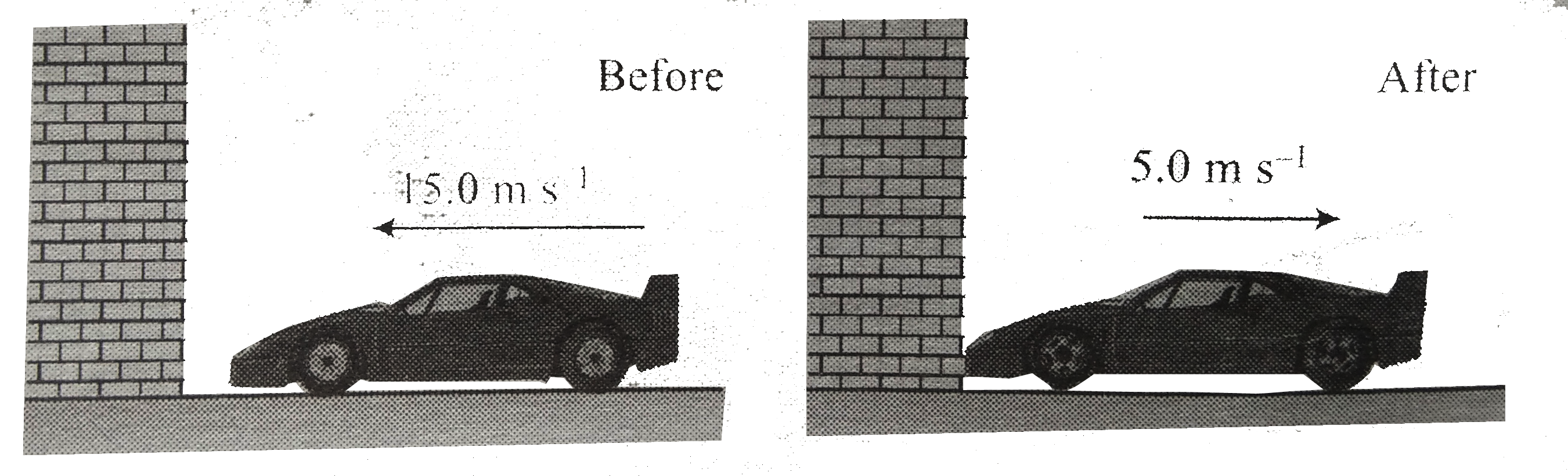
In a particular crash test, a car of mas...

In a particular crash test, a car of mass 1500 kg collies with a wall as shown in fig. The initial and final velocities on the car are →vi=-15.0ˆims-1 and →vf=5.00ˆims-1, respectively. If the collision lasts 0.150s, find the impulse caused by the collision and the average force exerted on the car.

Promotional Banner

Topper's Solved these Questions

  • GRAVITATION

    CHETANA PUBLICATION|Exercise EXERCISE|76 Videos
  • MAGNETISM

    CHETANA PUBLICATION|Exercise EXERCISE|118 Videos

Similar Questions

Explore conceptually related problems

A body of mass 2 kg collides with a body of mass 1 kg. Their initial velocities are 6 m/s and 4 m/s respectively. If the velocity of the first body after collision is : (14)/3 m/s , find the velocity of the second body after collision.

Choose the correct options A ball of mass 250 g moving with 20 m//s strikes a vertical wall and rebounds along the same line with a velocity of 15 m//s . If the time of contact is 0.1 s, the force exerted by the wall on the ball is

A body of mass 1 kg moving with velocity 5 m/s collides with another body of mass 2 kg moving with velocity 1.5 m/s in opposite direction. If the coefficient of restitution is 0.8, their velocities aftter collision respectively are

A bullet of mass 0.1 kg moving horizontally with a velocity of 20 m//s strike a stationary target and is brought to rest in 0.1 s. Find the impulse and average force of impact.

Two bodies of masses m and 2m, moving with initial velocities 50 m//s in the + x direction and 40 m//s in the -x direction respectively, undergo a head -on elastic collision. (i) Calculate their final velocities (ii) What is the ratio of the final to initial kinetic energies for the body of mass m? (iii) Calculate the change in momentum of each body if m= 1kg (iv) What is the change in the momentum of the system?

Solve the following examples: (numerical problems) A body of mass 1 kg, moving with a velocity of 4 m/s collides with a body of mass 0.5 kg moving with a velocity of 2 m/s . If the velocity of the first body after collision is 8/3 m/s , find the velocity of the second body after collision.

A cricket ball of mass 0.5 kg strikes a circket bat normally with a velocity of 20" m s"^(-1) and rebounds with a velocity of 10" m s"^(-1) . The impulse of the force exerted by the ball on the bat is

A body of mass 0.1 kg travelling with a velocity of 5 m/s, collides head-on with another body of mass 0.2 kg travelling in the same direction with a velocity of 1.2 m/s. If the two bodies stick together after collision, their common velocity is

A body of mass 2 kg travels with a velocity of 8 m//s makes a head on collision with another body having mass 4 kg, which is travelling in the same direction with a velocity of 1 m//s . Calculate the velocities of the two bodies after collision. Find the loss in kinetic energy of the system. (Given e = 0.5)

CHETANA PUBLICATION-LAWS OF MOTION -EXERCISE
  1. A bomb of 12 kg expledes into 2 pieces of masses 4 kg and 8 kg mass i...

    Text Solution

    |

  2. Three equal masses each of 1 kg are placed at vertices of an equilater...

    Text Solution

    |

  3. In a particular crash test, a car of mass 1500 kg collies with a wall ...

    Text Solution

    |

  4. A force F = (2 + x) acts on a particle in x-direction, where F is in n...

    Text Solution

    |

  5. The potential energy of a conservative is given by u = ax^2 - bx, wher...

    Text Solution

    |

  6. An object of mass 5kg falls from rest through a verticle distance of 2...

    Text Solution

    |

  7. Choose the correct options Consider following pair of forces of equal...

    Text Solution

    |

  8. Choose the correct options Consider following forces: (w) Force due t...

    Text Solution

    |

  9. Choose the correct options At a given instant three point masses m, 2...

    Text Solution

    |

  10. Choose the correct options The rough surface of a horizontal table of...

    Text Solution

    |

  11. Choose the correct options A mass 2 m moving with some speed is direc...

    Text Solution

    |

  12. Choose the correct options A uniform rod of mass 2 m is held horizont...

    Text Solution

    |

  13. Choose the correct options Select WRONG statement about centre of mas...

    Text Solution

    |

  14. Choose the correct options For which of the following objects will ce...

    Text Solution

    |

  15. Choose the correct options Action and reaction forces do not cancel e...

    Text Solution

    |

  16. Choose the correct options A force vector applied on a mass is repres...

    Text Solution

    |

  17. Choose the correct options A ball of mass 250 g moving with 20 m//s s...

    Text Solution

    |

  18. Choose the correct options ……..force is defined in order to apply New...

    Text Solution

    |

  19. Choose the correct options Which of the following is NOT an example o...

    Text Solution

    |

  20. Choose the correct options The electrostatic and gravitional foces ar...

    Text Solution

    |