Home
Class 10
PHYSICS
A driver is driving his car along a road...

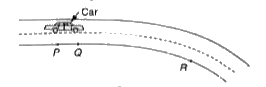
A driver is driving his car along a road as shown in Fig. 2.3. The driver makes sure that the speedometer reads exactly 40km/h. What happens to the speed of the car from P to Q?

A

Speed remains constant

B

Speed first increases then decreases

C

Speed first decreases then increases

D

Nothing can be decided

Text Solution

Verified by Experts

The correct Answer is:

A
Promotional Banner

Topper's Solved these Questions

  • MOTION

    MCGROW HILL PUBLICATION|Exercise HIGHER ORDER THINKING QUESTIONS|48 Videos
  • MISCELLANEOUS QUESTIONS

    MCGROW HILL PUBLICATION|Exercise PART-B|99 Videos
  • REFLECTION OF LIGHT

    MCGROW HILL PUBLICATION|Exercise HIGHER ORDER THINKING QUESTIONS|10 Videos

Similar Questions

Explore conceptually related problems

The rear view mirror of a car is a plane mirror. A driver is reversing his car at a speed of 2m/s. The driver sees in his rear view mirror the image of truck parked behind his car. The speed at which of the image of the truck appears to approach the driver will be

A car goes one kilometre at 30km/h and then goes another kilometre to 40 km/h. The average speed (in km/h) of the car for 2 km is

A car goes one kilometre at 30 km/h and then goes another kilometre to 40 km/h. The average speed (in km/h) of the car for 2 km is

A car is travelling at 20 m/s along a road. A child runs out into the road 50 m ahead and the car driver steps on the brake pedal. What must the car's deceleration be if the car is to stop just before it reaches the child ?

A car travels from City A to City B at a speed of 40km/hr and from B to A at a speed of 60km/hr. What is the average speed of the car?

A train(T) is running uniformly on a straight track. A car is travelling with constant speed along section AB of the road which is parallel to the rails. The driver of the car notices that the train is having a speed of 7 m//s with respect to him. The car maintains the speed but takes a right turn at B and travels along BC. Now the driver of the car finds that the speed of train relative of him is 13 m//s . Find the possible speeds of the car.

A car driver, driving in a fog, passes a pedestrian who was walking at the rate of 2 km/hr in the same direction. The pedestrian could see the car for 6 minutes and it was visible to him up to a distance of 0.6 km. What was the speed of the car?

MCGROW HILL PUBLICATION-MOTION-HIGHER ORDER THINKING QUESTIONS
  1. A driver is driving his car along a road as shown in Fig. 2.3. The dr...

    Text Solution

    |

  2. The location of a particle has changed. What can you say about the dis...

    Text Solution

    |

  3. A train 120m long is going towards north direction at a speed of 8ms^(...

    Text Solution

    |

  4. Which of the following velocity-time graphs does not represent motion ...

    Text Solution

    |

  5. A boy completes one round of a circular track of radius r in 40 s. His...

    Text Solution

    |

  6. A particle starts from the origin, goes along X-axis to the point (30m...

    Text Solution

    |

  7. A car runs on a circular track at a constant speed. The circular track...

    Text Solution

    |

  8. In question 68 above, the average velocity of the car is

    Text Solution

    |

  9. Which of the following distance-time graphs is not possible?

    Text Solution

    |

  10. Two persons start running towards each other from two points that arc ...

    Text Solution

    |

  11. In question 71 above, two persons meet each other from the first point...

    Text Solution

    |

  12. If a car at rest accelerates uniformly to a speed of 144km/h 20 s, it ...

    Text Solution

    |

  13. A body starting from rest is moving with a uniform acceleration of 8m/...

    Text Solution

    |

  14. A 120 m long train is moving in a direction with a speed of 20ms^(-1)....

    Text Solution

    |

  15. A bullet is fired with a speed of 10^(3)ms^(-1) in order to hit s targ...

    Text Solution

    |

  16. A car moves for half of its time at 80 km//h and for rest of time at 4...

    Text Solution

    |

  17. The distance (5) travelled varies with time (t) for four different-bod...

    Text Solution

    |

  18. The area under acceleration-time graph gives

    Text Solution

    |

  19. The displacement of a body is given to be proportional to the cube of ...

    Text Solution

    |

  20. Fig. 3.39 shows the acceleration - time graph for a particle in rectil...

    Text Solution

    |

  21. A body nis thrown vertically upward. Which of the following graphs cor...

    Text Solution

    |
