Home
Class 12
CHEMISTRY
Write SN^(2) mechanism of the conversion...

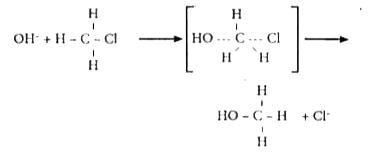
Write `SN^(2)` mechanism of the conversion of methyl chloride to methyl alcohol.

Text Solution

Verified by Experts
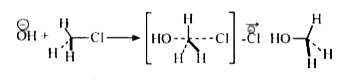

`SN^(2)` mechanism
The nucleophile `OH^(-)` attacks electrons deficient carbon atom from the rear side [back side] of the carbon atom to form a transition state it is unstable. In the transition state a partial `(HO-C)` bond is formed and partial `C-Cl` bond is broken. The product methyl alchohol obtained has inversion configuration.
Promotional Banner

Topper's Solved these Questions

  • ANNUAL EXAM QUESTION PAPER MARCH - 2017

    SUNSTAR PUBLICATION|Exercise PART - C|12 Videos
  • ANNUAL EXAM QUESTION PAPER JULY - 2017

    SUNSTAR PUBLICATION|Exercise PART - D|25 Videos
  • ANNUAL EXAM QUESTION PAPER MARCH - 2018

    SUNSTAR PUBLICATION|Exercise PART - D|28 Videos

Similar Questions

Explore conceptually related problems

Write equations for the steps in SN^1 mechanism of the conversion of tert.butyl bromide into tert.butyl alcohol.

(a) Write the equations for the steps involved in SN^(1) mechanism for the conversion of tert-butyl bromide to tert-butyl alcohol.

Write the equations for the steps in SN-1 mechanism of the convertion of tert-Butyl bromide into tert-butyl alcohol.

Write the conversion of acetic acid to t-butyl alcohol.

Write the equations for the steps in SN^(1) mechanism of the conversion of the conversion of tert -butyl bromide into tert-butyl alcohol.

a) i) write the equations for the steps in SN1 mechanism of the conversion of tertiary butyl bromide in to tertiary butyl alcohol. ii) Haloarenes are less reactive towards nucleophilic substitution reactions than Haloalkanes. Give a reason.

Write equations for the steps in S_(N)1 mechanism of conversion of tertiary butyl bromide into tertiary butyl alcohol.

Write steps involved in S_(N)1 mechanism to the conversion of tertiary butyl bromide into tertiary butyl alcohol and mention its order.

SUNSTAR PUBLICATION-ANNUAL EXAM QUESTION PAPER MARCH - 2017-PART - D
  1. write any two differences between lyophilic and lyophobic colloids .

    Text Solution

    |

  2. Explain the mechanism of enzyme catalysis.

    Text Solution

    |

  3. How does entropy change for adsorption?

    Text Solution

    |

  4. Write SN^(2) mechanism of the conversion of methyl chloride to methyl ...

    Text Solution

    |

  5. Aldehydes are generally more reactive than ketones towards nucleophill...

    Text Solution

    |

  6. What is asymmetric carbon atom.

    Text Solution

    |

  7. Explain the Kolbe's reaction with equation.

    Text Solution

    |

  8. Write the mechanism of acid catalysed dehydration of ethanol to ethene...

    Text Solution

    |

  9. How benzene is converted into benzaldehyde by Gatterman-Koch reaction.

    Text Solution

    |

  10. Complete and name the following reaction.

    Text Solution

    |

  11. What is the effect of electron withdrawing group on the acidity of car...

    Text Solution

    |

  12. How aniline is prepared by Hoffmann bromamide degradation reaction? Gi...

    Text Solution

    |

  13. i) Write IUPAC name of CH(3)CH(2)NH(2). ii) Arrange the following am...

    Text Solution

    |

  14. Complete the following equation. C(6)H(5)NH(2)+NaNO(2)+2HCl overset(...

    Text Solution

    |

  15. Write Haworth structure for maltose.

    Text Solution

    |

  16. Give an example for i) Globular proteins. ii) Naturally occurring ...

    Text Solution

    |

  17. Name the nucleic acid which is responsible for genetic inform...

    Text Solution

    |

  18. Explain the preparation of Buna-N with equation.

    Text Solution

    |

  19. Name the monomer present in the following polymer i) Poly vinyl chlo...

    Text Solution

    |

  20. Give an example for biodegradable polymer.

    Text Solution

    |