Home
Class 11
CHEMISTRY
Configuration isomerism is shown by the ...

Configuration isomerism is shown by the compounds in which groups or atoms are arranged with rigid part like double bonded atoms, cycle asymmetric centre etc. Geometrical isomerism is possible in case of double bonded atoms as well as in cycle. The phytical. Properties of geometrical isomer differs which is observed fact.
Which of the following is correct?

A

cis-1,4-dimethyl cyclohexane will contains dipole moment value zero

B

trans- 1,3-dimethyl cyclohexane will contain dipole moment value zero

C

trans- 1,3 - dimethyl cyclobutane will contain dipole mament values zero

D

trans - 1,2-dimethyl cyclopropane will contain dipole moment value zero

Text Solution

Verified by Experts

The correct Answer is:
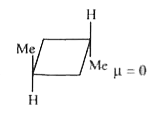
C

Promotional Banner

Topper's Solved these Questions

  • ISOMERISM

    AAKASH SERIES|Exercise PRACTICE SHEET (EXERCISE-II (LEVEL-II) MATRIX MATCHING TYPE QUESTIONS)|2 Videos
  • ISOMERISM

    AAKASH SERIES|Exercise PRACTICE SHEET (EXERCISE-II (LEVEL-II) INTEGER TYPE QUESTIONS)|3 Videos
  • ISOMERISM

    AAKASH SERIES|Exercise PRACTICE SHEET (EXERCISE-II (LEVEL-II) STRAIGHT OBJECTIVE TYPE QUESTIONS)|29 Videos
  • IONIC EQUILIBRIUM

    AAKASH SERIES|Exercise ADDITIONAL PRACTICE EXERCISE (LEVEL -II PRACTICE SHEET (ADVANCED) (Integer Type Questions))|8 Videos
  • PERIODIC CLASSIFICATION

    AAKASH SERIES|Exercise OBJECTIVE EXERCISE - 3 (RECENT AIPMT/NEET QUESTIONS)|14 Videos

Similar Questions

Explore conceptually related problems

Configuration isomerism is shown by the compounds in which groups or atoms are arranged with rigid part like double bonded atoms, cycle asymmetric centre etc. Geometrical isomerism is possible in case of double bonded atoms as well as in cycle. The phytical. Properties of geometrical isomer differs which is observed fact. Which of the following is true for 2 - butene ?

Geometrical isomerism is possible about which of the following multiple bonds?

Structural isomers have different covalent linkage of atoms. Stereoisomers are compounds that have same sequence of covalent bonds but differ in the relative dispositions of their atoms in space. Geometri cal and optical isomers are the two important types of configurational isomers. The compound with double bonds or ring structure have restricted rotation, so exist in two geometrical forms. The double bonds in larger rings (ring size 10 carbon large) can also cause geometrical isomerism. The optical isomers rotate the plane of plane-polarised light. A sp^(3) -hybridised carbon atom bearing four different types of substituents is called an asymmetric centre or chiral centre. A chiral object or molecule cannot be superimposed on its mirror image. Stereoisomers that are mirror images of each other are called enantiomers. The stereosomers that the pot mirror images of each other are called diastereomers. Diasteremers have different physical properties. A racemic mixture is optically inactive and contains equal amounts of both the enantiomers. Resolution refers to method of separating a racemic mixture. Into two pure enantiomers. A meso compound is an optically inactive stereoisomer, which is achiral due to the presence of an internal plane of symmetry or centre of symmetry within the molecule. The number of chiral centres present in the following compounds is

Structural isomers have different covalent linkage of atoms. Stereoisomers are compounds that have same sequence of covalent bonds but differ in the relative dispositions of their atoms in space. Geometri cal and optical isomers are the two important types of configurational isomers. The compound with double bonds or ring structure have restricted rotation, so exist in two geometrical forms. The double bonds in larger rings (ring size 10 carbon large) can also cause geometrical isomerism. The optical isomers rotate the plane of plane-polarised light. A sp^(3) -hybridised carbon atom bearing four different types of substituents is called an asymmetric centre or chiral centre. A chiral object or molecule cannot be superimposed on its mirror image. Stereoisomers that are mirror images of each other are called enantiomers. The stereosomers that the pot mirror images of each other are called diastereomers. Diasteremers have different physical properties. A racemic mixture is optically inactive and contains equal amounts of both the enantiomers. Resolution refers to method of separating a racemic mixture. Into two pure enantiomers. A meso compound is an optically inactive stereoisomer, which is achiral due to the presence of an internal plane of symmetry or centre of symmetry within the molecule. The following two compounds are

Geometrical Isomerism Molecules having same molecular formula but differing in the orientation of atoms in a space due to resistricted rotation. Compound which do not exhibit geometric isomerism

A carbon atom which is bonded to four different atoms or groups is called an asymmetric carbon atom

Molecules having same molecular formula. But differing in structure (or) spatial orientation of atom is known isomers and phenomenon known as isomerism. Molecules which differ in structural formula are known as structural isomers and phenomenon is known as structural isomerism structural isomerism can be broadly classified as (i) Chain isomerism (ii) Positional isomerism (iii) Functional isomerism (iv) Metamerism (v) Tautomerism Molecules having same molecular formula but differing in spatial orientation are known as stereo isomers and the phenomenon known as stereo isomerism. Stero isomerism can be classified as (i) Geometrical isomerism (ii) Optical isomerism Which of the following pair exhibit functional isomerism

Complex compounds are molecular compounds which retain their indentities even when dissolved in water. They do not give all the simple ions in solution but instead furnish complex ions. The complex compounds are often called coordination compounds because certain groups called ligands are attached to the central metal ion by coordinate or dative bonds. Coordination compounds exhibit isomerism, both structural and stereoisomerism. The struculre, magnetic property, colour and electrical properties of complexes are explained by various theories. which of the following pairs, both the complexes have the same geometry?

