Home
Class 12
PHYSICS
Three charges q each are at vertices of ...

Three charges `q` each are at vertices of equilateral triangle of side `r`? How much charge should be placed at the centroid so that the system remains in equilibrium?

Text Solution

Verified by Experts
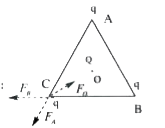

Due to three identical charges kept at three corners of a triangle, null point (E = 0) is formed at centre 0. Let .Q. be the charge placed at centre of triangle then the charge .Q is in equilibrium.
For system to be in equilibrium the force on each charge must be zero.
Consider the forces on charge at C. Let `F_A, F_B and F_0` . be the forces on the charge at .C. due to the charges at A, B and .O. respectively.
`F_A = F_B = 1/(4 pi epsilon_0) (q^2)/(a^2)`
Angle between `vec(F_A)`  and `vec(F_B) `  is `60^@`
The magnitude of resultant of
`vec(F_A) and vec(F_B) = sqrt(3) xx 1/(4 pi epsilon_0) (q^2)/(a^2)`
The direction of resultant is along OC.
The force on C due to "Q"is
`vec(F_O) = 1/(4 pi epsilon_0) (Qq)/(((a)/(sqrt3))^2) = 3 xx 1/(4 pi epsilon_0) (Qq)/(a^2) ` (along CO)
The resultant force on charge at C is Zero.
`vec(F) = vec(F_A) + vec(F_B) + vec(F_O) = 0`
`sqrt(3) 1/(4 pi epsilon_0) (q^(cancel(2)))/(cancel(r)^2) + (1)/(4 pi epsilon_0) (3Q cancel(q))/(cancel(r)^2) = 0 implies Q = - q/(sqrt(3))`
Negative sign indicates that the force `vec(F_O)` . is opposite to the resultant of `vec(F_A)` and `vec(F_B)`.
Promotional Banner

Similar Questions

Explore conceptually related problems

Consider three charges q_(1), q_(2), q_(3) each equal to q at the vertices of an equilateral triangle of side l. What is the force on a charge Q (with the same sign as q) placed at the centroid of the triangle, as shown in Fig. ?

Three point charges of 2 mC each are kept at the vertices of an equilateral triangle of side 50 cm . If the system is supplied energy at the rate 2 kW, the time taken to move one of the charges to the mid point of the line joining the other two charge is

