Home
Class 12
PHYSICS
Using Bohr's atomic model, derive an equ...

Using Bohr's atomic model, derive an equation of the radius of the nth orbit of an electron.

Text Solution

Verified by Experts
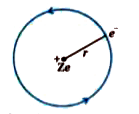
The atomic model of Bohr is shown in the figure.

Let mass of an electron m, charge e, linear speed in `n^(th)` orbit` v_(n)` and orbit with radius `r_(n)` and charge on nucleus Ze, where Ze = atomic number of an element.
The necessary centripetal force is provided Colombian attractive force between electron and nucleus. Thus.
`:. (mv_(n)^(2))/(r_(n))=(1)/(4pi epsi_(0))*((Ze)(e))/(r_(n)^(2))=(ze^(2))/(4pi epsi_(0)r_(n)^(2))`
where `epsi_(0)`= permittivity of medium
From Bohr hypothesis 2, if the anguli momentum of electron in `n^(th)` orbit is `L_(nm)`
`L_(n)=(nh)`
`:. mv_(n)r_(n)=(nh)/(pi) " "...(2)`
From equation (1),
`v_(n)(mv_(n)r_(n))=(Ze^(2))/(4pi epsi_(0))`
Putting the vlaue of equation (2),
`v_(n)-(nh)(2pi)-(Ze^(2))/(4pi epsi_(0))` [ From equation (2)]
`:.v_(n)=(Ze^(2))/(4pi epsi_(0))*(1)/((nh)/(2pi))`
`:.v_(n)=(1)/(n)*(Ze^(2))/(2h epsi_(0)) " "...(3)`
`:.v_(n) prop(Z)/(n)` where `e, 2h,epsi_(0)` constant
Hence orbital velocity in `n^(th)` orbit velocity decreases by a factor of n.
For hydrogen atom Z = 1,
`v_(n) prop (1)/(n)`
Now from equation (2).
`r_(n)=(nh)/(2pi mv_(n))`
Putting the value of eqution (3).
`r_(n)=(nhxxnxx2h epsi_(0))/(2pi mxxZe^(2))`
`:. r_(n)=(n^(2)h^(2) epsi_(0))/(pi mZe^(2))`
`:.r_(n) prop (n^(2))/(Z)[ :.` all other terms are contant]
For hydrogen Z=1
`:. r_(n)=(n^(2)h^(2) epsi_(0))/(pi me^(2))" "...(4)`
`:. r_(n) prop n^(2)` [ `:.` All other terms are constant] The size of the innermost orbit (n = 1) is called Bohr radius, represented by the symbol `a_(0)` thus Putting n = 1 in equation (4),
`r_(1)=a_(0)=n^(2)((h^(2) epsi_(0))/(pi me^(2)))`
putting the values of `h epsi_(0), pi` and.
`a_(0)=5.29xx10^(-11)m` or approximately `0.53Å`
Promotional Banner

Topper's Solved these Questions

  • ATOMS

    KUMAR PRAKASHAN|Exercise TRY YOURSELF |43 Videos
  • ATOMS

    KUMAR PRAKASHAN|Exercise SECTION-B (NUMERICALS) (Numerical From Textual Illustrations)|9 Videos
  • ALTERNATING CURRENTS

    KUMAR PRAKASHAN|Exercise SECTION-D MCQs (COMPETITIVE EXAMS)|64 Videos
  • BOARD'S QUESTION PAPER MARCH-2020

    KUMAR PRAKASHAN|Exercise PART-B SECTION -C|4 Videos

Similar Questions

Explore conceptually related problems

Explain Bohr's atomic model.

Suppose an electron is attracted towards the origin by a force (k)/(r ) where k is a constant and r is the distance of the electron from the origin. By applying Bohr model to this system, the radius of the n^(th) orbital of the electron is found to be r_(n) and the kinetic energy of the electron to be T_(n) . Then which of the following is true?

The gravitational attraction between electron and proton in a hydrogen atom is weaker than the coulomb attraction by a factor of about 10^(-40) . An alternative way of looking at this fact is to estimate the radius of the first Bohr orbit of a hydrogen atom if the electron and proton were bound by gravitational attraction. You will find the answer interesting.

According to Bohr's theory of hydrogen atom which of the following is quantised for and electron ?

is found experimentally that 13.6 eV energy is required to separate a hydrogen atom into a proton and an electron. Compute the orbital radius and the velocity of the electron in a hydrogen atom.

The energy of hydrogen atom in the nth orbit is En, then the energy in the nth orbit of single ionised helium atom is

The value of Bohr radius for hydrogen atom is

KUMAR PRAKASHAN-ATOMS-Section-D -MCQs asked in GUJCET / Board Exam
  1. Using Bohr's atomic model, derive an equation of the radius of the nth...

    Text Solution

    |

  2. The ratio of longest wavelength and the shortest wavelength observed i...

    Text Solution

    |

  3. Which line of the Balmer series has the maximum wavelength ?

    Text Solution

    |

  4. As the quantum number increases, the difference of energy between cons...

    Text Solution

    |

  5. In Rutherford's alpha-scattering experiment, what will be the correct ...

    Text Solution

    |

  6. The potential energy of the orbital electron in the ground state of hy...

    Text Solution

    |

  7. What will the angular momentum in fourth orbit, if L is the angular mo...

    Text Solution

    |

  8. The ratio of areas of the electron orbits for the first excited state ...

    Text Solution

    |

  9. What is the difference of angular momenta of an electron between two c...

    Text Solution

    |

  10. The ratio of kinetic energy of the total energy of an electron of a Bo...

    Text Solution

    |

  11. The potential difference applied to an X-ray tube is 5 kV and the curr...

    Text Solution

    |

  12. For an electron in the second orbit of Bohr's hydrogen atom, the momen...

    Text Solution

    |

  13. of the following transitions in the hydrogen atom, the one which gives...

    Text Solution

    |

  14. The relation between principle quantum number (n) and orbital radius (...

    Text Solution

    |

  15. The total energy of an electron in second excited state is - 2E. What ...

    Text Solution

    |

  16. The atom of hydrogen absorbs 12.75 eV of energy in ground state. Then ...

    Text Solution

    |

  17. Find out the atomic number of the element which gives X-ray of minimum...

    Text Solution

    |

  18. The minimum wavelength of the X-rays produced by electrons accelerated...

    Text Solution

    |

  19. Write range of wave length of X - rays.

    Text Solution

    |

  20. If , lambda(1) and lambda(2) are the wavelength of the numbers of th...

    Text Solution

    |

  21. Number of spectral line of hydrogen atom is

    Text Solution

    |

