Home
Class 12
PHYSICS
What is the ground state of an atom ? An...

What is the ground state of an atom ? And what is the ionization energy and excitation energy of a hydrogen atom ?

Text Solution

Verified by Experts
Total energy of electron in atom is
`E_(n)=-(mZ^(2)e^(4))/(8n^(2)h^(2)epsi_(0)^(2))`
`:. E_(n)=-(13.6Z^(2))/(n^(2))eV`
Negative sign indicates that as the value of .n. increases the negative `E_(n)` decreases that is energy increases that is the energy of the electron increases gradually in far orbits from nucleus.
When electron is revolving in an orbit closest to the nucleus mean in n = 1 orbit, the absolute value of the energy (maximum negative value) is smaller. Such a lowest state of the atom is called the ground state.
The energy of electron orbiting in orbit of Bohr radius `a_(0)` is ,
`E_(1)=(13.6Z^(2))/(n^(2))eV`
For hydrogen Z=1,n=1
`:. E_(1)=-13.6eV`
Therefore, the minimum energy required to free the electron from the ground state of hydrogen atom is 13.6 eV is called the ionization energy.
At room temperature, most of the hydrogen atoms are in ground state. When a hydrogen atom receives energy by processes, the atom may acquire sufficient energy to raise the electron to higher energy states.
The atom is then said to be in an excited state. The energy required to excite an electron in hydrogen atom to its first excited state (n = 2)
`E_(2)-E_(1)=-(13.6)/(2^(2))-(-(3.6)/(1^(2)))`
`=(13.6-(13.6)/(4))eV` energy needed
`=13.6-3.4=10.eV`
And the energy required to bring an electron in H atom from ground state to second excited state (n=3) is
`E_(3)-E_(1)=-(13.6)/(3^(2))-(-(13.6)/(1^(2)))`
`=13.6-1.51`
`=12.09eV`
Hence, the energy required to bring an electron in H atom from ground state to second excited state is 12.09 eV.
Similarly, the energy required to bring electron in third excited state and fourth excited state and infinite excited state are 12.75 eV, 13.06 eV and 13.6 eV respectively.
If the electron returns from a excited state to a low energy state, a photon is emitted in this process.
Thus, as the excitation of hydrogen atom increases that is as n increases, the value of minimum energy required to free the electron from the excited atom decreases.
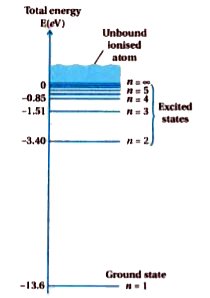
Thus, from equation `E_(n)=-(13.6)/(n^(2))eV`,the energy level diagram for stationary states of a hydrogen atom is shown in figure.

The energies corresponding to different orbits as shown by horizontal lines on vertical axis.
The energy levesl of the hydrogen atom are shown by horizontal line.
As the quantum nuber increases the energy difference between the two successive energy levels decreases.
Promotional Banner

Topper's Solved these Questions

  • ATOMS

    KUMAR PRAKASHAN|Exercise TRY YOURSELF |43 Videos
  • ATOMS

    KUMAR PRAKASHAN|Exercise SECTION-B (NUMERICALS) (Numerical From Textual Illustrations)|9 Videos
  • ALTERNATING CURRENTS

    KUMAR PRAKASHAN|Exercise SECTION-D MCQs (COMPETITIVE EXAMS)|64 Videos
  • BOARD'S QUESTION PAPER MARCH-2020

    KUMAR PRAKASHAN|Exercise PART-B SECTION -C|4 Videos

Similar Questions

Explore conceptually related problems

What is ionization energy of an atom ?

What does the negative electronic energy for hydrogen atom mean?

What is the total energy of electron at infinite distance in an atom ?

What is the unit of energy in atomic and nuclear physics?Define it.

The ionization energy of 10 times the ionized sodium atom ......

The ground state energy of hydrogen atom is –13.6 eV. What are the kinetic and potential energies of the electron in this state?

KUMAR PRAKASHAN-ATOMS-Section-D -MCQs asked in GUJCET / Board Exam
  1. What is the ground state of an atom ? And what is the ionization energ...

    Text Solution

    |

  2. The ratio of longest wavelength and the shortest wavelength observed i...

    Text Solution

    |

  3. Which line of the Balmer series has the maximum wavelength ?

    Text Solution

    |

  4. As the quantum number increases, the difference of energy between cons...

    Text Solution

    |

  5. In Rutherford's alpha-scattering experiment, what will be the correct ...

    Text Solution

    |

  6. The potential energy of the orbital electron in the ground state of hy...

    Text Solution

    |

  7. What will the angular momentum in fourth orbit, if L is the angular mo...

    Text Solution

    |

  8. The ratio of areas of the electron orbits for the first excited state ...

    Text Solution

    |

  9. What is the difference of angular momenta of an electron between two c...

    Text Solution

    |

  10. The ratio of kinetic energy of the total energy of an electron of a Bo...

    Text Solution

    |

  11. The potential difference applied to an X-ray tube is 5 kV and the curr...

    Text Solution

    |

  12. For an electron in the second orbit of Bohr's hydrogen atom, the momen...

    Text Solution

    |

  13. of the following transitions in the hydrogen atom, the one which gives...

    Text Solution

    |

  14. The relation between principle quantum number (n) and orbital radius (...

    Text Solution

    |

  15. The total energy of an electron in second excited state is - 2E. What ...

    Text Solution

    |

  16. The atom of hydrogen absorbs 12.75 eV of energy in ground state. Then ...

    Text Solution

    |

  17. Find out the atomic number of the element which gives X-ray of minimum...

    Text Solution

    |

  18. The minimum wavelength of the X-rays produced by electrons accelerated...

    Text Solution

    |

  19. Write range of wave length of X - rays.

    Text Solution

    |

  20. If , lambda(1) and lambda(2) are the wavelength of the numbers of th...

    Text Solution

    |

  21. Number of spectral line of hydrogen atom is

    Text Solution

    |

