Home
Class 12
PHYSICS
Dia-atomic molecule is composed of masse...

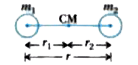
Dia-atomic molecule is composed of masses `m_(1)` and `m_(2)` and distance between them is r. By using the principle of quantisation of angular momentem of Bohr its energy of rotation is given by the formula ....... [Where n is integer and `h=(h)/(2pi)` ]

A

`(n^(2)h^(2))/(2(m_(1)+m_(2))r^(2))`

B

`(2n^(2)h^(2))/((m_(1)+m_(2))r^(2))`

C

`((m_(1)+m_(2))n^(2)h^(2))/(2m_(1)m_(2)r^(2))`

D

`((m_(1)+m_(2))^(2)n^(2)h^(2))/(2m_(1)m_(2)r^(2))`

Text Solution

Verified by Experts

The correct Answer is:
C


Reduced mass of this system `m=(m_(1)m_(2))/((m_(1)+m_(2)))`
`:.` Moment of inertia
`I=mr^(2)`
`=(m_(1)m_(2))/((m+m_(2)))r^(2)" ".......(1)`
`:.` Angular momentum in `n^(th)` orbit in Bohr model `L=(nh)/(2pi)=nh" "......(2)`
`:.` Rotational energy `E=(L^(2))/(2I)`
`:.E(n^(2)h^(2)(m_(1)+m_(2)))/(2m_(1)m_(2)r^(2))`
Promotional Banner

Topper's Solved these Questions

  • ATOMS

    KUMAR PRAKASHAN|Exercise Section-D -MCQs asked in AIIMS|17 Videos
  • ATOMS

    KUMAR PRAKASHAN|Exercise Section-D -MCQs asked in GUJCET / Board Exam|34 Videos
  • ATOMS

    KUMAR PRAKASHAN|Exercise Section-D (Multiple Choice Questions (MCQs)) (MCQs From .DARPAN Based On Textbook) (MCQs based on Textual Illustrations and Exercise )|11 Videos
  • ALTERNATING CURRENTS

    KUMAR PRAKASHAN|Exercise SECTION-D MCQs (COMPETITIVE EXAMS)|64 Videos
  • BOARD'S QUESTION PAPER MARCH-2020

    KUMAR PRAKASHAN|Exercise PART-B SECTION -C|4 Videos

Similar Questions

Explore conceptually related problems

Two bodies of masses M_(1) and M_(2) are kept separeated by a distance d. The potential at the point where the gravitational field produced by them is zero, is :-

Two blocks of masses m_(1) and m_(2) are connected by a massless pulley A, slides along th esmooth sides of a rectangular wedge of mass m, which rests on a smooth horizontal plane. Find the distance covered by the wedge on the horizontal plane till the mass m_(1) is lowered by the vertical distance h.

A body of mass m kg starts falling from a distance 2R above the earth's surface. What is its kinetic energy when it has fallen to a distance 'R' above the earth's surface ? (where R is the radius of Earth)

The key feature of Bohr's spectrum of hydrogen atom is the quantization of angular momentum when an electron is revolving around a proton. We will extend this to a general rotational motion to find quantized rotational energy of a diatomic molecule assuming it to be rigid.The rule to be applied is Bohr's quantization condition. it is found that the excitation from ground to the first excited state of rotation for the CO molecule is close to (4)/(pi) xx 10^(11) Hz then the moment of inertia of CO molecule about its center of mass is close to (Take h = 2 pi xx 10^(-34) J s )

Two blocks of mass m_(1)=10kg and m_(2)=5kg connected to each other by a massless inextensible string of length 0.3m are placed along a diameter of the turntable. The coefficient of friction between the table and m_(1) is 0.5 while there is no friction between m_(2) and the table. the table is rotating with an angular velocity of 10rad//s . about a vertical axis passing through its center O . the masses are placed along the diameter of the table on either side of the center O such that the mass m_(1) is at a distance of 0.124m from O . the masses are observed to be at a rest with respect to an observed on the tuntable (g=9.8m//s^(2)) . (a) Calculate the friction on m_(1) (b) What should be the minimum angular speed of the turntable so that the masses will slip from this position? (c ) How should the masses be placed with the string remaining taut so that there is no friction on m_(1) .

An object of mass m is raised from the surface of the earth to a height equal to the radius of the earth, that is, taken from a distance R to 2R from the centre of the earth. What is the gain in its potential energy ?

The given figure depicts a racing track whose left and right ends are semicircular. The distance between the two inner parallel line segments is 60m and they are each 106 m long. If the track is 10 m wide. Find : (1) the distance around the track along its inner edge. (2) the area of the track.

Separation of Motion of a system of particles into motion of the centre of mass and motion about the centre of mass : (a) Show p=p_(i).+m_(i)V where p_(i) is the momentum of the ith particle (of mass m_(i) ) and p_(i).=m_(i)v_(i). . Note v_(i). is the velocity of the i^(th) particle relative to the centre of mass Also, prove using the definition of the centre of mass Sigmap_(i).=0 (b) Show K=K.+(1)/(2)MV^(2) where K is the total kinetic energy of the system of particles, K. is the total kinetic energy of the system when the particle velocities are taken with respect to the centre of mass and (1)/(2)MV^(2) is the kinetic energy of the translation of the system as a whole (i.e. of the centre of mass motion of the system). The result has been used in Sec. 7.14). (c ) Show vecL=vecL.+vecRxxvec(MV) where vecL.=Sigmavec(r_(i)).xxvec(p_(i)). is the angular momentum of the system about the centre of mass with velocities taken relative to the centre of mass. Remember vec(r._(i))=vec(r_(i))-vecR , rest of the notation is the velcities taken relative to the centre of mass. Remember vec(r._(i))=vec(r_(i))-vecR rest of the notation is the standard notation used in the chapter. Note vecL , and vec(MR)xxvecV can be said to be angular momenta, respectively, about and of the centre of mass of the system of particles. (d) Show vec(dL.)/(dt)=sumvec(r_(i).)xxvec(dp.)/(dt) Further, show that vec(dL.)/(dt)=tau._(ext) where tau._(ext) is the sum of all external torques acting on the system about the centre of mass. (Hint : Use the definition of centre of mass and Newton.s Thrid Law. Assume the internal forces between any two particles act along the line joining the particles.)

The mass of a nucleus ._(Z)^(A)X is less that the sum of the masses of (A-Z) number of neutrons and Z number of protons in the nucleus.The energy equivalent to the corresponding mass difference is known as the binding energy of the nucleus. A heavy nucleus of mass M can break into two light nuclei of masses m_(1) and m_(2) only if (m_(1)+m_(2)) lt M . Also two light nuclei of masses m_(3) and m_(4) can undergo complete fusion and form a heavy nucleus of mass M'. only if (m_(3)+m_(4)) gt M' . The masses of some neutral atoms are given in the table below: |{:(._(1)^(1)H ,1.007825u , ._(1)^(2)H,2.014102u,._(1)^(3)H,3.016050u,._(2)^(4)He,4.002603u),(._(3)^(6)Li,6.015123u,._(3)^(7)Li,7.016004u,._(30)^(70)Zn,69.925325u, ._(34)^(82)Se,81.916709u),(._(64)^(152)Gd,151.91980u,._(82)^(206)Pb,205.974455u,._(83)^(209)Bi,208.980388u,._(84)^(210)Po,209.982876u):}| Taking kinetic energy ( in KeV ) of the alpha particle, when the nucleus ._(84)^(210)P_(0) at rest undergoes alpha decay, is:

The distance between two particles of masses m_(1)andm_(2) is r. If the distance of these particles from the centre of mass of the system are r_(1)andr_(2) respectively, then show that r_(1)=r((m_(2))/(m_(1)+m_(2)))andr_(2)=r((m_(1))/(m_(1)+m_(2)))

KUMAR PRAKASHAN-ATOMS-Section-D (MCQs asked in Competitive Exams) (MCQs asked in AIEEE and JEE (Main))
  1. The radiation corresponding to 3 to 2 transition of hydrogen atom fall...

    Text Solution

    |

  2. Hydrogen (""(1)H^(1)), Deuterium (""(1)H^(2)), single ionised Helium (...

    Text Solution

    |

  3. Dia-atomic molecule is composed of masses m(1) and m(2) and distance b...

    Text Solution

    |

  4. As an electron makes a transition from an excited state to the ground ...

    Text Solution

    |

  5. Some energy levels of a molecule are shown the figure. The ratio of th...

    Text Solution

    |

  6. An electron from various excited states of hydrogen atom emit radiatio...

    Text Solution

    |

  7. If the series limit frequency of the Lyman series is v(L), then the se...

    Text Solution

    |

  8. The time period of revolution of an electron in its ground state orbit...

    Text Solution

    |

  9. Number of the a-particle deflected in Rutherford's a-particle scatteri...

    Text Solution

    |

  10. The ionisation energy of hydrogen atom is 13.6 eV, the ionisation ener...

    Text Solution

    |

  11. To explain his theory, Bohr used………

    Text Solution

    |

  12. In terms of Bohr radius a, the radius of the second Bohr orbit of a hy...

    Text Solution

    |

  13. The radius of hydrogen atom in its ground state is 5.3xx10^(-11)m. Aft...

    Text Solution

    |

  14. J.J.Thomson's cathode ray tube experiment demonstrated that ......

    Text Solution

    |

  15. In which of the following system will the radius of the first orbit (n...

    Text Solution

    |

  16. The Bohr model of atom ......

    Text Solution

    |

  17. Energy of a hydrogen atom with principal quantum number n is shown by ...

    Text Solution

    |

  18. The total energy of an electron in the first excited state of the hydr...

    Text Solution

    |

  19. Ionization potential of hydrogen atom is 13.6 eV. Hydrogen atoms in th...

    Text Solution

    |

  20. The ground state energy of hydrogen atom is - 13.6 eV. When electron i...

    Text Solution

    |

