Home
Class 12
PHYSICS
A particle of mass m moves in a circular...

A particle of mass m moves in a circular orbit under the central potential field, `U(r)==-C/r,` where C is a positive constant.
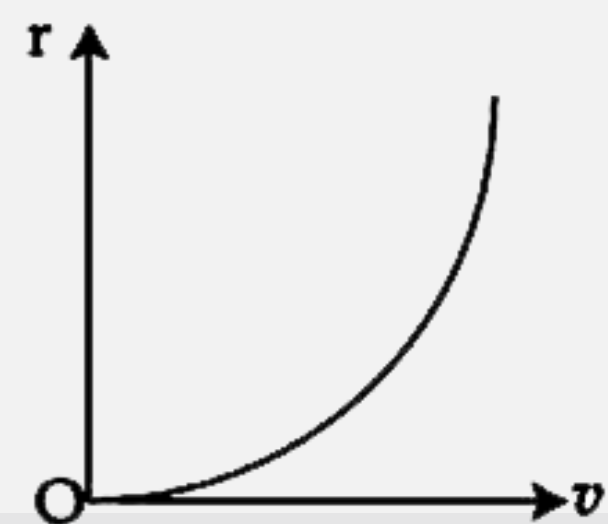
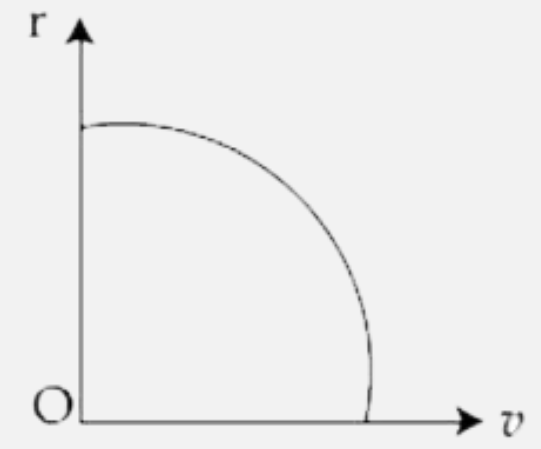
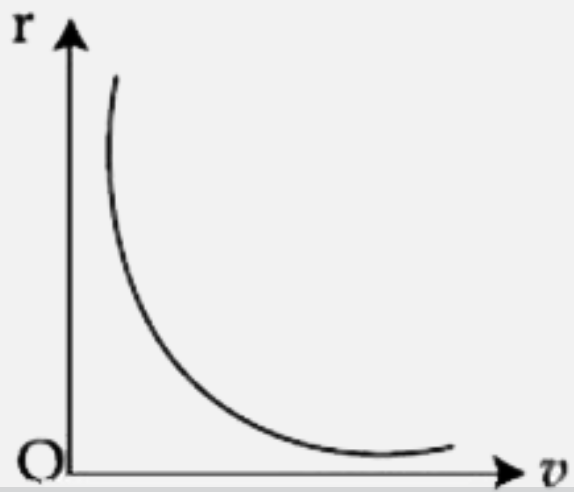
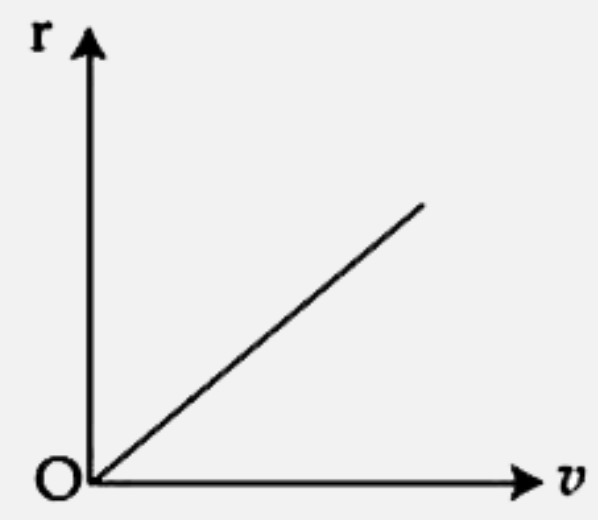
The correct radius -velocity graph of the particle's motion is.

A

B

C

D

Text Solution

AI Generated Solution

Promotional Banner

Similar Questions

Explore conceptually related problems

A particle of mass m moves under the action of a central force. The potential energy function is given by U(r)=mkr^(3) Where k is a positive constant and r is distance of the particle from the centre of attraction. (a) What should be the kinetic energy of the particle so that it moves in a circle of radius a0 about the centre of attraction? (b) What is the period of this circualr motion ?

A particle of mass m moves in circular orbits with potential energy N(r )=Fr , wjere F is a positive constant and r its distance from the origin. Its energies are calculated using the Bohr model. If the radius of the the n^(th) orbit (here h is the Planck's constant)

A particle of mass m is moving in a horizontal circle of radius r, under a centripetal force equal to (-K//r^(2)) , where k is a constant. The total energy of the particle is -

A particle of mass m is moving in a horizontal circle of radius r, under a centripetal force equal to - (K//r^(2)) . Where K is constant. What is the total energy of the particle?

A particle of mass m moves in a circular orbit in a central potential field U(r )=U_(0)r^(4) . If Bohr's quantization conditions are applied, radü of possible orbitals r_(n) vary with n^((1)/(alpha)) , where alpha is _________.

A particle of mass m moves in a circular orbit in a central potential field U(r )=(1)/(2) Kr^(2) . If Bohr's quantization conditions are applied , radii of possible orbitls and energy levels vary with quantum number n as :

A test particle is moving in a circular orbit in the gravitational field produced by a mass density rho(r)=K/r^2 . Identify the correct relation between the radius R of the particle’s orbit and its period T:

A small particle of mass m , moves in such a way that the potential energy U = ar^(3) , where a is position constant and r is the distance of the particle from the origin. Assuming Rutherford's model of circular orbits, then relation between K.E and P.E of the particle is :

Two particles of identical mass are moving in circular orbits under a potential given by V(r) = Kr^(-n) , where K is a constant. If the radii of their orbits are r_(1), r_(2) and their speeds are v_(1), v_(2) , respectively, then
