

Home
Class 12
PHYSICS
A 2 muF capacitor C(1) is first charged...

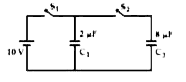
A `2 muF` capacitor `C_(1)` is first charged to a potential difference of 10 V using a battery. Then the battery is removed and the capacitor is connected to an uncharged capacitor `C_(2)` of 8`muF`. The charge in `C_(2)` on equilibrium condition is _______`muC`. (Round off to the Nearest Integer)

Promotional Banner

Similar Questions

Explore conceptually related problems

A capacitor C_(1) is charged to a p.d.V. The charging battery is then removed and the capacitor is connected to an uncharged capacitor C_(2) . The final p.d. across the combination is

An uncharged capacitor is connected to a battery. On charging the capacitor

A capacitor C is charged to a potential difference V and battery is disconnected. Now if the capacitor plates are brough close slowely by some distance:

A capacitor of capacitance C is charged to a potential difference V_(0) . The charged battery is disconnected and the capacitor is connected to a capacitor of unknown capacitance C_(x) . The potential difference across the combination is V. The value of C_(x) should be

A capacitor C is charged to a potential V by a battery. It is then disconnected from the battery and again connected with its polarity reversed to the battery

A muF capacitor C_1 is charged to V_0 = 120 V . The charging battery is then removed and the capacitor is connected in parallel to an uncharged + 4muF capacitor C_2 . (a) what is the potential difference V across the combination? (b) what is the stored energy before and after the switch S is closed?

A capacitor of capacity C_(1) = 1 muF is charged to a potential of 100 V. The charging battery is then removed and it is connected to another capacitor of capacity C_(2) = 2 muF . One plate of C_(2) is earthed as shown in figure. The charges on C_(1) and C_(2) in steady state will be

A capacitor of capacitance of 2muF is charged to a potential difference of 200V , after disconnecting from the battery, it is connected in parallel with another uncharged capacitor. The final common potential is 20V then the capacitance of second capacitor is :

A 10 muF capacitor is charged to a potential difference of 1000 V . The terminals of the charged capacitor are disconnected from the power supply and connected to the terminals of an uncharged 6 muF capacitor. What is the final potential difference across each capacitor ?