Text Solution
Verified by Experts
The correct Answer is:



Topper's Solved these Questions
VECTORS
DC PANDEY ENGLISH|Exercise Example|40 VideosVECTORS
DC PANDEY ENGLISH|Exercise check point 2.1|15 VideosVECTORS
DC PANDEY ENGLISH|Exercise Single Correct|39 VideosUNITS, DIMENSIONS & ERROR ANALYSIS
DC PANDEY ENGLISH|Exercise Medical entrances gallery|32 VideosWAVE MOTION
DC PANDEY ENGLISH|Exercise Integer Type Question|11 Videos
Similar Questions
Explore conceptually related problems
DC PANDEY ENGLISH-VECTORS-Subjective
- The work done by a force vecF during a displacement vecr is given by v...
Text Solution
|
- If vecA,vecB,vecC are mutually perpendicular show that vecCxx(vecAxxve...
Text Solution
|
- Prove that vecA.(vecAxxvecB)=0
Text Solution
|
- Find the resultant of the three vectors shown in figure (2W1). .
Text Solution
|
- Given an example for which vecA.vecB=vecC.vecB but vecA!=vecC.
Text Solution
|
- Obtain the angle between A+B and A-B if A = 2hati +3hatj and B = hati ...
Text Solution
|
- Deduce the condition for the vectors 2hati + 3hatj - 4hatk and 3hati -...
Text Solution
|
- Find the area of the parallelogram whose sides are represented by 2hat...
Text Solution
|
- If vectors A and B be respectively equal to 3hati - 4hatj + 5hatk and ...
Text Solution
|
- if A = 2hati - 3hatj+7hatk, B = hati + 2hatj and C=hatj - hatk. Find A...
Text Solution
|
- The x and y-components of vector A are 4 m and 6 m respectively. The x...
Text Solution
|
- Three vectors which are coplanar with respect to a certain rectangular...
Text Solution
|
- Let vecA and vecB be the two vectors of magnitude 10 unit each. If the...
Text Solution
|
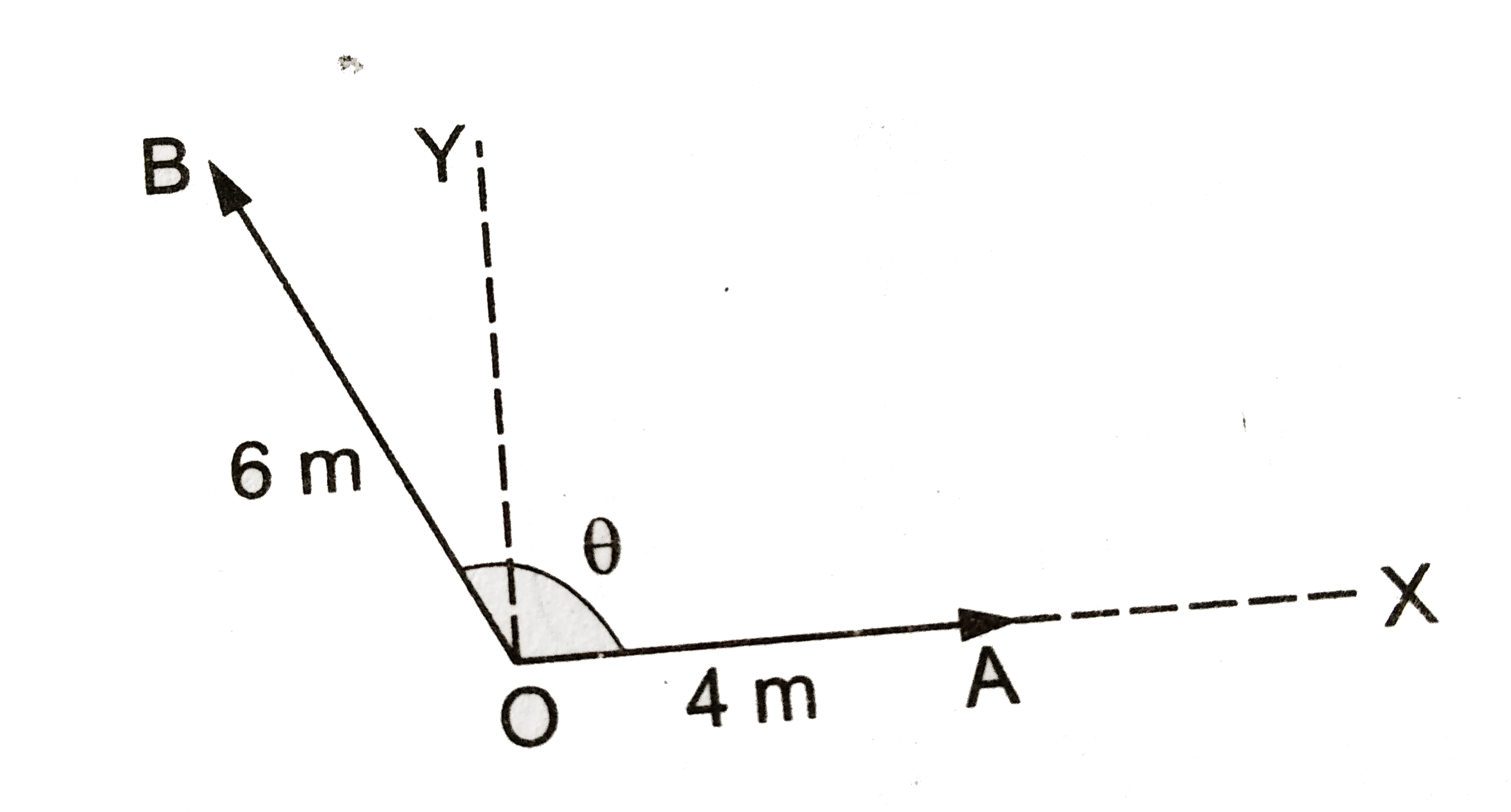
- The resultant of vectors vec(OA) and vec(OB) is peerpendicular to vec(...
Text Solution
|
- Find the components of a vector A = 2hati + 3hatj along the direction...
Text Solution
|
- If two vectors are A = 2hati + hatj - hatk and B = hatj - 4hatk. By ca...
Text Solution
|
- The resultant of two vector A and B is at right angles to A and its ma...
Text Solution
|
- Four forces of magnitude P, 2P, 3P and 4P act along the four sides of ...
Text Solution
|
- If P + Q = R and P - Q = S, prove that R^2 + S^2 = 2(P^2 + Q^2)
Text Solution
|
- In an Delta ABC as showin in Fig. 2 . (2) .71 (a) prove that a/(sin...
Text Solution
|