Home
Class 11
PHYSICS
A particle of mass 1 kg has a velocity o...

A particle of mass 1 kg has a velocity of `2m//s`. A constant force of 2N acts on the particle for 1s in a direction perpendicular to its initial velocity. Find the velocity and displacement of the particle at the end of 1 s.

Text Solution

Verified by Experts

The correct Answer is:
A

Force acting on the particle is constant. Hence, acceleration of the particle will also remain constant.
`a=F/m=2/1=2m//s^2`
Since, acceleration is constant. We can apply
`v=u+at`
and `s=ut+1/2at^2`
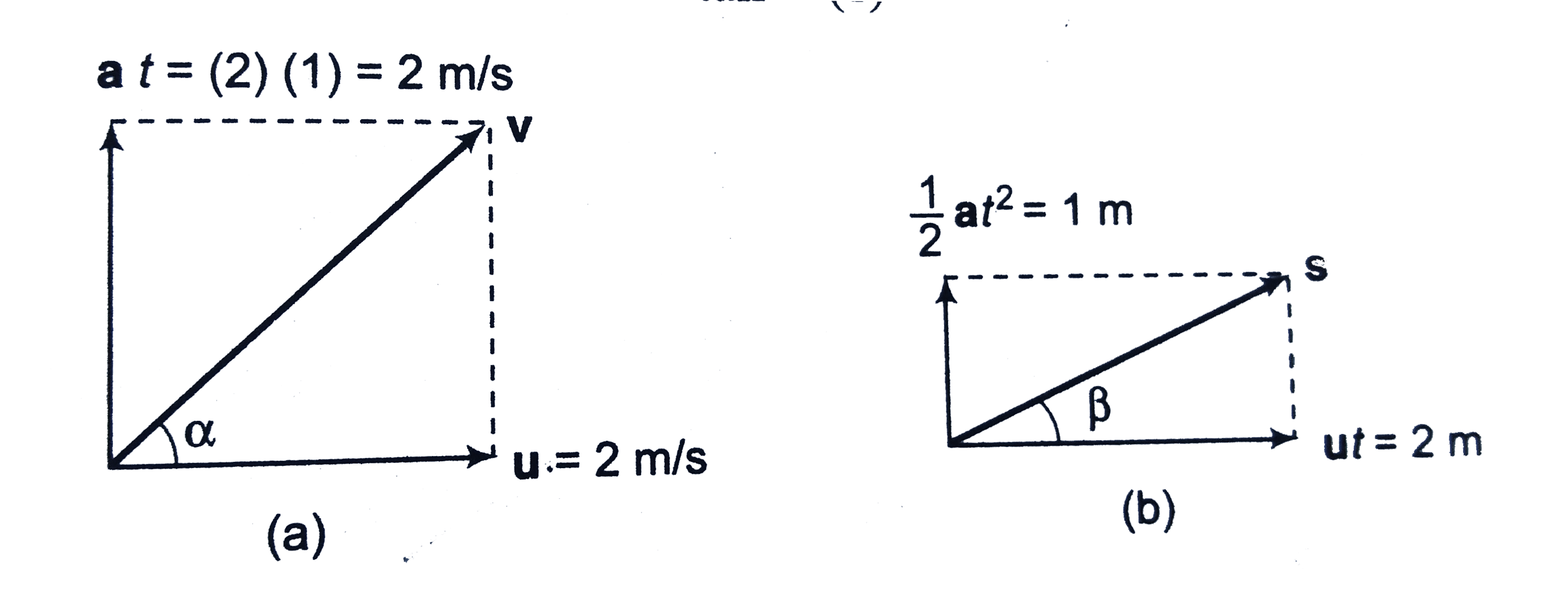
Refer Fig. 6.17 (a) `v=u+at`
Here, u and a t are two mutually perpendicular vectors. So,
`|v|=sqrt((|u|)^2+(|at|)^2)`
`=sqrt((2)^2+(2)^2)`
`2(sqrt2) m//s`
`alpha=tan^-1(|at|/|u|)=tan^-1(2/2) `
`=tan^-1(1)=45^@`

Thus, velocity of the particle at the end of `1s` is `2sqrt2 m//s` at an angle of `45^@` with its initial velocity.
Refer Fig.(b) `s=ut+1/2at^2`
Here, `ut` and `1/2at^2` are also two mutually perpendicular vectors. So,
`|s|=sqrt((|ut|)^2+(|1/2at^2|)^2)`
`=sqrt((2)^2+(1)^2)`
`sqrt5 m`
and `beta=tan^-1(|1/2at^2|/|ut|)`
`= tan^-1(1/2)`
Thus, displacement of the particle at the end of `1s` is `sqrt5 m` at an angle of `tan^-1(1/2)` from its initial velocity.
Promotional Banner

Topper's Solved these Questions

  • KINEMATICS

    DC PANDEY ENGLISH|Exercise Example Type 1|1 Videos
  • KINEMATICS

    DC PANDEY ENGLISH|Exercise Example Type 2|1 Videos
  • GRAVITATION

    DC PANDEY ENGLISH|Exercise (C) Chapter Exercises|45 Videos
  • KINEMATICS 1

    DC PANDEY ENGLISH|Exercise INTEGER_TYPE|15 Videos

Similar Questions

Explore conceptually related problems

Velocity of a particle at time t=0 is 2 hati m/s. A constant acceleration of 2 m/s^2 acts on the particle for 2 s at an angle of 60^@ with its initial velocity. Find the magnitude of velocity and displacement of particle at the end of t=2s.

Velocity of particle at time t=0 is 2ms^(-1) .A constant acceleration of 2ms^(-2) act on the particle for 1 second at an angle of 60^(@) with its initial velocity .Find the magnitude velocity and displacement of the particle at the end of t=1s.

The magnetic force on a charged particle is always perpendicular to its velocity. Can the magnetic force change the velocity of the particle? Speed of the particle?

A particle is projected from ground with velocity 40(sqrt2) m//s at 45^@ . Find (a) velocity and (b) displacement of the particle after 2 s. (g = 10 m//s^2)

If a particle with a = kv^(2) and initial velocity is u then velocity after S displacement. Here k is a constant

A particle is projected vertically upwards with an initial velocity of 40 m//s. Find the displacement and distance covered by the particle in 6 s. Take g= 10 m//s^2.

A particle of mass 2kg is initially at rest. A force starts acting on it in one direction whose magnitude changes with time. The force time graph is shown in figure. Find the velocity of the particle at the end of 10s .

Velocity and acceleration of a particle at time t=0 are u=(2 hati+3 hatj) m//s and a=(4 hati+3 hatj) m//s^2 respectively. Find the velocity and displacement if particle at t=2s.

A constant force(F) is applied on a stationary particle of mass 'm'. The velocity attained by the particle in a certain displacement will be proportional to

Four particles have velocities 1, 0,2, and 3 m//s . The root mean square velocity of the particles (definition wise) is.

