Home
Class 11
PHYSICS
A river 400 m wide is flowing at a rate ...

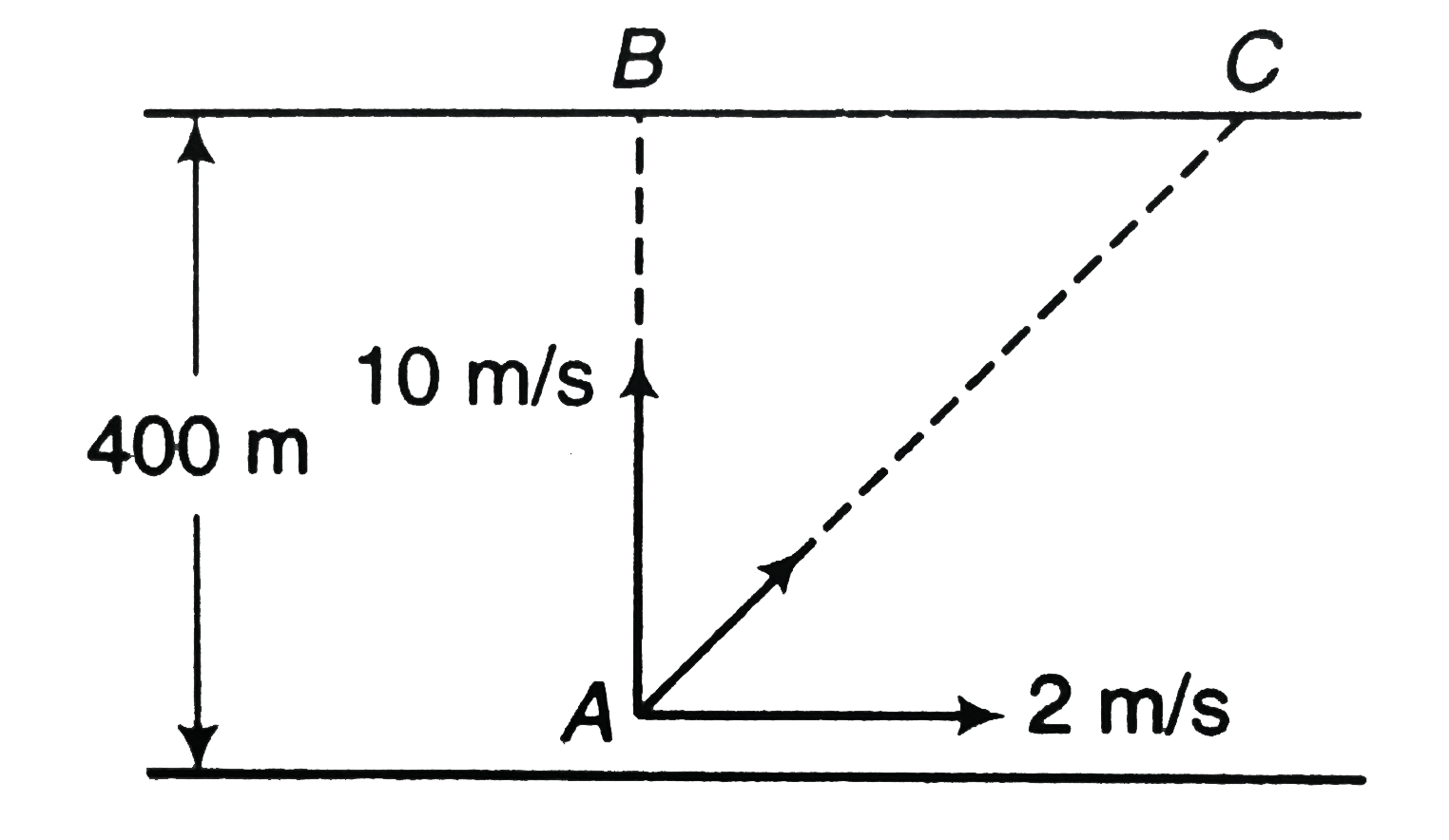
A river `400 m` wide is flowing at a rate of `2.0 m//s.` A boat is sailing at a velocity of `10.0 m//s` with respect to the water In a direction perpendicular to the river.
(a) Find the time taken by the boat to reach the opposite bank.
(b) How far from the point directly opposite to the starting point does the boat reach the opposite bank?

Text Solution

Verified by Experts

The correct Answer is:
A, B, D

(a) `t=400/10=40s`

(b) `BC=(2 m//s)(t)`
`=2xx40=80m`
Promotional Banner

Topper's Solved these Questions

  • KINEMATICS

    DC PANDEY ENGLISH|Exercise Assertion And Reason|12 Videos
  • KINEMATICS

    DC PANDEY ENGLISH|Exercise Objective|45 Videos
  • KINEMATICS

    DC PANDEY ENGLISH|Exercise Exercise 6.8|5 Videos
  • GRAVITATION

    DC PANDEY ENGLISH|Exercise (C) Chapter Exercises|45 Videos
  • KINEMATICS 1

    DC PANDEY ENGLISH|Exercise INTEGER_TYPE|15 Videos

Similar Questions

Explore conceptually related problems

A 400 m wide river is flowing at a rate of 2.0 m s^-1 . A boat is sailing with a velocity of 10 m s^-1 with respect to the water, in a direction perpendicular to the river. (a) Find the time taken by the boat to reach the opposite bank. (b) How far from the point directly opposite to the starting point does the boat reach the opposite bank ? ( c) In what direction does the boat actually move ?

A river 500m wide is flowing at a rate of 4 m//s. A boat is sailing at a velocity of 10 m//s with respect to the water, in a direction perpendicular to the river. The time taken by the boat to reach the opposite bank

A river is 20 m wide. River speed is 3 m//s. A boat starts with velocity 2sqrt2 m//s at angle 45^@ from the river current (relative to river) (a) Find the time taken by the boat to reach the opposite bank. (b) How far from the point directly opposite to the starting point does the boat reach the opposite bank?

A ,man wishing to cross a river flowing with velocity u jumps at an angle theta with the river flow. (a) Find the net velocity of the man with respect to ground if he can swim with speed v in still water. (b) In what direction does the boat actually move ? ( c) Find how far from the point directly opposite to the starting point does the boat reach the opposite bank, if the width of the river is d .

A swimmer wants to cross a 200 m wide river which is flowing at a speed of 2 m/s. the velocity of the swimmer with respect to the river is 1 m/s. how far from the point directly opposite to the starting point does the swimmer reach the opposite bank ?

Velocity of the boat with respect to river is 10m/s. From point A it is steered in the direction shown. Where will it reach on the opposite bank ?

The width of a river is 3 sqrt(3) km. A boat has a velocity of sqrt(3) km/s and starts to cross the river in a direction perpendicular to the bank of the river. If the river is flowing with a velocity 2km/sec, find the distance drifted by the boat.

A boatman moves his boat with a velocity 'v' (relative to water) in river and finds to his surprise that velocity of river 'u' (with respect to ground) is more than 'v'. He has to reach a point directly opposite to the starting point on another bank by travelling minimum possible distance. Then

Width of a river is 30 m, velocity is 2 m//s and rowing velocity is 5 m//s at 37^@ from the direction of river current (a) find the time taken to cross the river, (b) drift of the boatman while reaching the other shore.

The rowing speed of a man relative to water is 5 kmh^(-1) and the speed of water flow is 3 kmh^(-1) . At angle to the river flow should he head if he wants to reach a point on the other bank, directly opposite to starting point ?

