Home
Class 11
PHYSICS
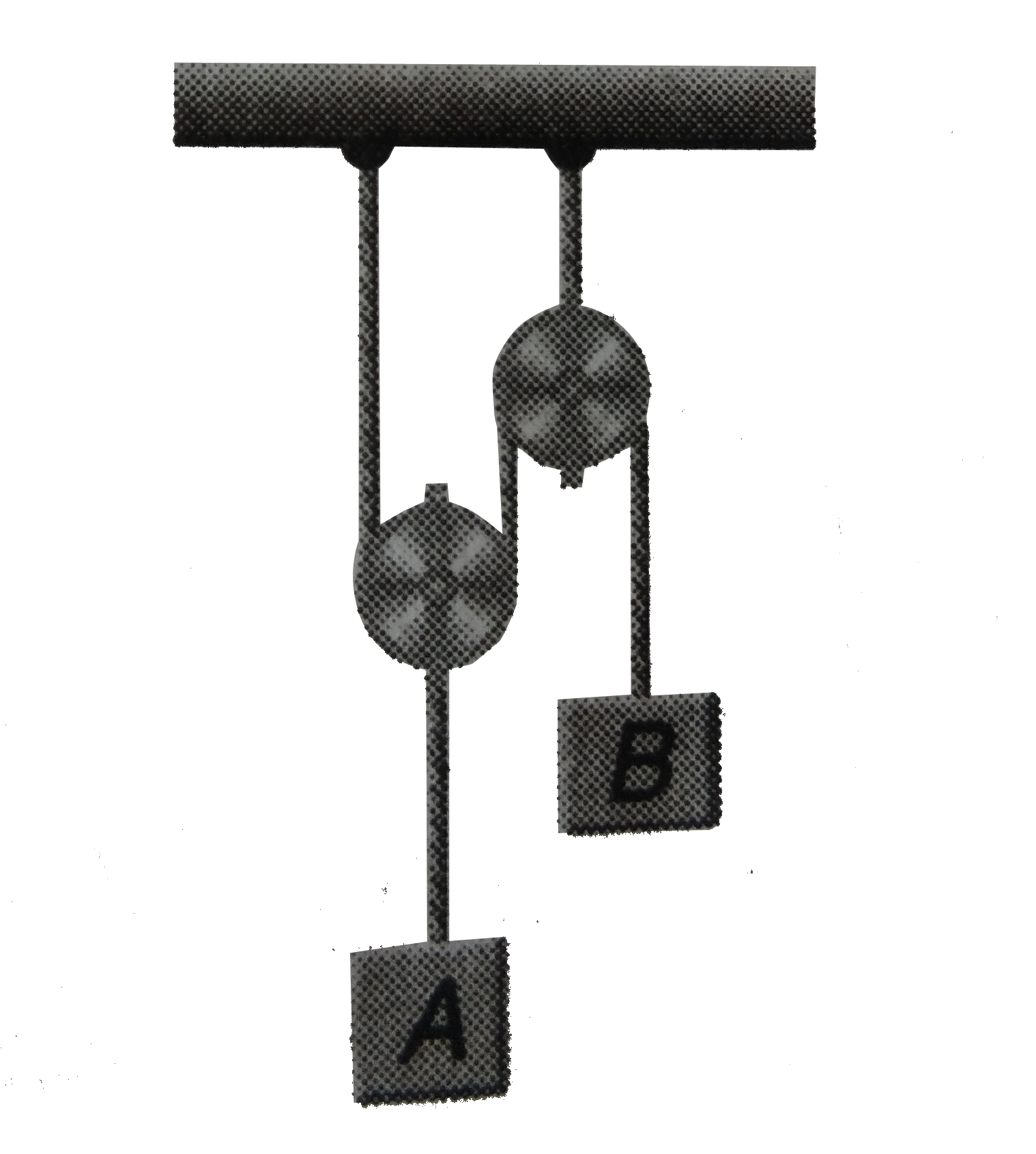
Block A has a weight of 3000 N and block...

Block A has a weight of `3000 N` and block B has a weight of `500 N`. Determine the distance that A must descend from rest before it obtains a speed of `2.5 m//s`. Neglect the mass of the cord and pulleys.
.

Text Solution

Verified by Experts

If A descends X then B will ascend 2x. Further if speed of A at this instant is `2.5 m//s`, then speed of B at this instant will be `5 m//s`. Now,
Deecrease in potential energy of `A =` increase in potential energy of `B +` increase in kinetic energy of both
`:. (300)x =(50)(2x) + 1/2 ((300)/(9.8)) (2.5)^(2)`
`+(1)/(2) ((50)/(9.8))(5.0)^(2)`
Solving we get,
`x=0.796 m`.
Promotional Banner

Similar Questions

Explore conceptually related problems

Block A has a weight of 300 N and block B has a weight of 50 N . Coefficient of friction for A is mu_(k) = 0.2 . Determine the speed of block A after moves 1 m down the plane, starting from rest. Negelect the mass of the cord and pulleys.

If the system is released from rest, determine the speeds of both masses after B has moved 1 m. Neglect friction, the masses of pulleys and inextensible string.

Block A has a mass of 5kg and is placed on top of a smooth triangular block, B having a mass of 30kg . If the system is released from rest, determine the distance, B moves when A reaches the bottom. Neglect the size of block A.

The system is released from rest with the spring initially stretched 75 mm . Calculate the velocity v of the block after it has dropped 12 mm . The spring has a stiffness of 1050 N//m . Neglect the mass of the small pulley.

In figure, the stiffness of the spring is k and mass of the block is m . The pulley is fixed. Initially, the block m is held such that the elongation in the spring is zero and then released from rest. Find: a. the maximum elongation in the spring. b. the maximum speed of the block m . Neglect the mass of the spring and that of the string. Also neglect the friction.

What is the weight of a block of mass 10.5 kg ? Take g= 10 m s^(-2)

Block A weight 20 kg placed on a smooth surface. Weight B of 2 kg is mounted on the block . The coefficient of friction between the block and the weight is 0.25 Calculate the acceleration of the block and the weightand also the frictional force between the block and the weight when a horizontal force 2 N applied to the weight as shown in fig What will these quantities be if the horizontal force is 20 N? (g = 10ms^(-2))

The drawing shows a frictionless incline and pulley. The two blocks are connected by a wire (mass per unit length, mu = 25 g//m ) and remain stationary. A transcerse wave on the wire has a speed of 60 m//s relative to it. Neglect the weight of the wire relative to the tension in the wire. If the mass m_(2) be increased by 1% , the speed of the transverse wave will be

A block B is pulled by a force of 18 N applied to a light pulley as shown in the figure. If the coefficient of friction is 0.4 and the acceleration of the block is 0.5 ms^(-2) , the mass of the block is (g = 10 m//s^2)

A block of wood of density 500 kg//m^(3) has mass m kg in air. A lead block which has apparent weight of 28 kg in water is attached to the block of wood, and both of them are submerged in water. If their combined apparent weight in water is 20 kg , find the value of m . Take density of water =1000kg//m^(3)

