Home
Class 11
PHYSICS
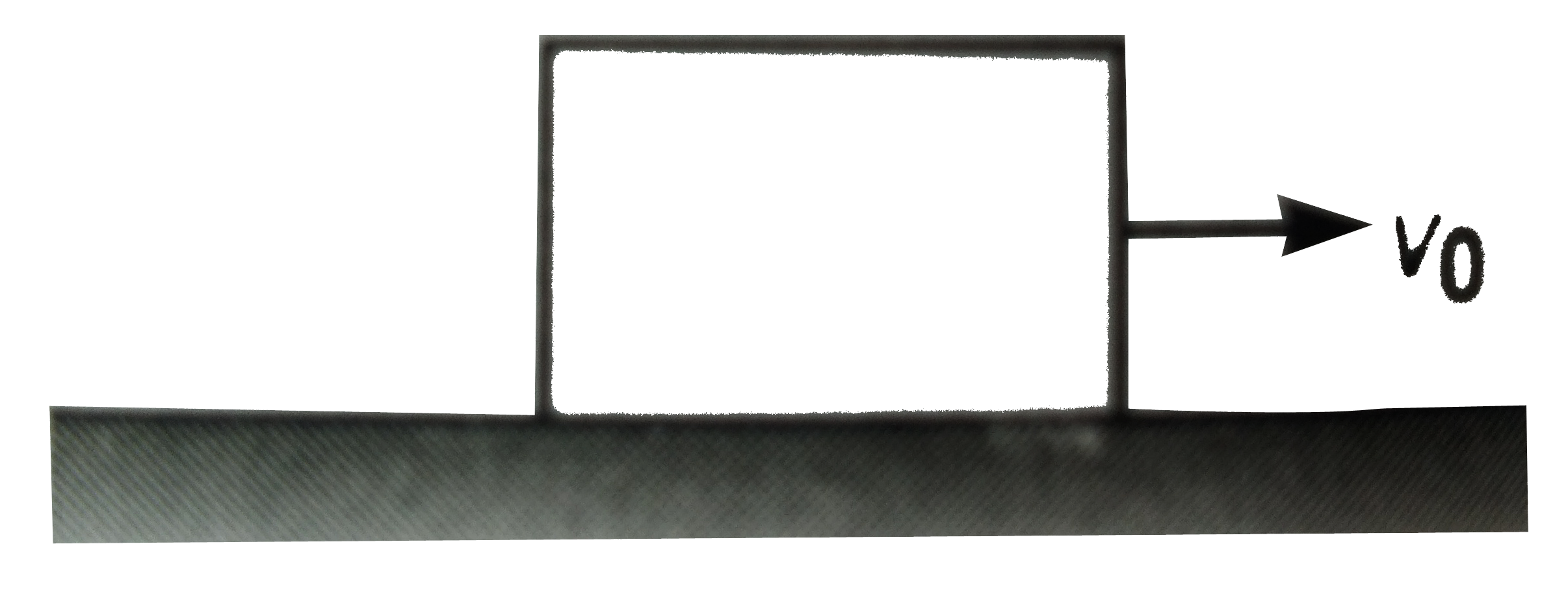
Assertion: A cubical block is moving on ...

Assertion: A cubical block is moving on a rough ground with velocity `v_()`. During motion net normal reaction on the block from ground will not pass through centre of cube. it will shift towards right.
Reason: It is to keep the block is rotational equilibrium

A

If both Assertion and Reason are true and the Reason is correct explanation of the Assertion.

B

If both Assertion and Reason are true but Reason is not the correct explanation of Assertion.

C

If assertion is true, but the reaction is false.

D

If assertion is false but the reason is true.

Text Solution

Verified by Experts


`f=` friction force
Promotional Banner

Topper's Solved these Questions

  • ROTATIONAL MECHANICS

    DC PANDEY ENGLISH|Exercise Level 1 Objective|30 Videos
  • ROTATIONAL MECHANICS

    DC PANDEY ENGLISH|Exercise Level 1 Subjective|32 Videos
  • ROTATIONAL MECHANICS

    DC PANDEY ENGLISH|Exercise Exercise 12.11|2 Videos
  • ROTATION

    DC PANDEY ENGLISH|Exercise (C) Chapter Exercises|39 Videos
  • ROTATIONAL MOTION

    DC PANDEY ENGLISH|Exercise Integer Type Questions|17 Videos

Similar Questions

Explore conceptually related problems

Asseration : A block of mass m starts moving on a rough horizontal surface with a velocity v. It stops due to friction between the block and the surface after moving through a ceratin distance. The surface is now tilted to an angle of 30^@ with the horizontal and same block is made to go up on the surface with the same initial velocity v. The decrease in the mechanical energy in the second situation is small than the first situation. Reason : The coefficient of friction between the block and the surface decreases with the increase in the angle of inclination.

These questions consists of two statements each printed as Assertion and Reason. While answering these question you are required to choose any one of the following five reponses (a) If both Assertion and Reason arecorrect and Reason is the correct explanation of Asserrtion. (b) If both Assertion and Reason are correct but Reason is not the correct explanation of Assertion. (c ) If Assertion is true but Reason is false. (d) If Assertion is false but Reason is true. Assertion A block of mass m starts moving on a rough horizontal surface with a velocity v. It stops due to friction between the block and the surface after moving through a certain distance. The surface is now tilted to an angle of 30^(@) with the horizontal and the same block is made to go up on the surface with the same initial velocity v. The decrease in the mechanical energy in the second situation is smaller than that in the first situation. Reason The coefficient of friction between the block and the surface decreases with the increase in the anglle of inclination.

Assertion: In the figure shown, linear momentum of system (of blocks A and B) moves towards right during motion of block A over the block B. Reason: Initial acceleration of center of mass is towards right.

A block of mass m moves on a horizontal rough surface with initial velocity v . The height of the centre of mass of the block is h from the surface. Consider a point A on the surface.

Assertion: Two blocks of masses m_(A) and m_(B) (gtm_(A) are thrown towards each other with same speed over a rough ground. The coefficient of friction of both the blocks with ground is same. Initial velocity of CM is towards left. Reason: Initial acceleration of center of mass is towards right.

Assertion A small block of mass m is rotating in a circle inside a smooth cone as shown in figure. In this case the normal reaction, N ne "mg cos"theta Reason In this case, acceleraion of the block is not along the surface of cone. It is horizontal.

Assertion: A ball is released on a rough ground in the condition shown in figure. it will start pure rolling after some time towards left side. Reason: Friction will convert the pure rotational motion of the ball into pure rolling

A block of mass 10 kg is moving on a rough horizontal surface as shown in figure. At t=0 , velocity of block is 10 m/s towards left and a constant force F= 10 N acts horizontally towards right. Acceleration of the block at t=3s is ( g= 10 m s^(-2) )

A rod AB is shown in figure. End A of the rod is fixed on the ground. Block is moving with velocity 2 ms^-1 towards right. The velocity of end B of rod at the instant shown in figure is

Figure shown a block P of mass m resting on a smooth horizontal ground, attached to one and a spring of force constant k in netural length. If another block od same mass and moving with a velocity u towards right is placed on the block on which stick to it due to friction ,find the time it will take to reach its exterme position. Also find the amplitude of oscillation of the combined mass 2m .

