Home
Class 11
PHYSICS
With the assumption of no slipping, dete...

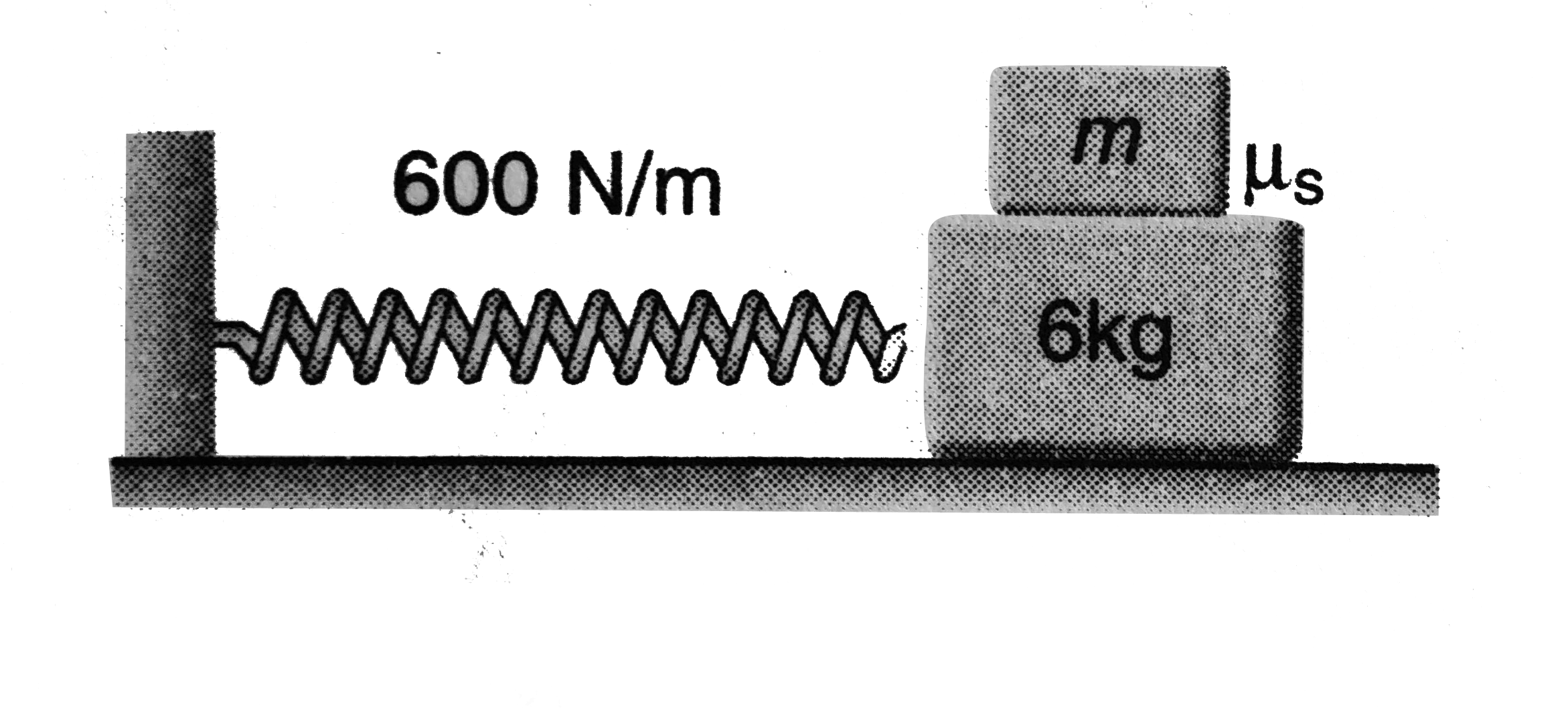
With the assumption of no slipping, determine the mass m of the block which must be placed on the top of a `6 kg` cart in order that the system period is `0.75s`. What is the minimum coefficient of static friction `mu_(s)` for which the block will not slip relative to the cart is displaced `50 mm` from the equilibrium position and released? Take `(g = 9.8 m//s^(2))`.

Text Solution

Verified by Experts

The correct Answer is:

A, B, C

(a) `T = 2pisqrt((m+6)/(600))" "(T = 2pi sqrt((m)/(K)))`
or `0.75 = 2pisqrt((m+6)/(600))`
`:. m = ((0.75)^(2)xx600)/((2pi)^(2))-6`
`= 2.55kg `
(b) Maximum acceleration of SHM is,
`a_(max) = omega^(2)A` (A = amplitude)
i.e. maximum force on mass 'm' is `m omega^(2)A` which is bieng provided by the force of friction between the mass and the cart. Therefore,
`mu_(s)mg ge momega^(2)A or mu_(s) ge (omega^(2)A)/(g)` or ` mu_(s) ge ((2pi)/(T))^(2). A/g`
or `mu_(s) ge((2pi)/(0.75))^(2) ((0.05)/(9.8))`
`(A = 50 mm)`
or `mu_(s)ge0.358`
Thus, the minimum value of mu_(s) should be `0.358`.
Promotional Banner

Topper's Solved these Questions

  • SIMPLE HARMONIC MOTION

    DC PANDEY ENGLISH|Exercise Example Type 6|4 Videos
  • SIMPLE HARMONIC MOTION

    DC PANDEY ENGLISH|Exercise Example Type 7|1 Videos
  • SIMPLE HARMONIC MOTION

    DC PANDEY ENGLISH|Exercise Example Type 4|1 Videos
  • SEMICONDUCTORS AND ELECTRONIC DEVICES

    DC PANDEY ENGLISH|Exercise More than One Option is Correct|3 Videos
  • SOLVD PAPERS 2017 NEET, AIIMS & JIPMER

    DC PANDEY ENGLISH|Exercise Solved paper 2018(JIPMER)|38 Videos

Similar Questions

Explore conceptually related problems

The three blocks in figure are released from rest and accelerate at the rate of 2 m/s^(2) . If M = 5 kg , what is the coefficient of friction between the surface and the block B ?

A block of mass 2 kg is placed on the floor. The coefficient of static friction is 0.4. A force F of 2.5 N is applied on the block as shown in Fig. 15.4.4. The force of friction between the block and the floor is (g = 9.8 m//s^(2))

A marble block of mass 2 kg lying on ice when given a velocity of 6m//s is stopped by friction in 10s. Then the coefficient of friction is

A marble block of mass 2 kg lying on ice when given a velocity of 6m//s is stopped by friction in 10s. Then the coefficient of friction is

A block of mass 1 kg is placed on a truck which accelerates with acceleration 5ms^(-2) . The coefficient of static friction between the block and truck is 0.6. The frictional force acting on the block is

A block of mass m is placed on the top of a 6kg cart such that the time period of the system is 0.75 s assuming there is no slipping. If the cart is displaced by 50 mm from its equilibrium position and released, then the coefficient of static friction mu_(s) between block and cart is just sufficient to prevent the block from sliding. The value of m and mu_(s) respectively are (Take g = 9.8 m//s^(2))

A block of mass 2 kg is at rest on a floor . The coefficient of static friction between block and the floor is 0.54. A horizonatl force of 2.8 N is applied to the block . What should be the frictional force between the block and the floor ? ( take , g = 10 m//s^(2) )

In the masses of A and B are 10 kg and 5 kg . Calculate the minimum mass of C which may stop A from slipping Coefficient of static friction between block A and table is 0.2 .

A block of mass 2 kg is placed on the floor . The coefficient of static friction is 0.4 . If a force of 2.8 N is applied on the block parallel to floor , the force of friction between the block and floor is : (Taking g = 10 m//s^(2) )

A block of mass 2 kg is placed on the floor. The coefficient of static friction it 0.4 . A force F of 2.5 N is applied on the block, as shown. calculate the force of friction between the block and the floor. (g=9.8m//s^(2)) .
