Home
Class 11
PHYSICS
Two pulses travelling in opposite direct...

Two pulses travelling in opposite directions along a string are shown for `t=0` in the figure. Plot the shape of the string at `t= 1.0, 2.0, 3.0, 4.0 and 5.0s respectively .

Text Solution

Verified by Experts
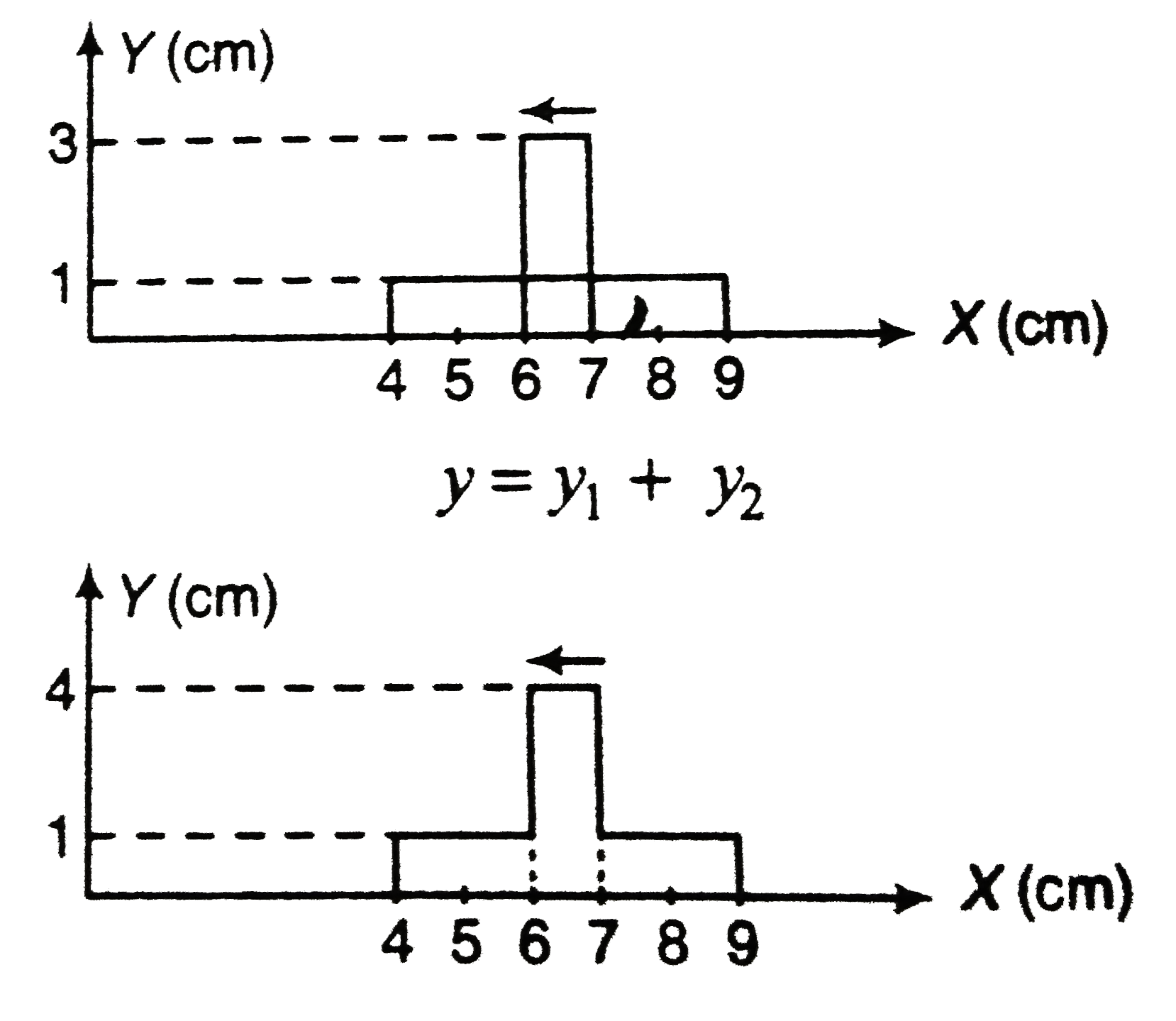
Let us plot at `t = 3s`

Similarly, we can draw at other times.
Promotional Banner

Topper's Solved these Questions

  • SUPERPOSITION OF WAVES

    DC PANDEY ENGLISH|Exercise Level 2 Single Correct|15 Videos
  • SUPERPOSITION OF WAVES

    DC PANDEY ENGLISH|Exercise Level 2 More Than One Correct|6 Videos
  • SUPERPOSITION OF WAVES

    DC PANDEY ENGLISH|Exercise Level 1 Subjective|24 Videos
  • SOUND WAVES

    DC PANDEY ENGLISH|Exercise Exercise 19.7|4 Videos
  • THERMOMETRY THERMAL EXPANSION AND KINETIC THEORY OF GASES

    DC PANDEY ENGLISH|Exercise Medical entrance gallary|30 Videos

Similar Questions

Explore conceptually related problems

Two wave pulses travel in opposite directions on a string and approch each other. The shape of the one pulse is same with respect to the other

Two pulses travel in mutually opposite directions in a string with a speed of 2.5 cm//s as shown in the figure. Initially the pulses are 10 cm apart. What will be the state of the string after two seconds?

Two sinusoidal waves with same wavelengths and amplitudes travel in opposite directions along a string with a speed 10ms^-1 . If the minimum time interval between two instant when the string is flat is 0.5s , the wavelength of the waves is

Consider a standing wave formed on a string . It results due to the superposition of two waves travelling in opposite directions . The waves are travelling along the length of the string in the x - direction and displacements of elements on the string are along the y - direction . Individual equations of the two waves can be expressed as Y_(1) = 6 (cm) sin [ 5 (rad//cm) x - 4 ( rad//s)t] Y_(2) = 6(cm) sin [ 5 (rad//cm)x + 4 (rad//s)t] Here x and y are in cm . Answer the following questions. If one end of the string is at x = 0 , positions of the nodes can be described as

Consider a standing wave formed on a string . It results due to the superposition of two waves travelling in opposite directions . The waves are travelling along the length of the string in the x - direction and displacements of elements on the string are along the y - direction . Individual equations of the two waves can be expressed as Y_(1) = 6 (cm) sin [ 5 (rad//cm) x - 4 ( rad//s)t] Y_(2) = 6(cm) sin [ 5 (rad//cm)x + 4 (rad//s)t] Here x and y are in cm . Answer the following questions. Figure 7.104( c) shows the standing wave pattern at t = 0 due to superposition of waves given by y_(1) and y_(2) in Figs.7.104(a) and (b) . In Fig. 7.104 (c ) , N is a node and A and antinode . At this instant say t = 0 , instantaneous velocity of points on the string named as A

Figure shows a wave pulse at t=0. The pulse moves to the right with a speed of 10cms^-1. Sketch the shape of the string at t=1s, 2s and 3s.

Position-time graph for a particle moving along x- direction is as shown in the figure. Average speed of the particle from t = 0 to t = 4 is :

The switch S is closed in the circuit shown at time t=0 . The current in the resistor at t=0 and t =oo are respectively .

A 100 Hz sinusoidal wave is travelling in the posotive x-direction along a string with a linear mass density of 3.5 xx10^(-3) kg//m and a tension of 35 N . At time t= 0 , the point x=0 , has maximum displacement in the positive y-direction. Next when this point has zero displacement, the slope of the string is pi//20 . Which of the following expression represent (s) the displacement of string as a function of x (in metre) and t (in second)

Two triangular wave pulses are travelling toward each other on a stretched string as shown in Fig . 7.25. Both pulses are identical to each other and travels at 2.00 cm//s . The leading edges of the pulses are 1.00 cm apart at t = 0 . Sketch the shape of the string at t = 0.250 s, t = 0.500 s , t = 0.750 s, t = 1.000 s and t = 1.250 s .

