Home
Class 12
PHYSICS
Three charges q1=1muC, q2=2muC and q3=3m...

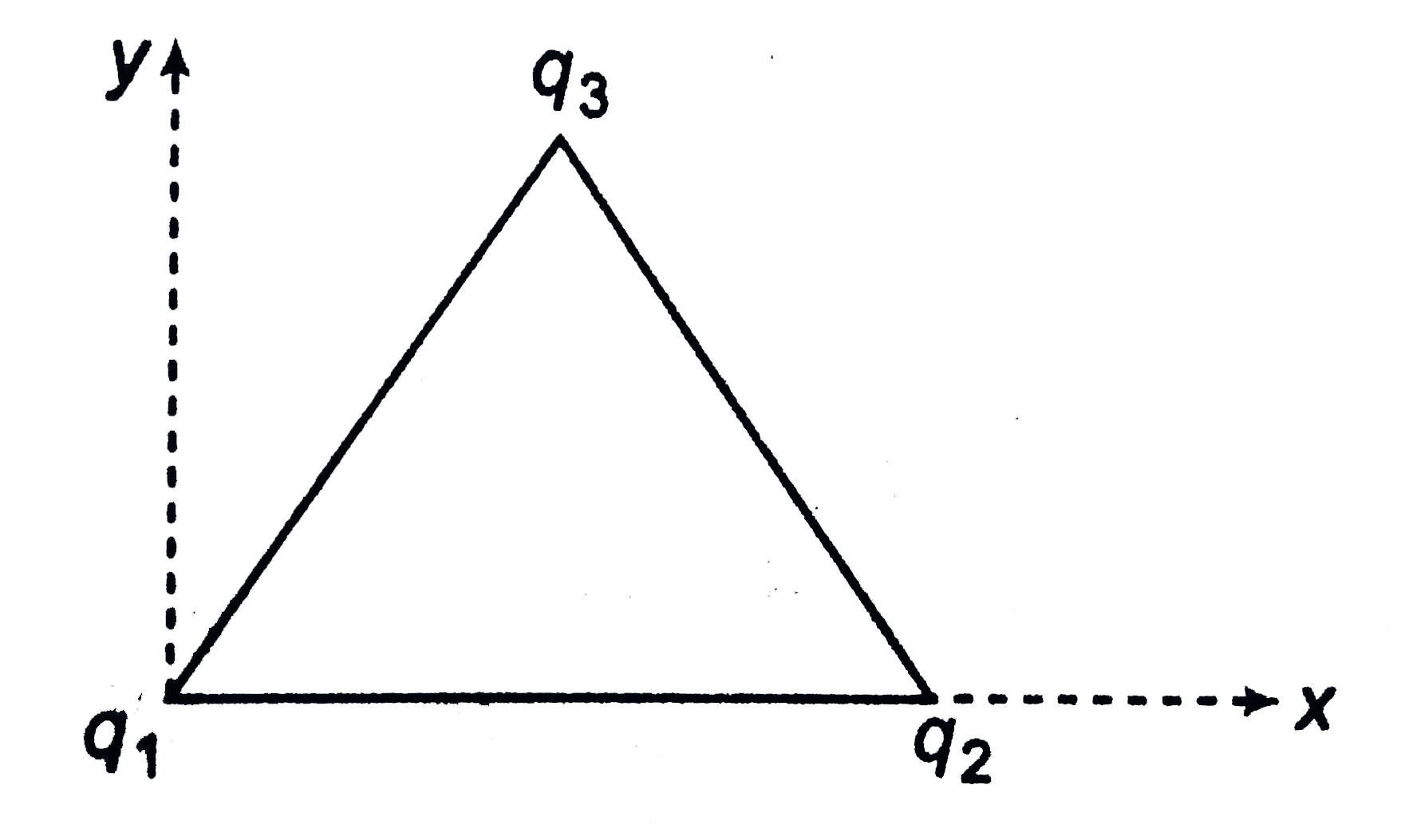
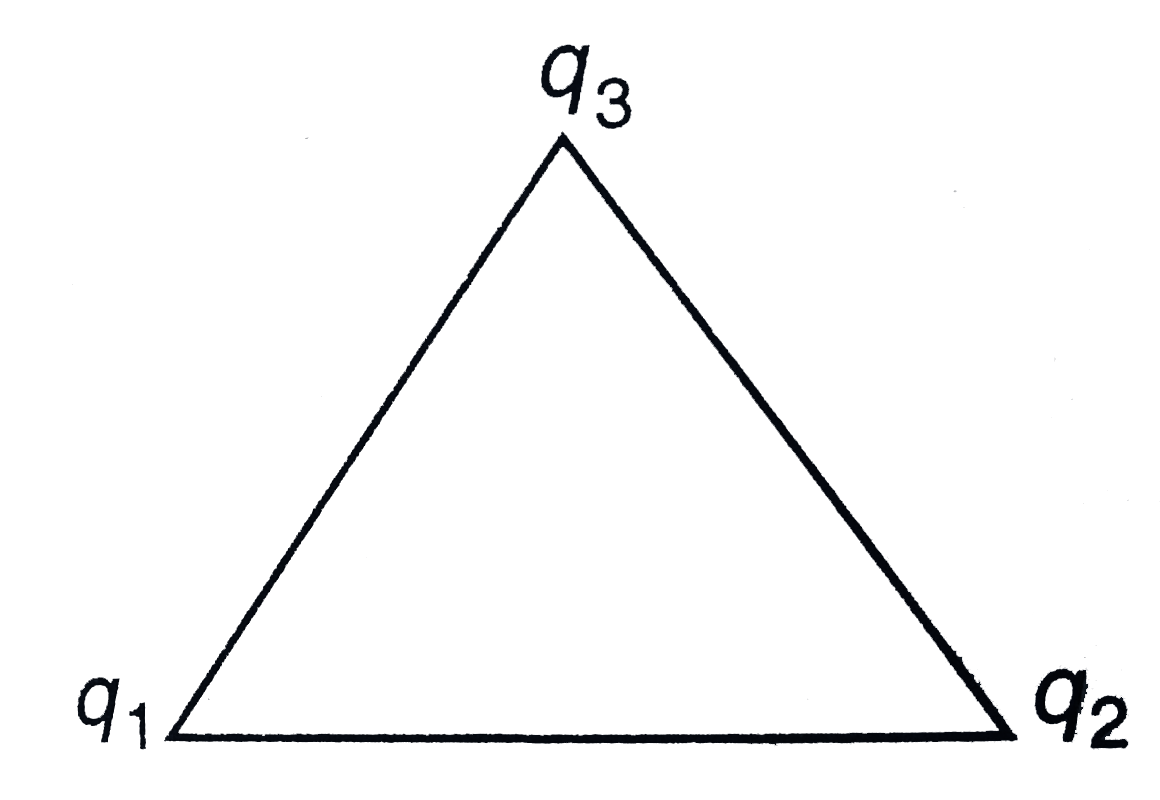
Three charges `q_1=1muC, q_2=2muC` and `q_3=3muC` are placed on the vertices of an equilateral triangle of side 1.0 m. Find the net electric force acting on charge `q_1`

Text Solution

Verified by Experts

The correct Answer is:
A, B, C, D

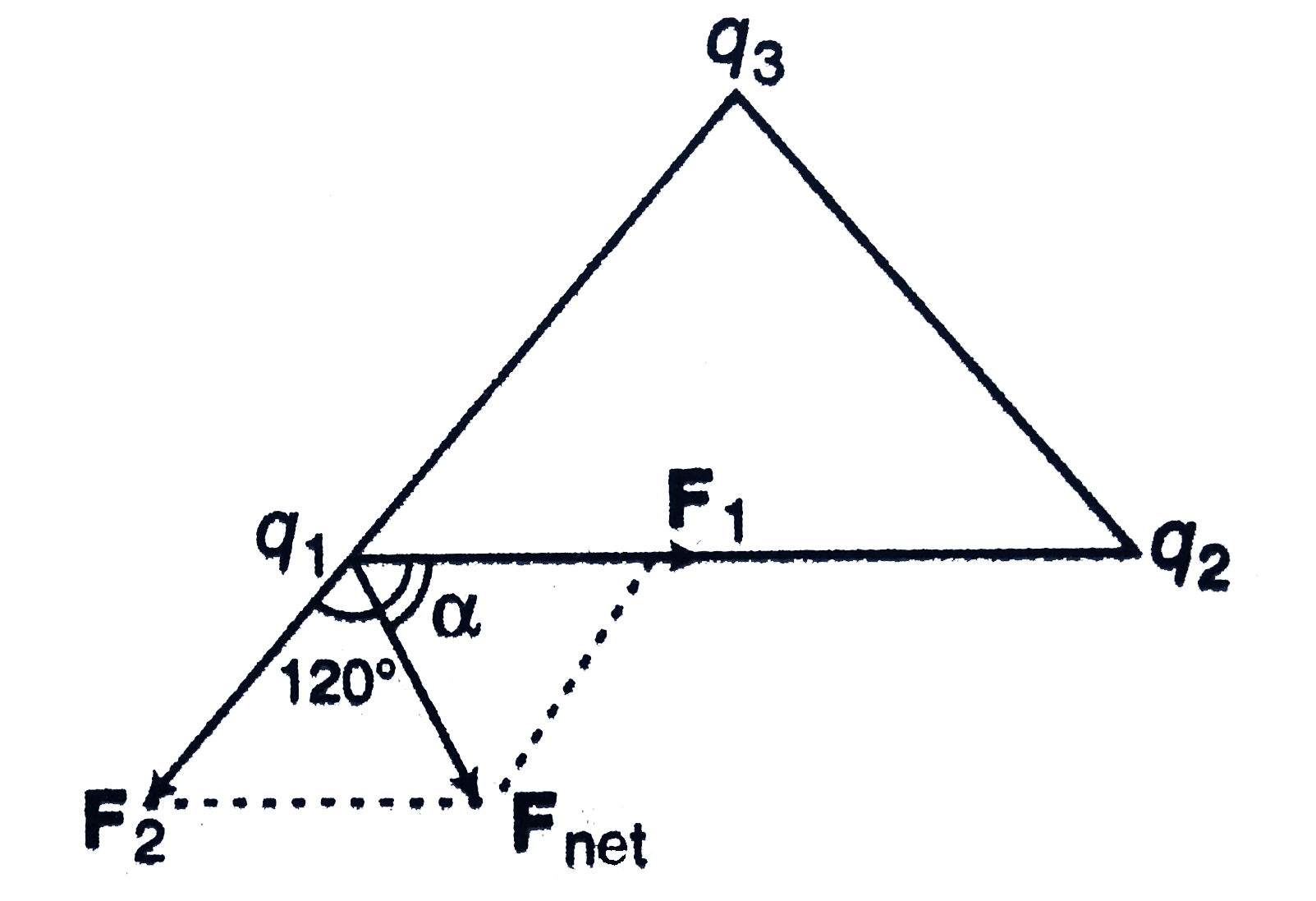
Method I. In the figure
`
`|F_(1)|=F_(1)=1/(4piepsilon_0).(q_1q_2)/r^2`
=magnitude of force between `q_1 and q_2`
`((9.0xx10^9)(1.0xx10^-6)(2.0xx10^-6))/((1.0)^2)`
`=1.8xx10^-2N`
`Similarly `|F_(2)|=F_(2)=1/(4piepsilon_0). (q_1q_3)/r^2`
`=magnitude of force between `q_1` and `q_3`
`=((9.0xx10^9)(1.0xx10^-6)(3.0xx10^-6))/((1.0)^2)`
`=2.7xx10^-2N`
Now, `|F_"net")|=sqrt(F_1^2+F_2^2+2F_1F_2cos120^@)`
`=(sqrt((1.8)^2+(2.7)^2=2(1.8)(2.7)(-1/2)))xx10^-2N`
`=2.38xx10^-2N`
and `tan alpha=(F_2sin120^@)/(F_1+F_2cos120^@)`
`=((2.7xx10^-2)(0.87))/((1.8xx10^-2)+(2.7xx10^-2)(-1/2))`
or `alpha=79.2^@`
Thus, the net force on charge `q_1` is `2.38xx10^-2` N at an angle `alpha=79.2^@` with a line joining `q_1` and `q_2` as shown in the figure.
Method 2. In this figure method let us assume a coordinate axes with `q_1` at origin as shown in figure. The coordinate of `q_1,q_2` and `q_3` in this coordinate system are `(0,0,0), (1m,0,0)` and `(0.5m, 0.87m,0)` respectively. Now
`
`F_1`=force of `q_1` due to charge `q_2`
`=1/(4piepsilon_0) .(q_1q_2)/(|r_1-r_2|\^3)(r_1-r_2)`
`=((9.0xx10^9)(1.0xx10^-6)(-2.0xx10^-6))/((1.0)^3)[(0.1)hati+(0-0)hatj+(0-0)hatk]`
`=(1.8xx10^-2hati)N`
and `F_2`=Force on `q_1` due to charge `q_3`
`=1/(4piepsilon_0).(q_1q_3)/(|r_1-r_3|^3)(r_1-r_3)`
`=((9.0xx10^9)(1.0xx10^-6)(3.0xx10^-6))/(1.0)^3[(0-0.5)hati+(0-0-0.87)hatj+(0-0)hatk]`
`=(-1.35hati-2.349hatj)xx10^-2N`
Therefore net force on `q_1` is `F=F_1+F_2`
`=(0.45hati-2.349hatj)xx10^-2N`
Promotional Banner

Topper's Solved these Questions

  • ELECTROSTATICS

    DC PANDEY ENGLISH|Exercise Example Type 5|5 Videos
  • ELECTROSTATICS

    DC PANDEY ENGLISH|Exercise Example Type 6|4 Videos
  • ELECTROSTATIC POTENTIAL AND CAPACITORS

    DC PANDEY ENGLISH|Exercise (C) Chapter exercises|50 Videos
  • GRAVITATION

    DC PANDEY ENGLISH|Exercise All Questions|135 Videos

Similar Questions

Explore conceptually related problems

Three charges q_(1) = 1 mu C, q_(2) = -2 muC and q_(3) = 3mu C are placed on the vertices of an equilateral triangle of side 1.0 m. find the net electric force acting on charge q_(1) . How to proceed Charge q_(2) will attract charge q_(1) (along the line joining them) and charge q_(3) will repel charge q_(1) . Therefore, two forces will act on q_(1) , one due to q_(2) and another due to q_(3) . Since , the force is a vector quantity both of these force (say F_(1) and F_(2) ) will be added by vector method. Following are two methods of their addition

For charges q_1=1muC, q_2=2muC, q_3=-3muC and q_4=4muC are kept on the vertices of a square of side 1m . Find the electric potential energy of this system of charges.

Three point charges q are placed at three vertices of an equilateral triangle of side a. Find magnitude of electric force on any charge due to the other two.

Three charges 2q, -q, and -q are located at the vertices of an equilateral triangle. At the center of the triangle,

Four charges q_(1) = 1 muC,q_(2)=2 muC,q_(3)=-3 muC and q_(4)=4 muC are kept on the vertices of a square of side 1 m . Find the electric potential energy of this system of charges.

Consider the charges q,q and -q placed at the vertices of an equilateral triangle of each side l. What is the force on each charge ?

Three charges Q, (+q) and (+q) are placed at the vertices of an equilateral triangle of side l as shown in the figure. It the net electrostatic energy of the system is zero, then Q is equal to

Three charges Q, (+q) and (+q) are placed at the vertices of an equilateral triangle of side l as shown in the figure. It the net electrostatic energy of the system is zero, then Q is equal to

Three charges +q, -q and +q are kept at the corners of an equilateral triangle of side d. Find the resultant electric force on a charge +q placed at the centroid O of the triangle.

The point charges -2q, -2q and +q are put on the vertices of an equilateral triangle of side a . Find the work done by some external force in increasing the separation to 2a (in joules).

DC PANDEY ENGLISH-ELECTROSTATICS-Medical entrances gallery
  1. Three charges q1=1muC, q2=2muC and q3=3muC are placed on the vertices ...

    Text Solution

    |

  2. An electric dipole is placed at an angle of 30^(@) with an electric fi...

    Text Solution

    |

  3. The electric field in a certain region is acting radially outward and ...

    Text Solution

    |

  4. A Gaussian surface in the cylinder of cross-section pia^(2) and length...

    Text Solution

    |

  5. A total charge of 5 muC is distributed uniformly on the surface of the...

    Text Solution

    |

  6. Two small spherical shells a and B are given positive charges of 9 C a...

    Text Solution

    |

  7. A point charge q is situated at a distance r from one end of a thin co...

    Text Solution

    |

  8. When 10^(19) electrons are removed from a neutral metal plate through ...

    Text Solution

    |

  9. A charge Q is uniformly distributed over a large plastic plate. The el...

    Text Solution

    |

  10. A uniform electric field E is created between two parallel ., charge...

    Text Solution

    |

  11. The line A A' is on charged infinite conducting plane which is perpend...

    Text Solution

    |

  12. The electric field at a point on equatorial of a dipole and direction ...

    Text Solution

    |

  13. Pick out the statement which is incorrect?

    Text Solution

    |

  14. An electron of mass m(e ) initially at rest moves through a certain di...

    Text Solution

    |

  15. Two charges 10 muC and - 10 muC are placed at points A. and B separate...

    Text Solution

    |

  16. A uniform electric field exists in space. Find the flux of this field...

    Text Solution

    |

  17. An inclined plane of length 5.60 m making an angle of 45^(@) with the ...

    Text Solution

    |

  18. Two charge spheres separated at a distance d exert a force F on each o...

    Text Solution

    |

  19. If a charge on the body is 1 nC, then how many electrons are present o...

    Text Solution

    |

  20. Electric field at a point of distance r from a uniformly charged wire ...

    Text Solution

    |

  21. Two equal and opposite charges of masses m(1) and m(2) are accelerated...

    Text Solution

    |