Home
Class 12
PHYSICS
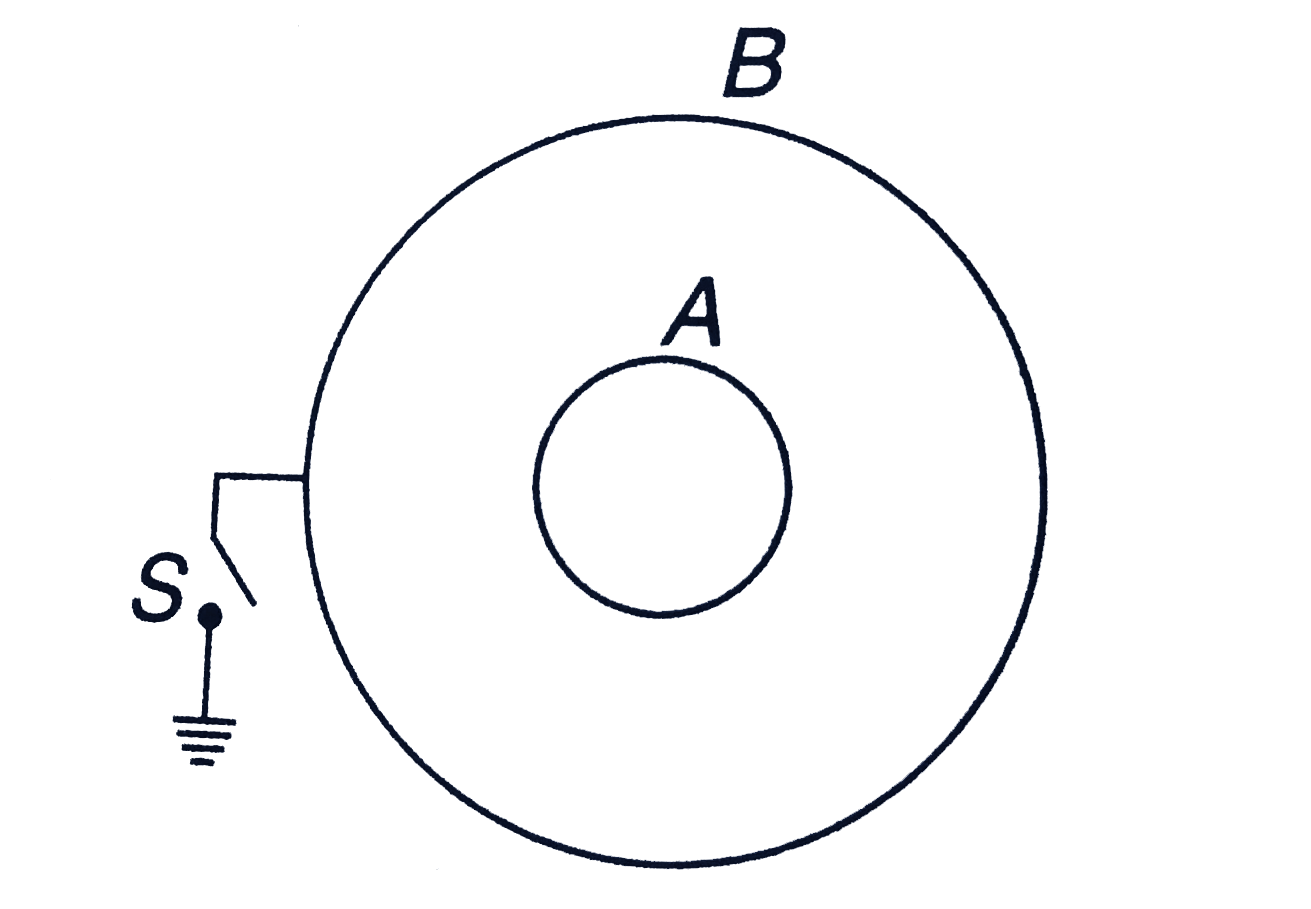
Initially the spheres A and B are at pot...

Initially the spheres A and B are at potentials `V_A` and `V_B`. Find the potential of A when sphere B is earthed.

Text Solution

Verified by Experts

The correct Answer is:

A, B

As we have studied above that the potential difference between these two spheres depends n the charge on the inner sphere only. Hence, the PD will remain unchanged because by earthing the sphere B charge on A remains constant. Let `V'A` be the new potential at A. Then
`V_A-V_B=V_A^'=V_B^'`
but `V_B^'=0` as it is earthed. Hence,
`V_A^'=V_A-V_B`
Promotional Banner

Topper's Solved these Questions

  • ELECTROSTATICS

    DC PANDEY ENGLISH|Exercise Example Type 8|3 Videos
  • ELECTROSTATICS

    DC PANDEY ENGLISH|Exercise Level 2 Single Correct|94 Videos
  • ELECTROSTATICS

    DC PANDEY ENGLISH|Exercise Example Type 5|5 Videos
  • ELECTROSTATIC POTENTIAL AND CAPACITORS

    DC PANDEY ENGLISH|Exercise (C) Chapter exercises|50 Videos
  • GRAVITATION

    DC PANDEY ENGLISH|Exercise All Questions|135 Videos

Similar Questions

Explore conceptually related problems

If the potential at A is 2000V the potential at B is

In the given circuit. If the potential at A is 95 V, then the potential of B is

A hollow metallic sphere of radius 0.1 m is charged to a potential of 5 V. The potential at its centre is

A metal sphere A of radius a is charged to potential V. What will be its potential if it is enclosed ny a spherical conducting shell B of radius b and the two are connected by a wire ?

Metallic sphere of radius R is charged to potential V. Then charge q is proportional to

A conducting sphere is enclosed by a hollow conducting shell. Initially the inner sphere has a charge Q while the outer one is uncharged. The potential difference between the two spherical surface is found to be V. later on the outer shell is given a charge -4Q. The new potential difference between the two surfaces is : (A) V (B) -V (C) -2V (D) 2V

Acidified water from certain reservoir kept at a potential V falls in the form of small droplets each of radius r through a hole into a hollow conducting sphere of radius a. The sphere is insulated and is initially at zero potential. If the drops continue to fall untill the sphere is half full, the potential acquired by the sphere is

A hollow metal sphere of radius 5 cm is charged so that the potential on its surface is 10 V . The potential at the centre of the sphere is

Two conducting concentric, hollow spheres A and B have radii a and b respectively, with A inside B. Their common potentials is V. A is now given some charge such that its potential becomes zero. The potential of B will now be

A hollow metal sphere of radius 10cm is charged such that the potential on its surface is 80 V. The potential at the centre of the sphere is
