Home
Class 12
PHYSICS
A nonconducting disk of radius a and uni...

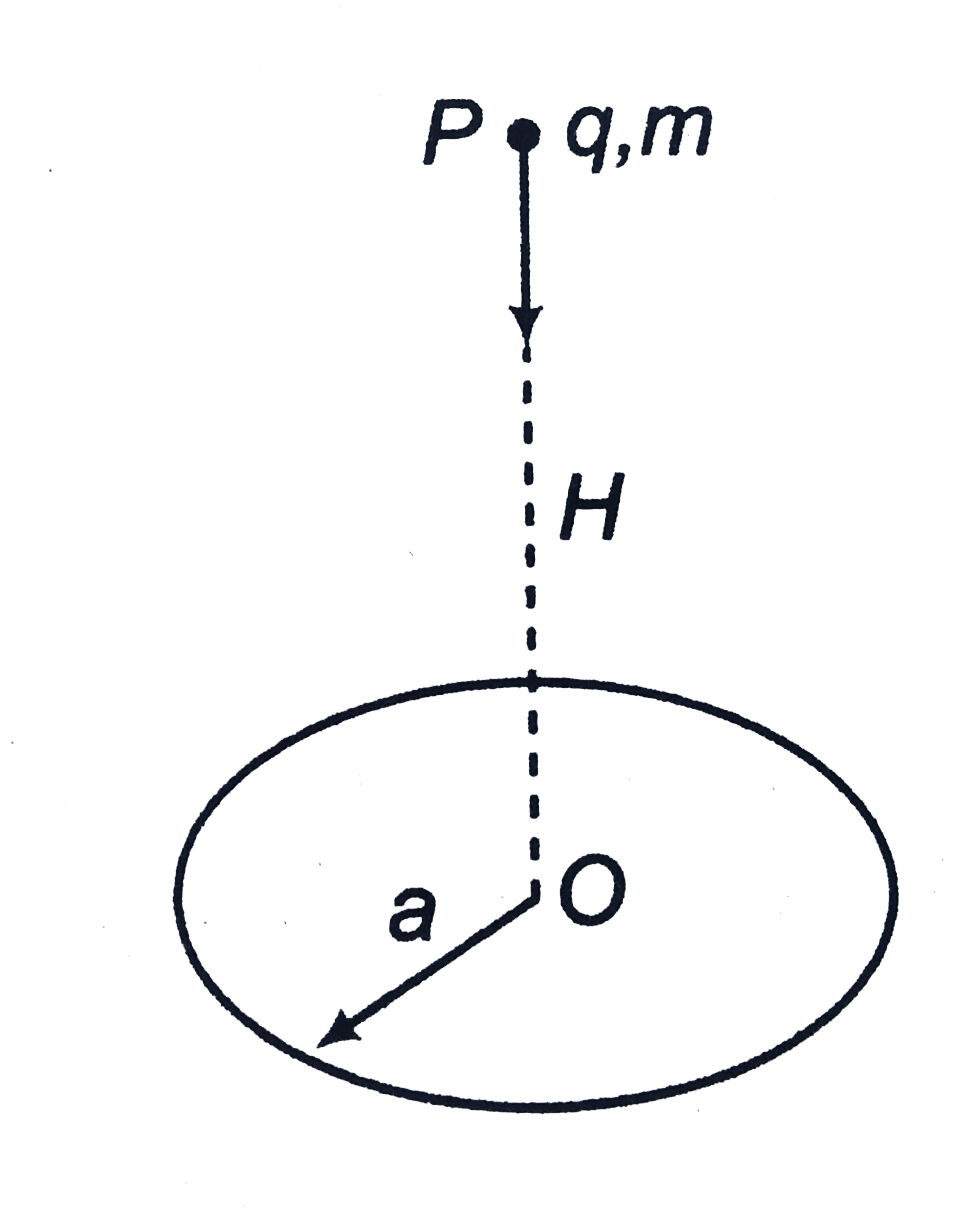
A nonconducting disk of radius a and uniform positive surface charge density `sigma` is placed on the ground, with its axis vertical. A particle of mass m and positive charge q is dropped, along the axis of the disk, from a height H with zero initial velocity. The particle has `q//m = 4 epsilon_(0) g// sigma`.
(i) Find the value of H if the particle just reaches the disk.
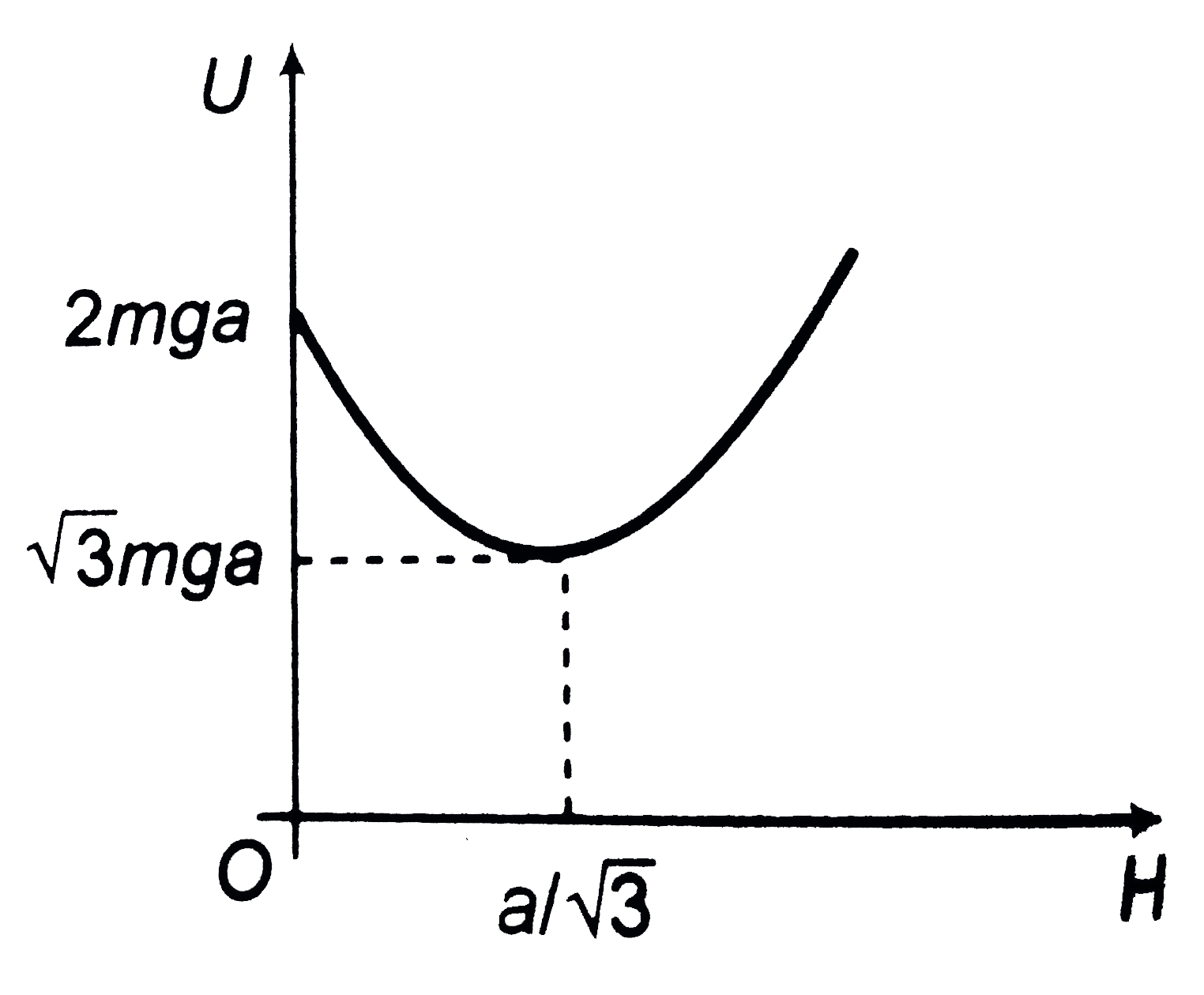
(ii) Sketch the potential energy of the particle as a function of its height and find its equilibrium position.

Text Solution

Verified by Experts

The correct Answer is:
A, B, C, D

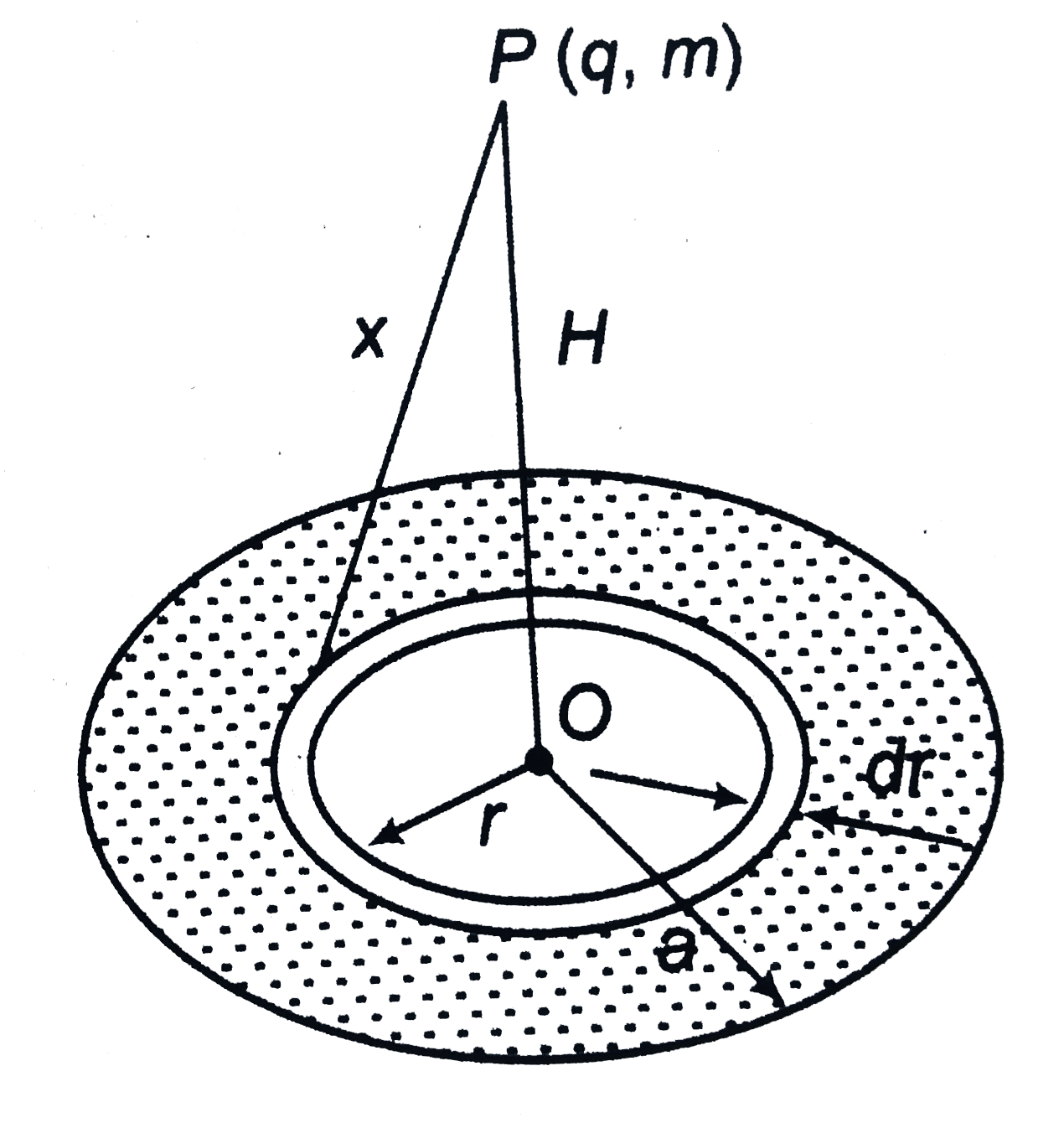
Potential at a height H on the axis of the disc `V(P)`. The charge `dq` contained in the ring shown in figure `dq=(2pirdr)sigma`
Potential of P due to this ring
`dV=1/(4epsilon_0).(dq)/x`, where `x=sqrt(H^2-r^2)`
`dV=1/(4piepsilon_0).((2pirdr)sigma)/sqrt(H^2+r^2)=sigma/(2epsilon_0)(rdr)/sqrt(H^2+r^2)`
`:.` Potential due to the complete disc,
`V_P=int_(r=0)^(r=a)dV=sigma/(2epsilon_0) int_(r=0)^(r=a) (rdr)/sqrt(H^2+r^2)`
`V_P=sigma/(2epsilon_0)[sqrt(a^2+H^2)-H]`
Potential at centre, O will be
`V_O=(sigmaa)/(2epsilon_0)` `(H=0)`
a. Particle is relesed from P and it just reaches point O. Therefore, from conservation of mechanical energy
decrease is gravtational potential energy = increase in electrostatic potential energy
`(/_\KE=0` because `K_i=K_f=0)`
`:.mgH=q[V_O-V_P]`
or `gH=(q/m)(sigma/(2epsilon_0)[a-sqrt(a^2+H^2)+H]`
`q/m=(4epsilon_0g)/sigmaimplies(qsigma)/(2epsilonm)=2g`
Substituting in Eqn. i we get
`gH=2g[a+H-sqrt(a^2+H^2)]`
or `H/2 =(a+H)-sqrt(a^2+H^2)`
or `sqrt a^2+H^2=a^2+H^2/4+aH`
or `3/4=aH` or `H=4/3 a ` and `H=0`
`:. =(4//3)a`
b. Potential energy of the particle at height `H=` Electrostatic potential energy + gravitational potentail energy
`:. U=qV+mgH`
Here, `V=` Potential at height H
`U=(sigmaq)/(2epsilon_0) [sqrt(a^2+H^2)-H]+mgH` ..............ii
At equlibrium position, `F=(-dU)/(dH)=0`
`Differentiating Eqn ii w.r.t H,
or `mg+(sigmaq)/(2epsilon_0)[(1/2)(2H)=1/sqrt(a^2+H^2)-1]=0` `[(sigmaq)/(2epsilon_0)=2mg)`
`mg+2mg[H/sqrt(a^2+H^2)-1]=0`
or `1+(2H)/sqrt(a^2+H^2)-2=0implies(2H)/sqrt(a^2+H^2)=1`
or `H=a/sqrt3`
From eqn ii we can see that
`U+2 mga` at `H=0` and
`U=U_min=sqrtmga` ag `H=a/sqrt y3`
Therefore U-H graph wil bbe as shown.
Note that at `H=a/sqrt3,U` is minimum.
`Therefore, `H=a/sqrt3` is stable equlibrium position.
Promotional Banner

Topper's Solved these Questions

  • ELECTROSTATICS

    DC PANDEY ENGLISH|Exercise Exercise 24.1|4 Videos
  • ELECTROSTATICS

    DC PANDEY ENGLISH|Exercise Exercise 24.2|9 Videos
  • ELECTROSTATICS

    DC PANDEY ENGLISH|Exercise Example Type 8|3 Videos
  • ELECTROSTATIC POTENTIAL AND CAPACITORS

    DC PANDEY ENGLISH|Exercise (C) Chapter exercises|50 Videos
  • GRAVITATION

    DC PANDEY ENGLISH|Exercise All Questions|135 Videos

Similar Questions

Explore conceptually related problems

A uniform cube of mass m and edge a moves on a horizontal surface along the positive x-axis, with initial velocity v_(0) . Then

A particle of mass m and charge q is thrown in a region where uniform gravitational field and electric field are present. The path of particle:

A smooth chute is made in a dielectric sphere of radius R and uniform volume charge density. rho . A charge particle of mass m and charge -q is placed at the centre of the sphere. Find the time period of motion of the particle?

A long solenoid carrying a current I is placed with its axis vertical as shown in the figure. A particle of mass m and charge q is released from the top of the solenoid. Its acceleration is (g being acceleration due to gravity)

An infinte wire having linear charge density lambda is arranged as shown in fig. A charge particle of mass m and charge q is released charged q is released from point P. Find the initial acceleration of the particle just after the particle is released.

A circular ring of radius R with uniform positive charge density lambda per unit length is located in the y z plane with its center at the origin O. A particle of mass m and positive charge q is projected from that point p( - sqrt(3) R, 0,0) on the negative x - axis directly toward O, with initial speed V. Find the smallest (nonzero) value of the speed such that the particle does not return to P ?

Positive charge Q is distributed uniformly over a circular ring of radius R. A particle having a mass m and a negative charge q, is placed on its axis at a distance x from the centre. Find the force on the particle. Assuming x is very less than R, find the time period of oscillation of the particle if it is released from there.

A particle of mass m and positive charge q is projected with a speed of v_0 in y–direction in the presence of electric and magnetic field are in x–direction. Find the instant of time at which the speed of particle becomes double the initial speed.

A thin circular disk of radius R is uniformly charged with density sigma gt 0 per unit area.The disk rotates about its axis with a uniform angular speed omega .The magnetic moment of the disk is :

A charge particle of mass m and charge q is projected with velocity v along y-axis at t=0. Find the velocity vector and position vector of the particle vec v (t) and vec r (t) in relation with time.

DC PANDEY ENGLISH-ELECTROSTATICS-Level 2 Single Correct
  1. The intensity of an electric field depends only on the coordinates x a...

    Text Solution

    |

  2. Find the electric field caused by a disc of radius a with a uniform su...

    Text Solution

    |

  3. A nonconducting disk of radius a and uniform positive surface charge d...

    Text Solution

    |

  4. Four point charges +8muC,-1muC,-1muC and , +8muC are fixed at the poin...

    Text Solution

    |

  5. Potential difference beween centre and surface of the sphere of radius...

    Text Solution

    |

  6. A positively charged disc is placed on a horizontal plane. A charged ...

    Text Solution

    |

  7. The curve represents the distribution of potential along the staight l...

    Text Solution

    |

  8. A point charge q1=q is placed at point P. Another point charge q2=-q i...

    Text Solution

    |

  9. The variation of electric field between two charge q1 and q2 along the...

    Text Solution

    |

  10. A charge q is placed at O in the cavity in a sphereical uncharged cond...

    Text Solution

    |

  11. A uniform electric field of 400 V/m is directed at 45^@ above the x-ax...

    Text Solution

    |

  12. Initially the spheres A and B are at potentials VA and VB. Find the po...

    Text Solution

    |

  13. A particle of mass m and charge q is fastened to one end of a string f...

    Text Solution

    |

  14. A charged particle of mass m and charge q is released from rest the po...

    Text Solution

    |

  15. A charge +Q is uniformly distributed in a spherical volume of radius R...

    Text Solution

    |

  16. Two identical coaxial rings each of radius R are separated by a distan...

    Text Solution

    |

  17. A uniform electric fied exists in x-y plane. The potential of ponts A(...

    Text Solution

    |

  18. Two fixed charges -2Q and +Q are located at points (-3a,0) and (+3a,0)...

    Text Solution

    |

  19. A particle of mass m and charge -q is projected from the origin with a...

    Text Solution

    |

  20. A particle of charge -q and mass m moves in a circle of radius r aroun...

    Text Solution

    |