Home
Class 12
PHYSICS
Two identical beads each have a mass m a...

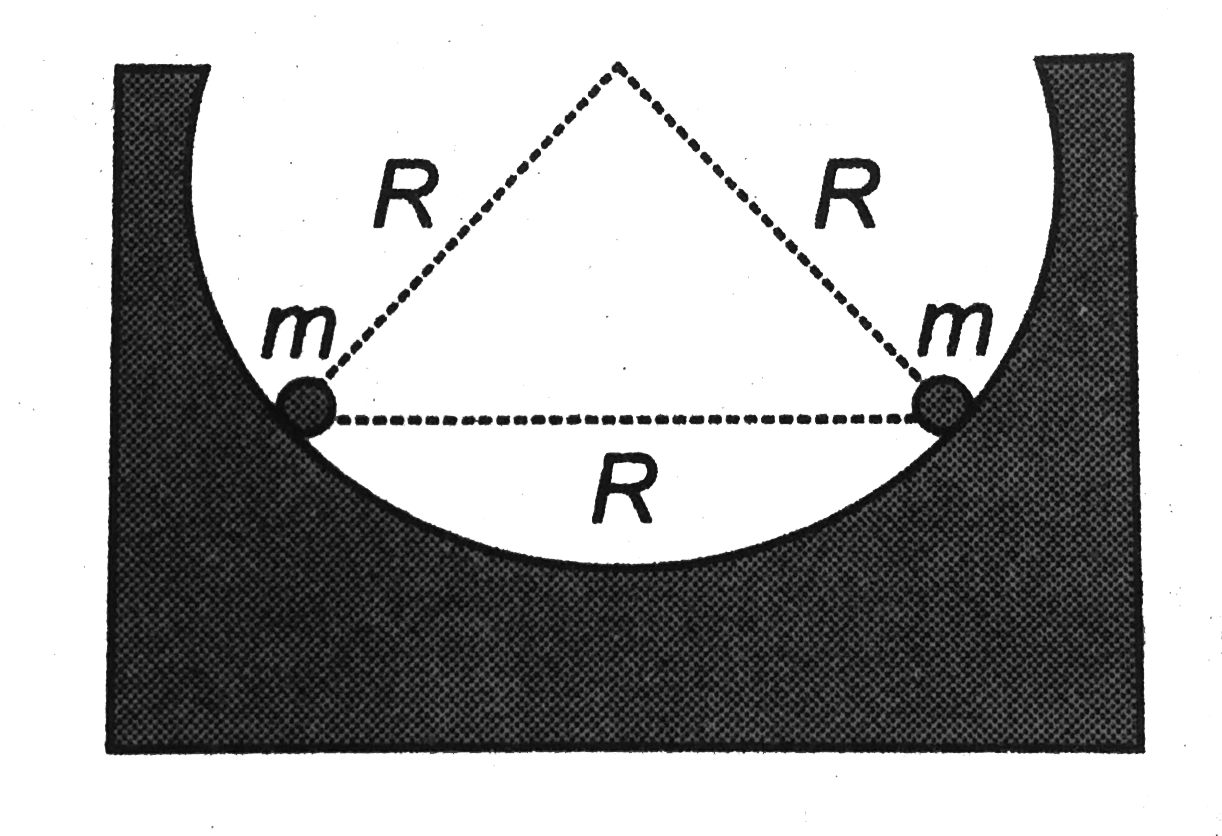
Two identical beads each have a mass m and charge q. When placed in a hemispherical bowl of radius R with frictionless, non-conducting walls, the beads move, and at equilibrium they area distance R apart (figure). Determine the charge on each bead.

Text Solution

Verified by Experts

The correct Answer is:
A, B, C, D


Using Lami's theorem we have
`(mg)/(sin(90^@+30^@))=(mg)/(sin(90^@+60^@))`
`:. F=(mg)/sqrt3 or 1/(4piepsilon_0) ((q)(q))/R^2=(mg)/sqrt3`
`:. Q=sqrt(piepsilon_0mgR^2)/sqrt3`
Promotional Banner

Topper's Solved these Questions

  • ELECTROSTATICS

    DC PANDEY ENGLISH|Exercise Level 1 Subjective|15 Videos
  • ELECTROSTATICS

    DC PANDEY ENGLISH|Exercise SUBJECTIVE_TYPE|6 Videos
  • ELECTROSTATICS

    DC PANDEY ENGLISH|Exercise Level 1 Assertion And Reason|19 Videos
  • ELECTROSTATIC POTENTIAL AND CAPACITORS

    DC PANDEY ENGLISH|Exercise (C) Chapter exercises|50 Videos
  • GRAVITATION

    DC PANDEY ENGLISH|Exercise All Questions|135 Videos

Similar Questions

Explore conceptually related problems

Two identical small balls each have a mass m and charge q. When placed in a hemispherical bowl of radius R with frictionless, nonconductive walls, the bead move, and at equilibrium the line joining the balls is horizontal and the distance between them is R (see figure). Neglect any induced charge on the hemispherical bowl. Then the charge on each bead is : (here K=(1)/(4piepsilon_(0)) )

Two point charges, each of mass m and charge q are released when they are at a distance d from each other. What is the speed of each charged particle when they are at a distance 2r ?

A point charge +Q is place just outside an imaginary hemispherical surface of radius R as shown in the figure. Which of the following statements is/are correct ?

Two identical spheres each of mass M and Radius R are separated by a distance 10R. The gravitational force on mass m placed at the midpoint of the line joining the centres of the spheres is

A rigid insulated wire frame in the form of a right-angled triangle ABC is set in a vertical plane as shown in fig. two beads of equal masses m each and carrying charges q_(1) and q_(2) are connected by a cord of length l and can slide without friction on the wires. Cinsidering the case when the beads are stationary, determine (i) the angel alpha (ii) the tension in the cord, and (iii) The normal recation on teh beads. If the cord is now cut, what are the value of the charges for which the beads continue to remain stationary?

In the shown figure, the charge appearing on the conducting shell (grounded) of Radius R, when a point charge q is kept at a distance of d from the centre of the sphere is:

Two identical bar magnets are fixed with their centres at a distance d apart. A stationary charge Q is placed at P in between the gap of the two magnets at distance D from the centre O as shown in the figure. The force on the charge Q is

Two identical small charged spheres, each having a mass m, hang in equilibrium the length of each string is l, and the angle made by any string with the vertical is theta . Find the magnitude of the charge on each sphere.

Two balls of radius r each are placed at a distance R and released . The speed of each ball when they collide

A charge q is placed at a distance of 2R from the centre of a spherical conducting shell of radius R. What is electrical potential, due to charges induced on the shell, at a point which is farthest from the point charge ?

DC PANDEY ENGLISH-ELECTROSTATICS-Level 1 Objective
  1. Point charges q1 and q2 lie o the x-axis at points x=-a and x=+a respe...

    Text Solution

    |

  2. Two particles (free to move) with charges +q and +4q are a distance L ...

    Text Solution

    |

  3. Two identical beads each have a mass m and charge q. When placed in a ...

    Text Solution

    |

  4. Three identical small balls, each of mass 0.1 g, are suspended at one ...

    Text Solution

    |

  5. Three charges, each equal to q, are placed at the three. corners of a ...

    Text Solution

    |

  6. A point charge q = - 8.0 nC is located at the origin. Find the electri...

    Text Solution

    |

  7. Find the electric field at the centre of a uniformly charged semicircu...

    Text Solution

    |

  8. Find the electric field at a point P on the perpendicular bisector of ...

    Text Solution

    |

  9. Find the direction of electric field at P for the charge distribution ...

    Text Solution

    |

  10. A clock face has charges -q, -2q, ,.....-12q fixed at the position of ...

    Text Solution

    |

  11. A charged particle of mass m = 1 kg and charge q = 2muC is thrown from...

    Text Solution

    |

  12. Protons are projected with an initial speed vi = 9.55 xx 10^3 m//s int...

    Text Solution

    |

  13. At some instant the velocity components of an electron moving between ...

    Text Solution

    |

  14. A point charge q1 = + 2muC is placed at the origin of coordinates. A s...

    Text Solution

    |

  15. A charge Q is spread uniformly in the form of a line charge density la...

    Text Solution

    |

  16. A uniform electric field of magnitude 250 V// m is directed in the pos...

    Text Solution

    |

  17. A small particle has charge -5.00muC and mass 2.00 xx 10-4 kg. It move...

    Text Solution

    |

  18. A plastic rod has been formed into a circle of radius R. It has a posi...

    Text Solution

    |

  19. A point charge q1=+2.40muC is held stationary at the origin. A second...

    Text Solution

    |

  20. A point charge q1 = 4.00 nC is placed at the origin, and a second poin...

    Text Solution

    |

