Home
Class 12
PHYSICS
Two identical positive charges are place...

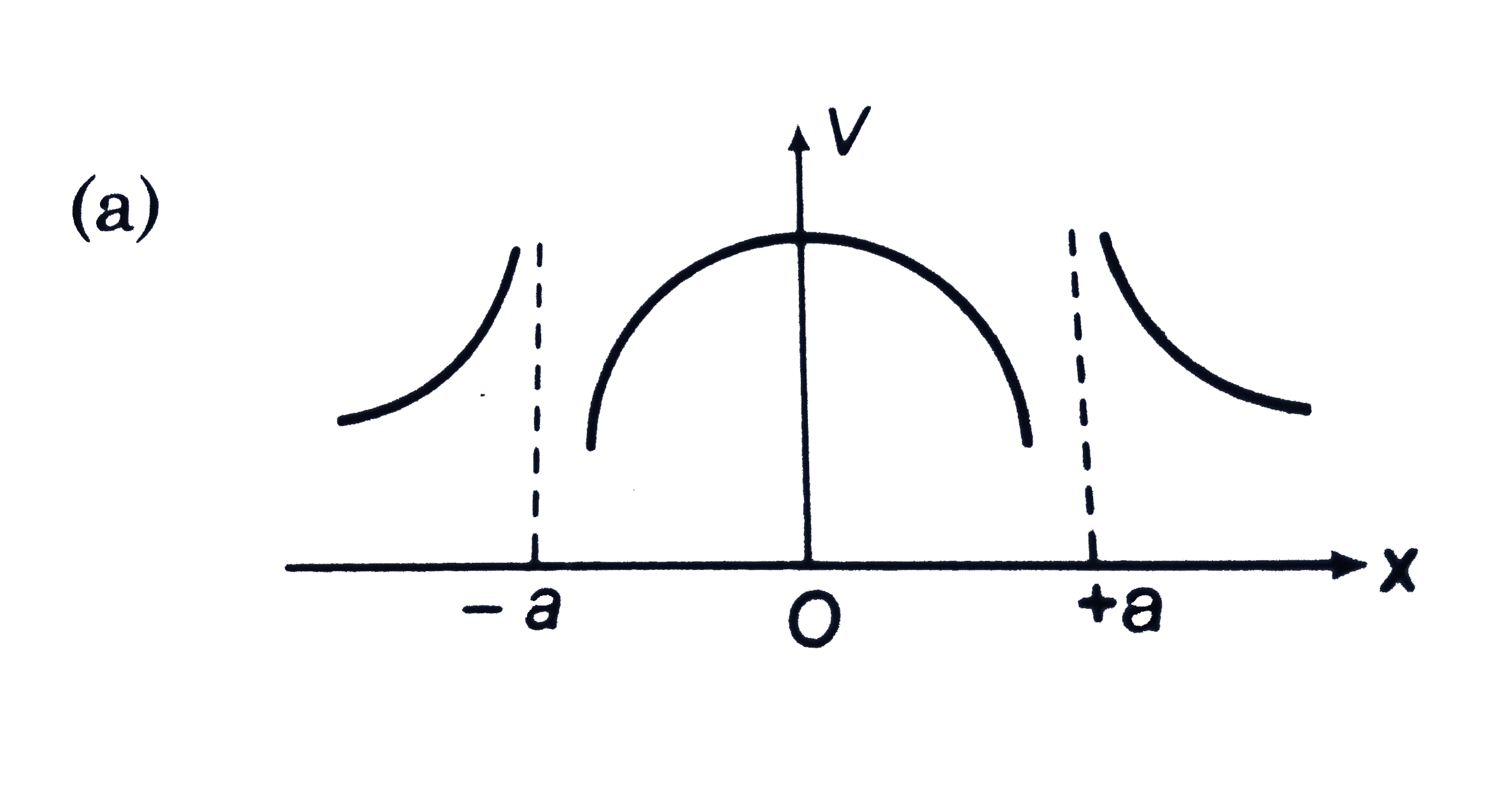
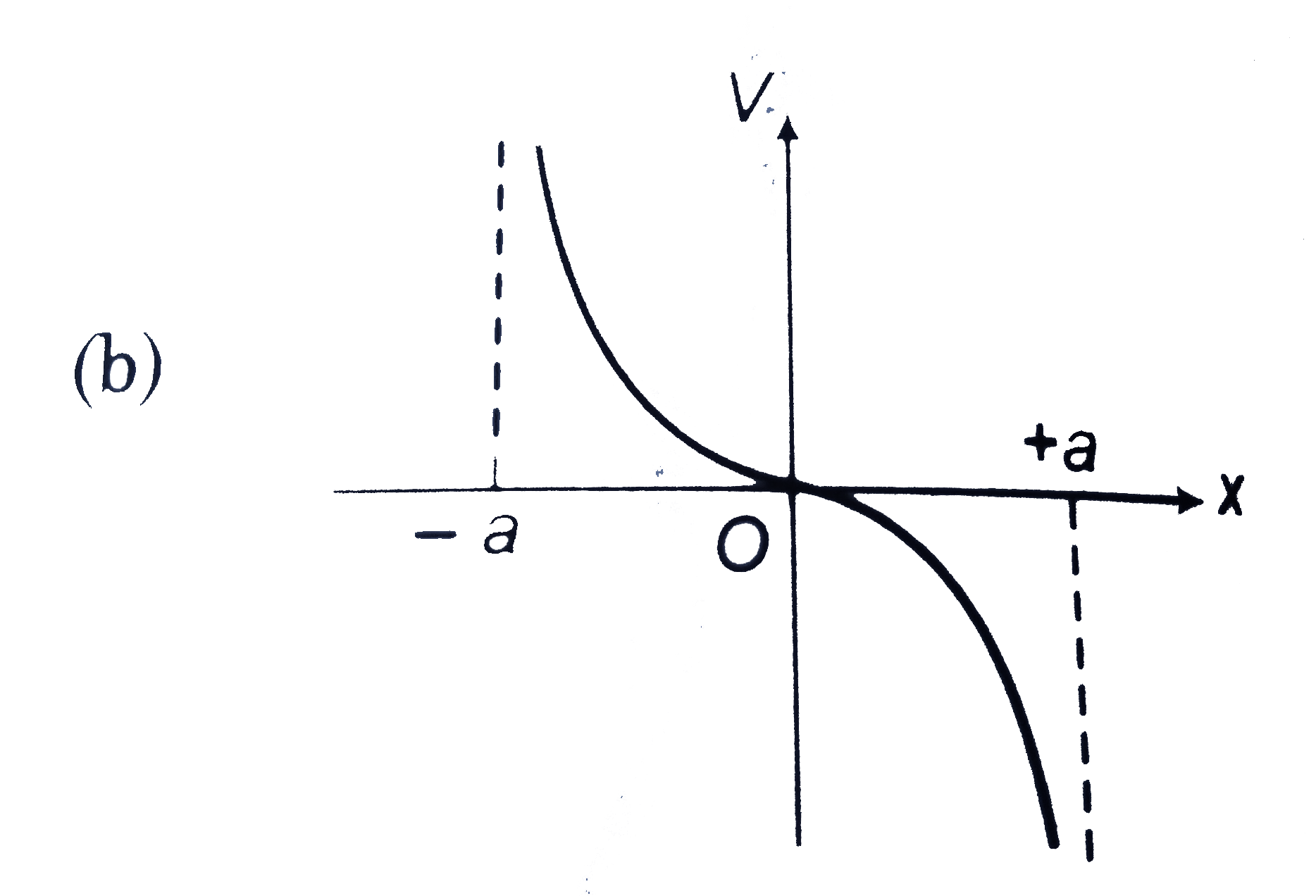
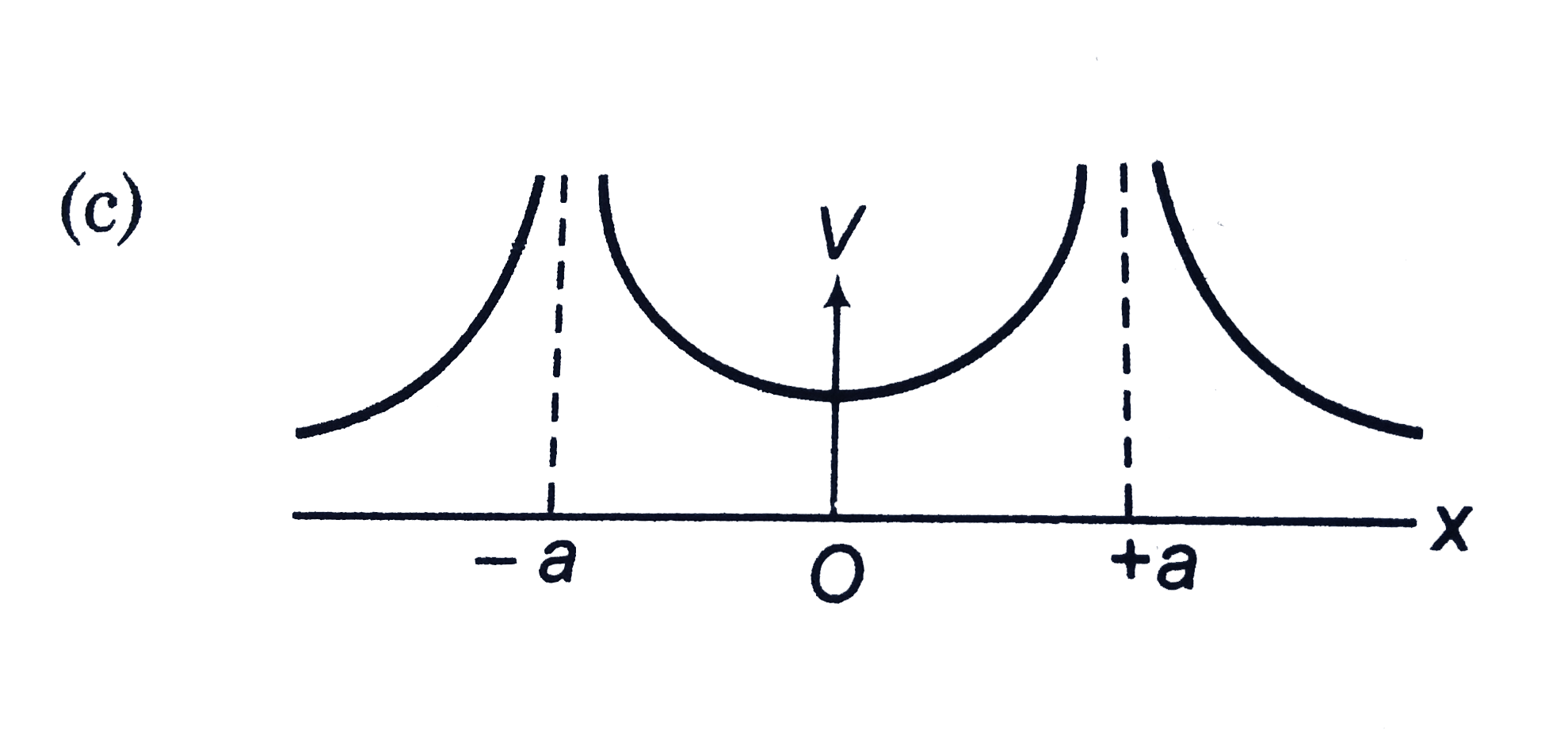
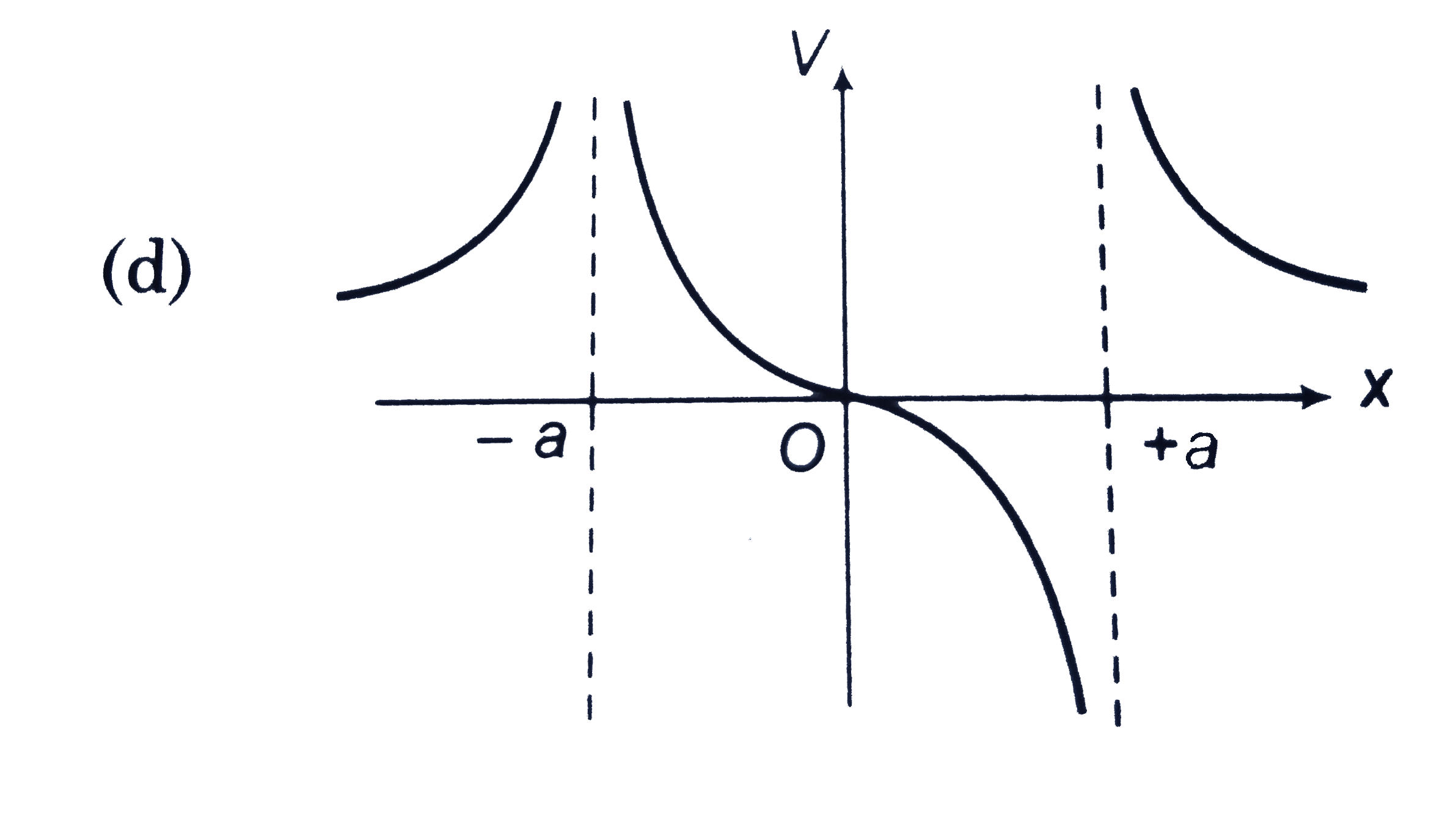
Two identical positive charges are placed at `x=-a` and `x=a`. The correct variation of potential V along the x-axis is given by

A

B

C

D

Text Solution

AI Generated Solution

The correct Answer is:

To solve the problem of finding the variation of electric potential \( V \) along the x-axis due to two identical positive charges placed at \( x = -a \) and \( x = a \), we can follow these steps: ### Step 1: Understand the Configuration We have two identical positive charges, \( +Q \), located at positions \( x = -a \) and \( x = a \). The electric potential \( V \) at any point \( x \) on the x-axis is the sum of the potentials due to each charge. ### Step 2: Write the Expression for Electric Potential The electric potential \( V \) at a point \( x \) due to a point charge \( Q \) is given by: \[ V = \frac{kQ}{r} \] where \( k \) is Coulomb's constant and \( r \) is the distance from the charge to the point where we are calculating the potential. ### Step 3: Calculate the Potential at Point \( x \) For our configuration: - The distance from the charge at \( x = -a \) to a point \( x \) is \( |x + a| \). - The distance from the charge at \( x = a \) to a point \( x \) is \( |x - a| \). Thus, the total potential \( V \) at a point \( x \) is: \[ V(x) = \frac{kQ}{|x + a|} + \frac{kQ}{|x - a|} \] ### Step 4: Analyze the Potential at Specific Points 1. **At the origin \( x = 0 \)**: \[ V(0) = \frac{kQ}{|-a|} + \frac{kQ}{|a|} = \frac{kQ}{a} + \frac{kQ}{a} = \frac{2kQ}{a} \] 2. **As \( x \) approaches \( -a \) or \( a \)**: - As \( x \) approaches \( -a \), \( |x + a| \) approaches 0, leading \( V \) to approach \( +\infty \). - As \( x \) approaches \( a \), \( |x - a| \) approaches 0, leading \( V \) to approach \( +\infty \). 3. **As \( x \) approaches \( \pm \infty \)**: - As \( x \) approaches \( +\infty \) or \( -\infty \), both \( |x + a| \) and \( |x - a| \) become very large, thus \( V \) approaches 0. ### Step 5: Sketch the Graph - The potential \( V \) is \( +\infty \) at \( x = -a \) and \( x = a \). - The potential is \( \frac{2kQ}{a} \) at \( x = 0 \). - The potential approaches 0 as \( x \) goes to \( \pm \infty \). ### Conclusion The variation of potential \( V \) along the x-axis will have a shape that approaches \( +\infty \) at the positions of the charges and approaches 0 as \( x \) moves towards \( \pm \infty \). The correct option representing this variation is option C.

To solve the problem of finding the variation of electric potential \( V \) along the x-axis due to two identical positive charges placed at \( x = -a \) and \( x = a \), we can follow these steps: ### Step 1: Understand the Configuration We have two identical positive charges, \( +Q \), located at positions \( x = -a \) and \( x = a \). The electric potential \( V \) at any point \( x \) on the x-axis is the sum of the potentials due to each charge. ### Step 2: Write the Expression for Electric Potential The electric potential \( V \) at a point \( x \) due to a point charge \( Q \) is given by: \[ ...
Promotional Banner

Topper's Solved these Questions

  • ELECTROSTATICS

    DC PANDEY ENGLISH|Exercise Exercise 24.1|4 Videos
  • ELECTROSTATICS

    DC PANDEY ENGLISH|Exercise Exercise 24.2|9 Videos
  • ELECTROSTATICS

    DC PANDEY ENGLISH|Exercise Example Type 8|3 Videos
  • ELECTROSTATIC POTENTIAL AND CAPACITORS

    DC PANDEY ENGLISH|Exercise (C) Chapter exercises|50 Videos
  • GRAVITATION

    DC PANDEY ENGLISH|Exercise All Questions|135 Videos

Similar Questions

Explore conceptually related problems

Two identical point charges are placed at A and B. The potential difference V_0-V_C is ( k= 1/4π epsilon_0 )

Two point charge +-q are placed on the axis at x= -a and x= +a , as shown in fig. (i) Plot the variation of E along the x-axis. (ii) Plot the variation of E along the y-axis.

Two point charges (Q each are placed at (0,y) and (0-y) A point charge q of the same polarity can move along the x-axis. Then

Two identical positive charges are fixed on the y-axis, at equal distances from the origin O. A particle with a negative charges starts on the x-axis at a large distance from O. moves along the x-axis passes through O, and moves far away from O on the other side. Its acceleration a is taken as positive along its direction of motion. Plot acceleration a of the particle against its x-coordinate.

Four identical charges are placed at the four vertices of a square lying in YZ plane. A fifth charge is moved along X axis. The variation of potential energy (U) along X axis is correctly represented by

Two identical infinite positive line changes are places into the lines x = +-a in the x=y plane. A positive point charge placed at origin is restricted to move along x-axis its equilibrium is

Two equal point charges are fixed at x=-a and x=+a on the x-axis. Another point charge Q is placed at the origin. The change in the electrical potential energy of Q, when it is displaced by a small distance x along the x-axis, is approximately proportional to

Three charges are placed along x- axis at x = -a , x=0 and x=a as shown . Calculate the potential energy of the system.

A particle free to move along x-axis is acted upon by a force F=-ax+bx^(2) whrte a and b are positive constants. , the correct variation of potential energy function U(x) is best represented by.

Two identical spherical balls, each of mass m, are placed as shown in figure. Plot the variation of g(gravitation intensity) along the x-axis due to both the masses.

DC PANDEY ENGLISH-ELECTROSTATICS-Level 2 Single Correct
  1. A small ball of masss m and charge +q tied with a string of length l, ...

    Text Solution

    |

  2. For charges A,B,C and D are plasced at the four corners of a squre of ...

    Text Solution

    |

  3. Two identical positive charges are placed at x=-a and x=a. The correct...

    Text Solution

    |

  4. Two identical charges are placed at the two corners of an equilateral ...

    Text Solution

    |

  5. A charged particle q is shot from a large distance towards another cha...

    Text Solution

    |

  6. Two identical charged spheres are suspended by strings of equal length...

    Text Solution

    |

  7. The electrostatic potential due to the charge configuration at point P...

    Text Solution

    |

  8. The figure show four situations in which charged particles are at equa...

    Text Solution

    |

  9. An isolated conduction sphere sphere whose radius R=1 m has a charge q...

    Text Solution

    |

  10. Two conducting concentric, hollow spheres A and B have radii a and b r...

    Text Solution

    |

  11. In a uniform electric field, the potential is 10V at the origin of co...

    Text Solution

    |

  12. There are two uncharged identicasl metallic spheres 1 and 2 of radius ...

    Text Solution

    |

  13. Figure shown a closed surface which intersects a conducting sphere. If...

    Text Solution

    |

  14. Two concentric coducting thin spherical shells A and B having radii rA...

    Text Solution

    |

  15. The electric potential at a point (x,y) in the x-y plane is given by V...

    Text Solution

    |

  16. Two concentric shells have radii R and 2R charges qA and qB and potent...

    Text Solution

    |

  17. A particle of mass 2 kg charge 1 mC is projected vertially with veloc...

    Text Solution

    |

  18. At a distance of 5 cm and 10 cm outward from the surface of a uniforml...

    Text Solution

    |

  19. Three charged particle sare in equilibrium under their electrostatic f...

    Text Solution

    |

  20. Charges Q1 and Q2 lie inside and outside, respectively, of a closed su...

    Text Solution

    |
