Home
Class 12
PHYSICS
Two charges +Q each are fixed at points ...

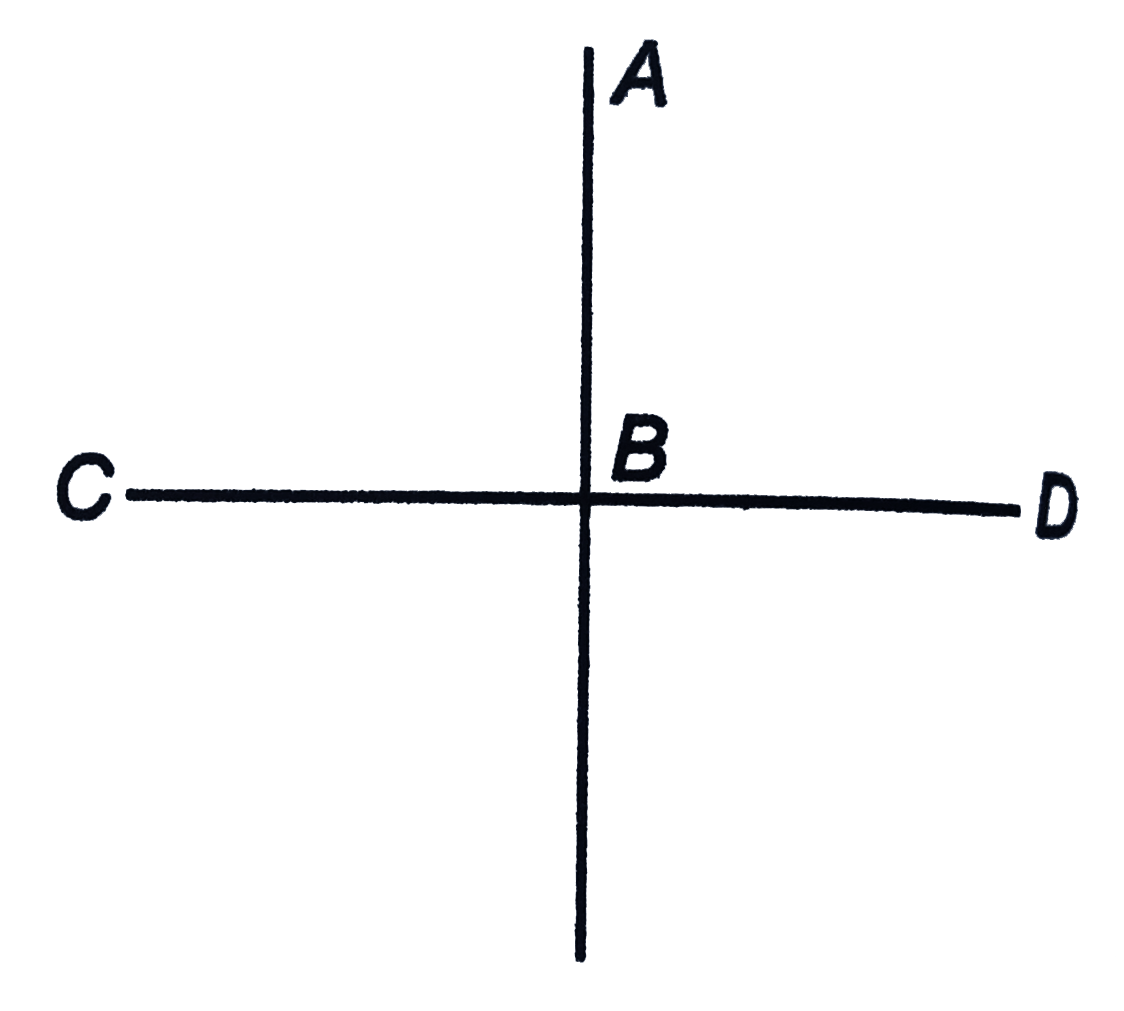
Two charges `+Q` each are fixed at points C and D. Line AB is the bisector line of CD. A third charge `+q` is moves from A to B, then from B to C

A

From A to B electrostatic potential energy wil decrese

B

from A to B electrostastic potential ennergy wil increase

C

From B to C electrostatic potential energy will increase

D

From B to C electrostatic potential energy will decrease

Text Solution

Verified by Experts

The correct Answer is:

B, C

Along the line `AB` charge `q` is at unstable equililbrium position at B (when displaced from B along `AB` net force on it is away from B, whereas force at B is zero). Hence potential energy at B is maximum.
Along `CD` equilibrium of q is stable. Hence, potential energy at B is minimum along `CD`.
Promotional Banner

Topper's Solved these Questions

  • ELECTROSTATICS

    DC PANDEY ENGLISH|Exercise Exercise 24.1|4 Videos
  • ELECTROSTATICS

    DC PANDEY ENGLISH|Exercise Exercise 24.2|9 Videos
  • ELECTROSTATICS

    DC PANDEY ENGLISH|Exercise Example Type 8|3 Videos
  • ELECTROSTATIC POTENTIAL AND CAPACITORS

    DC PANDEY ENGLISH|Exercise (C) Chapter exercises|50 Videos
  • GRAVITATION

    DC PANDEY ENGLISH|Exercise All Questions|135 Videos

Similar Questions

Explore conceptually related problems

Assertion: Two charges -q each are fixed points A and B. When a third chrge -q is moves from A to B, electrical potential energy first decreases than increases, Reason: Along the line joining A and B, third charge is stable equilibrium position at centre.

Two charge +aq and -q are kept apart. Then , at any point on the right bisector of line joining the two charge

A two point charges 4q and -q are fixed on the x - axis x=-d/2 and x = d/2 , respectively. If a third point charge 'q' is taken from the origin to x = d along the semicircle as shown in the figure, the energy of the charge will

A positive charge +Q is fixed at a point A. Another positively charged particle of mass m and charge +q is projected from a point B with velocity u as shown in (Fig. 3.103). Point B is at a large distance from A and at distance d from the line A C. The initial velocity is parallel to the line A C. The point C is at a very large distance from A. Find the minimum distance (in meter) of +q from +Q during the motion. Take Q q = 4 pi epsilon_0 m u^2 d and d (sqrt(2) - 1) m . .

Two equal positive charges Q are fixed at points (a, 0) and (-a,0) on the x-axis. An opposite charge -q at rest is relased from point (0, a) on the y-axis. The charge -q will

A charge (-q) and another charge (Q) are kept at two points A and B respectively. Keeping the charge (+Q) fixed at B , the charge (-q) at A is moved to another point C such that ABC forms an equilateral triangle of side l . The net work done in moving teh charge (-q) is

Two equal negative charges -q are fixed at points (0, -a) and (0,a) on y-axis. A poistive charge Q is released from rest at point (2a, 0) on the x-axis. The charge Q will

Two charges -q each are fixed separated by distance 2d. A third charge q of mass m placed at the mid-point is displaced slightly by x (xltltd) perpendicular to the line joining the two fixed charges as shown in Fig. Show that q will perform simple harmonic oscillation of time period. T = [(8pi^(3) in_(0) md^(3))/(q^(2))]^(1//2)

There is a fixed positive charges Q at O, and A and B are points equidistant from O. A positive charge +q is taken slowly by an external agent from A to B along the line AC and then along the line CB.

Two chargess +q and +2q , are held in place on the x axis at the locations x = -d and x= +d respectively. A third charge, +3q , is released from rest on the y axis at y = d . (a) Find the electric potential at the initial location of the third charge. (b) Find the initial electric potential energy of the third charge. (c) What is the kinetic energy of the third charge when it has moved infinity far away from the other two charges ?

DC PANDEY ENGLISH-ELECTROSTATICS-Level 2 Single Correct
  1. Two concentric spherical shells have charges +q and -q as shown in fig...

    Text Solution

    |

  2. A rod is hinged (free to rotate) ast its centre O as shown in figue. T...

    Text Solution

    |

  3. Two charges +Q each are fixed at points C and D. Line AB is the bisect...

    Text Solution

    |

  4. There are two concentric spherical shell of radii r and 2r. Initially,...

    Text Solution

    |

  5. There are two concentric spherical shell of radii r and 2r. Initially,...

    Text Solution

    |

  6. There are two concentric spherical shell of radii r and 2r. Initially,...

    Text Solution

    |

  7. A sphere of charges of radius R carries a positive charge whose volume...

    Text Solution

    |

  8. A sphere of charges of radius R carries a positive charge whose volume...

    Text Solution

    |

  9. A sphere of charges of radius R carries a positive charge whose volume...

    Text Solution

    |

  10. A sphere of charges of radius R carries a positive charge whose volume...

    Text Solution

    |

  11. A solid metallic sphere of radius a is surrounded by a conducting sphe...

    Text Solution

    |

  12. A solid metallic sphere of radius a is surrounded by a conducting sphe...

    Text Solution

    |

  13. A solid metallic sphere of radius a is surrounded by a conducting sphe...

    Text Solution

    |

  14. A 4.00 kg block carrying a charge Q = 50.0muC is connected to a spring...

    Text Solution

    |

  15. A particle of mass m and charge -Q is constrained to move along the ax...

    Text Solution

    |

  16. Three identical conducting plain parallel plates, each of area A are h...

    Text Solution

    |

  17. A long non-conducting, massless rod of length L pivoted at its centre ...

    Text Solution

    |

  18. The electric potential varies in space according to the relation V = 3...

    Text Solution

    |

  19. A simple pendulum with a bob of mass m = 1 kg, charge q = 5muC and str...

    Text Solution

    |

  20. There are two concentric spherical shell of radii r and 2r. Initially,...

    Text Solution

    |
