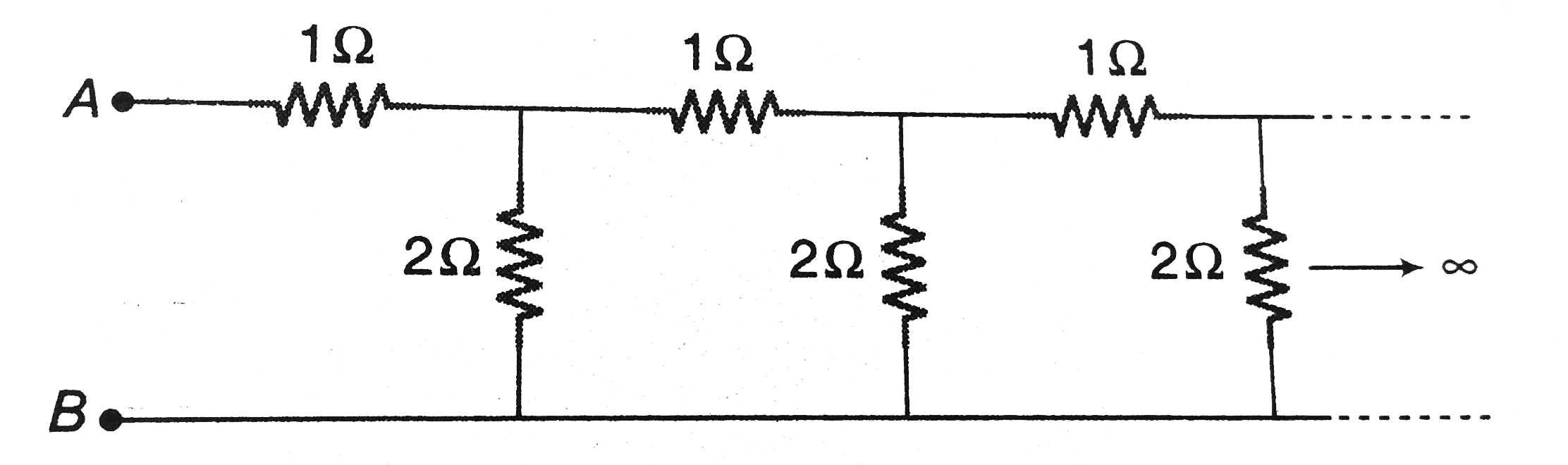
An infinite ladder network is constructed with `1Omega `and `2Omega` resistors as shown. Find the equivalent resistance points `A` and `B`.
Text Solution
Verified by Experts
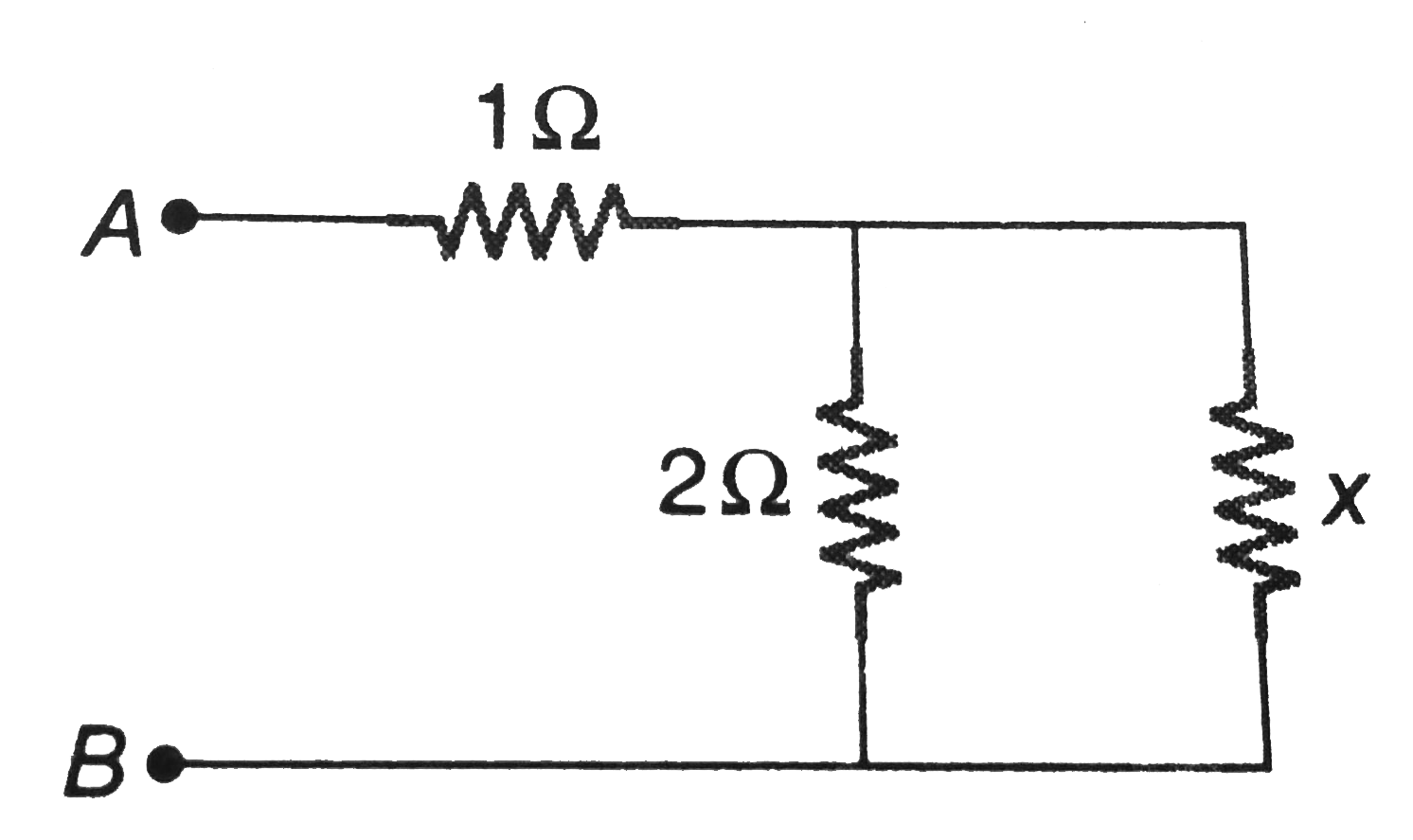
Let the equivalent resistance between `A` and `B` is `x`. We may consider the given circuit as shown in figure. in this diagram `R_(AB)=(2x)/(2+x)+1` or `x+(2x)/(2+x)+1` (as `R_(AB)=x)` or `x(2+x)=2x+2+x` or `x^2-x-x-2=0` `x=(1+-sqrt(1+8))/2=-1Omega` and `2Omega` Ignoring the negative value, we have `R_(AB)=x=2Omega`
Topper's Solved these Questions
CAPACITORS
DC PANDEY ENGLISH|Exercise Exercise|155 Videos
CAPACITORS
DC PANDEY ENGLISH|Exercise OBJECTIVE_TYPE|1 Videos
ATOMS
DC PANDEY ENGLISH|Exercise MEDICAL ENTRANCES GALLERY|42 Videos
COMMUNICATION SYSTEM
DC PANDEY ENGLISH|Exercise Subjective|11 Videos
Similar Questions
Explore conceptually related problems
An infinite ladder network of resistances is constructed with 1Omega and 2Omega resistances as shown
An infinite ladder is constructed with 1(Omega) and 2(Omega) resistor as shown in figure.(a)Find the effective resistance between the point A and B. (b) Find the current that passes through the (2 Omega) resistor nearest to the battery.
In the network shown, the equivalent resistance between A and B is
For the combination of resistors shown in Fig. find the equivalent resistance between the points A and B
In the network shown in Fig., calculate the equivalent resistance between the points A and B,
Find in the given network of resistors, the equivalent resistance between the points A and B
In the network of resistors shown in the adjoining figure, the equivalent resistance between A and B is
Each resistance is of 1Omega in the circuit diagram shown in figure. Find out equivalent resistance between A and B.
Find the equivalent resistance of the network shown in figure
For infinite ladder network containing identical resistance of R Omega each, are combined as shown in figure. The equivalent resistance between A and B is R_(AB) and between A and C is R_(AC) . Then the value (R_(AB))/(R_(AC)) is :