Home
Class 12
PHYSICS
Three parallel metalic plates each of ar...

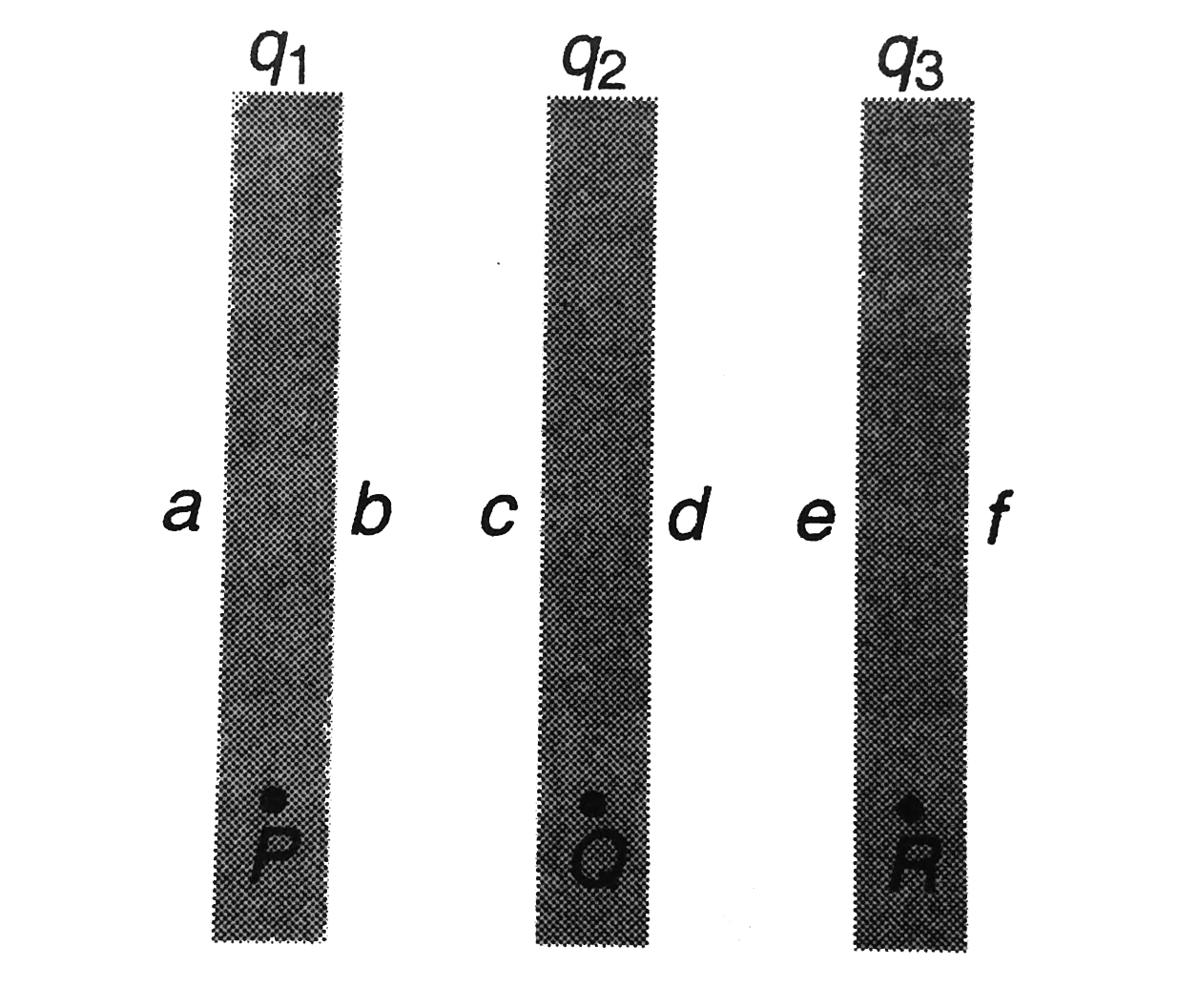
Three parallel metalic plates each of area `A` are kept as shown in figure and charges `q_1,q_2` and `q_3` are given to them. Find the resulting charge distribution on the six surfaces, neglecting edge effects as usual,

Text Solution

Verified by Experts

The plate separations do not affect the distribution of charge in this problem.
In the figure
`q_0=q_1-q_a,q_d=q_2-q_c`
`and q_f=q_3-q_e`
electric field at point P is zero because this point is lying inside a conductor.
`E=0`
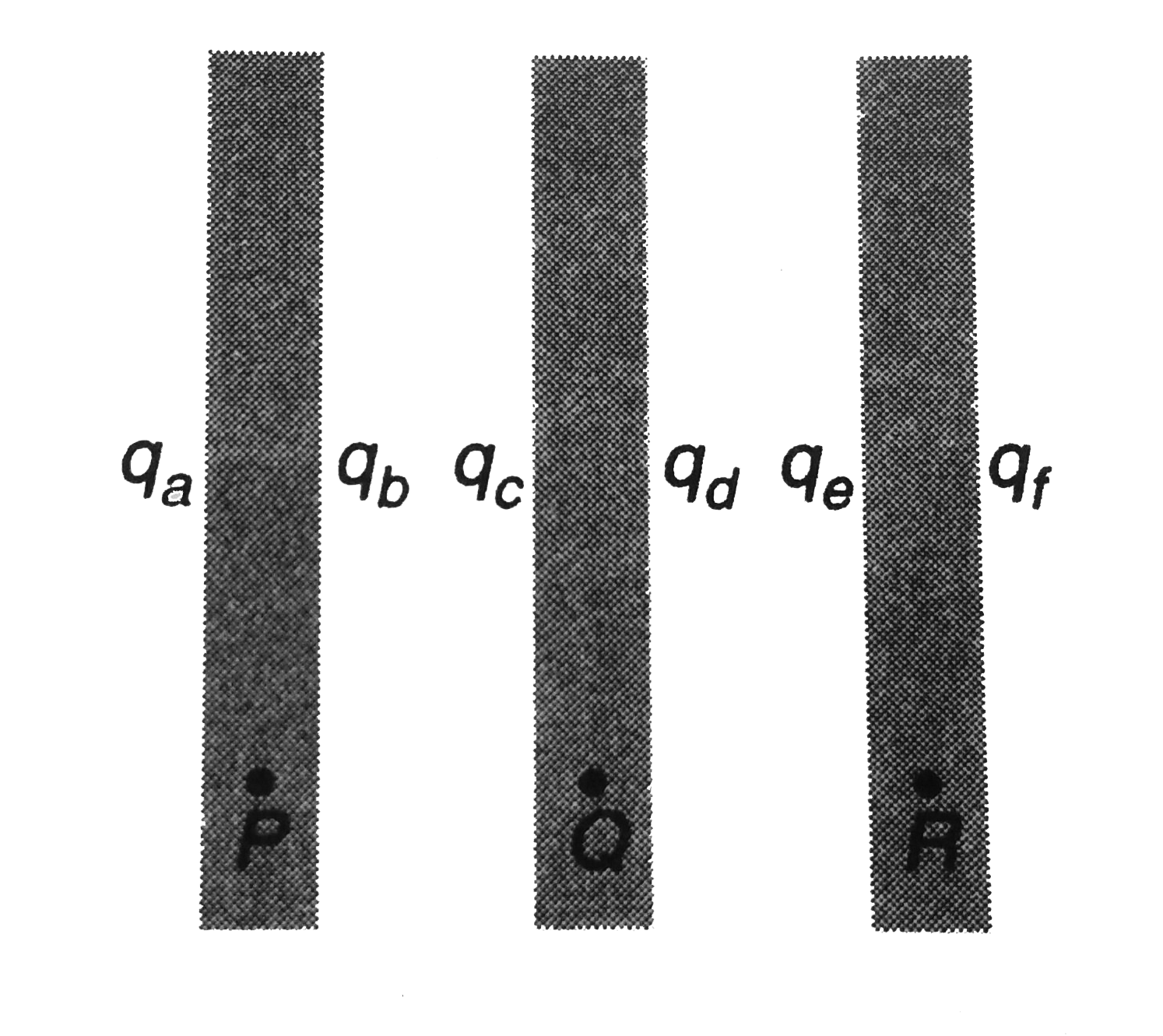
At `P` charge `q_a` will give an electric field towards right. All other charges `q_0, q_c.`.........etc. will give electric field towars left. So,
`1/(2Aepsilon_0)[q_a-(q_1-q_1)-q_c-(q_2-q_c)-q_e-(q_3-q_e)]=0`
or `2q_a-q_1-q_2-q_3=0`
or `q_a=(q_1+q_2+q_3)/2`
similarly the conditionn
`E_R=0`
will give the result
`q_f=(q_1+q_2+q_3)/2`
from here we may conclude that half of the sum of all charges appears on each of the two outermost surfaces of the system of plates.
Further we have a condition.
`E_Q=0`
`1/(2Aepsilon_0)[q_q+(q_1-q_a)+q_c-(q_2-q_c)-q_e-(q_3-q_e)]=0`
or `q_1+2q_c-q_2-q_3=0`
`:. q_c=(q_2+q_3-q_1)/2`
`q_b=q_1-q_a=(q_1-q_2-q_3)/2=-q_c`
similarly, we can show that
`q_d=-q_e`
from here we can find another important resultant that the pairs of opposite surfaces like `b,c`, and `d,e` carry equal and opposite charges.
Promotional Banner

Topper's Solved these Questions

  • CAPACITORS

    DC PANDEY ENGLISH|Exercise Exercise|155 Videos
  • CAPACITORS

    DC PANDEY ENGLISH|Exercise OBJECTIVE_TYPE|1 Videos
  • ATOMS

    DC PANDEY ENGLISH|Exercise MEDICAL ENTRANCES GALLERY|42 Videos
  • COMMUNICATION SYSTEM

    DC PANDEY ENGLISH|Exercise Subjective|11 Videos

Similar Questions

Explore conceptually related problems

Two parallel metallic pltes , each of tharea A are kept as shown in the figure and charges -2Q and 4Q are given to them. Edge effects are negligeble . The charges on the surface I and III are respectively

Three identical conducting plain parallel plates, each of area A are held with equal distance between successive surfaces. Charges Q , 2Q , and 3Q are placed on them.Neglecting edge effects, find the distribution of charges on the six surfaces.

Three identical metallic plates, each of area A, are kept at small separations as shown. Initially, charge Q, 3Q and 3Q are given to the plates A, B and c, respectively. Now, both the switches S_(1) and S_(2) are closed simultaneously. Then Charge flown through S_(1) and S_(2) are

Two metallic plates are kept parallel to one another and charges are given to them as shown in figure. Find the charge on all the four faces.

Two conducting plates A and B are placed parallel to each other. A is given a charge. Q_1 and B a charge Q_2 . Find the distribution of charges on the four surface.

Three identical plates of area A are arranged as shown. A charge +Q is given to plate ( 2 ). Then,

The three small spheres as shown in figure carry charges q_1 = 4nC, q_2 = -7.8nC and q_3 = 2.4nC . Find the net electic flux through each of the following closed surfaces shown in cross section in the figure. a. S_1 b. S_2 c. S_3 d. S_4 e. S_5 . Do your answers to parts from (a) to (e) depend on how the charge is distributed over each small sphere? Why or why not? .

A rubber balloon is given a charge Q distributed uniformly over its surface. Then

Figure shows three metallic plates with charges Q, 4Q, and -Q, respectively. Determine the final charges on all the surfaces.

Figure shows three large metallic plates with chrges -Q, 3Q and Q respectively. Determine the final charges on all the surfaces.

