When `E_|_B` and the particle is released at rest from origin.
When `E_|_B` and the particle is released at rest from origin.
Text Solution
Verified by Experts
Consider a particle of charge `q` and mass `m` emitted at origin with zero initial velocity into a regionof uniform electric and magnetic fields. The field `E` is acting along `x`-axis and field `B` along `y`=axis, i.e.
`E=E_0hatj`
and `B=B_0hatj`
Electric fiedl will provide the particle an acceleration (and therefore a velocity component `O`) in `x`-direction and the magnetic field will rotate the particle in `xy`-plane (perpendicular to `B`).
Hence, at any instant of time its velocity (and hence, position) will have only `x` and `y` components. Let at time t its veloicty be
`v=v_xhati+v_zhatk`
Net force on it at this instant is
`F=F_e+F_m=qE+q(vxxB)`
`=q[E_0hati+(v_xi+v_zhatk)xx(B_0hatj)]`
or `F=q(E_0-v_zB0)hati+qv_xB_0hatk`
`:. a=F/m=axhati+a_zhatk`
`where a_x=q/m(E_0-v_zB_0)` .............i
and `a_z q/m v_xB_0` ..........ii
Differenting eqn i w.r.t time we have
`(d^2v_x)/(dt^2)=(qB_0)/m((dv_z)/(dt))`
But, `(dv_z)/(dt)=a_z=(qB_0)/m v_x`
`:. (d^2v_x)/(dt^2)=-((qB_0)/m)^2v_x`........iii
comparing this equation with the differential equation of SHM `((d^2y)/(dt)^2=-omega^2y),` we get
`omega=(qB_0)/m`
and the general solution of eq. iii is
`v_x=(A sin(omegat+phi)`........iv
At time `t=0, v_x=0`, hence `phi=0`
Again `(dv_x)/(dt)=Aomegacosomegat) (as phi=0)`
From eqn i `a_x(qE_0)/m at t=0, as v_z=0 at t=0`
`:. Aomega=(qE_0)/m or A=(qE_0)/(omegam)`
Substituting `omega=(qB_0)/m`, we get `A=E_0/B_0`
Therefore eq. iv becomes
where `v_x=E_0/B_0 sinomegat`
`omega=(qB_0)/m`
Now substituting value of `v_x` in eqn ii we get
`(dv_z)/(dt)=(qE_0)/misnomegat`
`:. int_0^v_zdv_z=(qE_0)/m int_)^tsinomegat dt`
`or v_z=(qE_0)/(omegam) (1-cosomegat)`
Substituting `omega=(qB_0)/m` , we get
`v_z=E_0/B_0(1-cosomegat) `
on integrating equation for v_x and u_z and knowng that at `t=0, x=0` and `z=0` we get
`x=E_0/(B_0omega)(1-cosomegat)`
`z=E_0/(B_0omega) (omegat-sinomegat)`
These eqution are the equation for a cycloid which is defined as the path generated by the point on the circumference of a wheel rolling on a ground.
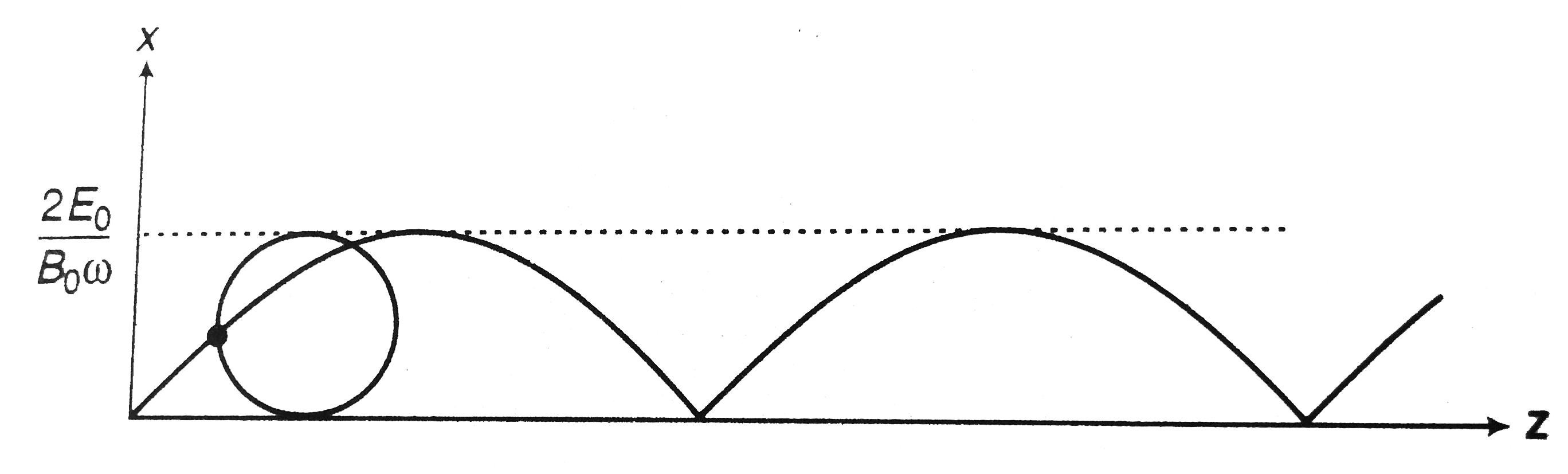
In the present case, the radius of the rolling wheel is `E_0/(B_0omega)` the maximum displacement along `x`- direction is `(2E_0)/(B_0omega)`. The `x`-displacement becomes zero at `t=9`, `2pi/omega, 4pi/omega`, etc.
`E=E_0hatj`
and `B=B_0hatj`
Electric fiedl will provide the particle an acceleration (and therefore a velocity component `O`) in `x`-direction and the magnetic field will rotate the particle in `xy`-plane (perpendicular to `B`).
Hence, at any instant of time its velocity (and hence, position) will have only `x` and `y` components. Let at time t its veloicty be
`v=v_xhati+v_zhatk`
Net force on it at this instant is
`F=F_e+F_m=qE+q(vxxB)`
`=q[E_0hati+(v_xi+v_zhatk)xx(B_0hatj)]`
or `F=q(E_0-v_zB0)hati+qv_xB_0hatk`
`:. a=F/m=axhati+a_zhatk`
`where a_x=q/m(E_0-v_zB_0)` .............i
and `a_z q/m v_xB_0` ..........ii
Differenting eqn i w.r.t time we have
`(d^2v_x)/(dt^2)=(qB_0)/m((dv_z)/(dt))`
But, `(dv_z)/(dt)=a_z=(qB_0)/m v_x`
`:. (d^2v_x)/(dt^2)=-((qB_0)/m)^2v_x`........iii
comparing this equation with the differential equation of SHM `((d^2y)/(dt)^2=-omega^2y),` we get
`omega=(qB_0)/m`
and the general solution of eq. iii is
`v_x=(A sin(omegat+phi)`........iv
At time `t=0, v_x=0`, hence `phi=0`
Again `(dv_x)/(dt)=Aomegacosomegat) (as phi=0)`
From eqn i `a_x(qE_0)/m at t=0, as v_z=0 at t=0`
`:. Aomega=(qE_0)/m or A=(qE_0)/(omegam)`
Substituting `omega=(qB_0)/m`, we get `A=E_0/B_0`
Therefore eq. iv becomes
where `v_x=E_0/B_0 sinomegat`
`omega=(qB_0)/m`
Now substituting value of `v_x` in eqn ii we get
`(dv_z)/(dt)=(qE_0)/misnomegat`
`:. int_0^v_zdv_z=(qE_0)/m int_)^tsinomegat dt`
`or v_z=(qE_0)/(omegam) (1-cosomegat)`
Substituting `omega=(qB_0)/m` , we get
`v_z=E_0/B_0(1-cosomegat) `
on integrating equation for v_x and u_z and knowng that at `t=0, x=0` and `z=0` we get
`x=E_0/(B_0omega)(1-cosomegat)`
`z=E_0/(B_0omega) (omegat-sinomegat)`
These eqution are the equation for a cycloid which is defined as the path generated by the point on the circumference of a wheel rolling on a ground.
In the present case, the radius of the rolling wheel is `E_0/(B_0omega)` the maximum displacement along `x`- direction is `(2E_0)/(B_0omega)`. The `x`-displacement becomes zero at `t=9`, `2pi/omega, 4pi/omega`, etc.



Topper's Solved these Questions
Similar Questions
Explore conceptually related problems
If magnetic field in space is 1Thati , electric field is 10 N//Chati , no gravitational field is present and a charged particle is released from rest from origin, it will
Let A, B and C be points in a vertical line at height h, (4h)/(5) and (h)/(5) and from the ground. A particle released from rest from the point A reaches the ground in time T. The time taken by the particle to go from B to C is T_(BC) . Then (T)/(T_(BC)) ^(2) =
A point particle of mass m, moves long the uniformly rough track PQR as shown in figure. The coefficient of friction, between the particle and the rough track equals mu . The particle is released, from rest from the point P and it comes to rest at a point R. The energies, lost by the ball, over the parts, PQ and QR, of the track, are equal to each other, and no energy is lost when particle changes direction from PQ to QR. The value of the coefficient of friction mu and the distance x (=QR) , are, respectively close to:
A proton is fixed at origin. Another proton is released from rest, from a point at a distance r from origin. Taking charge of portion as e and mass as m , find the speed of the proton (i) at a distance 2r from origin (ii) at large distance from origin.
A positively charged particle is released from rest in a uniform electric field. The electric potential energy of the charge.
A positively charged particle is released from rest in a uniform electric field. The electric potential energy of the charge.
A positively charged particle is released from rest in a uniform electric field. The electric potential energy of the charge.
In a region, steady and uniform electric and magnetic fields are present . These two fields are parallel to each other. A charged particle is released from rest in this region . The path of the particle will be a
A particle is released from rest from a tower of height 3h. The ratio of time intervals for fall of equal height h i.e. t_(1):t_(2):t_(3) is :
A particle is released from rest from a tower of height 3h. The ratio of time intervals for fall of equal height h i.e. t_(1):t_(2):t_(3) is :