Home
Class 12
PHYSICS
A conducting rod shown in figure of mass...

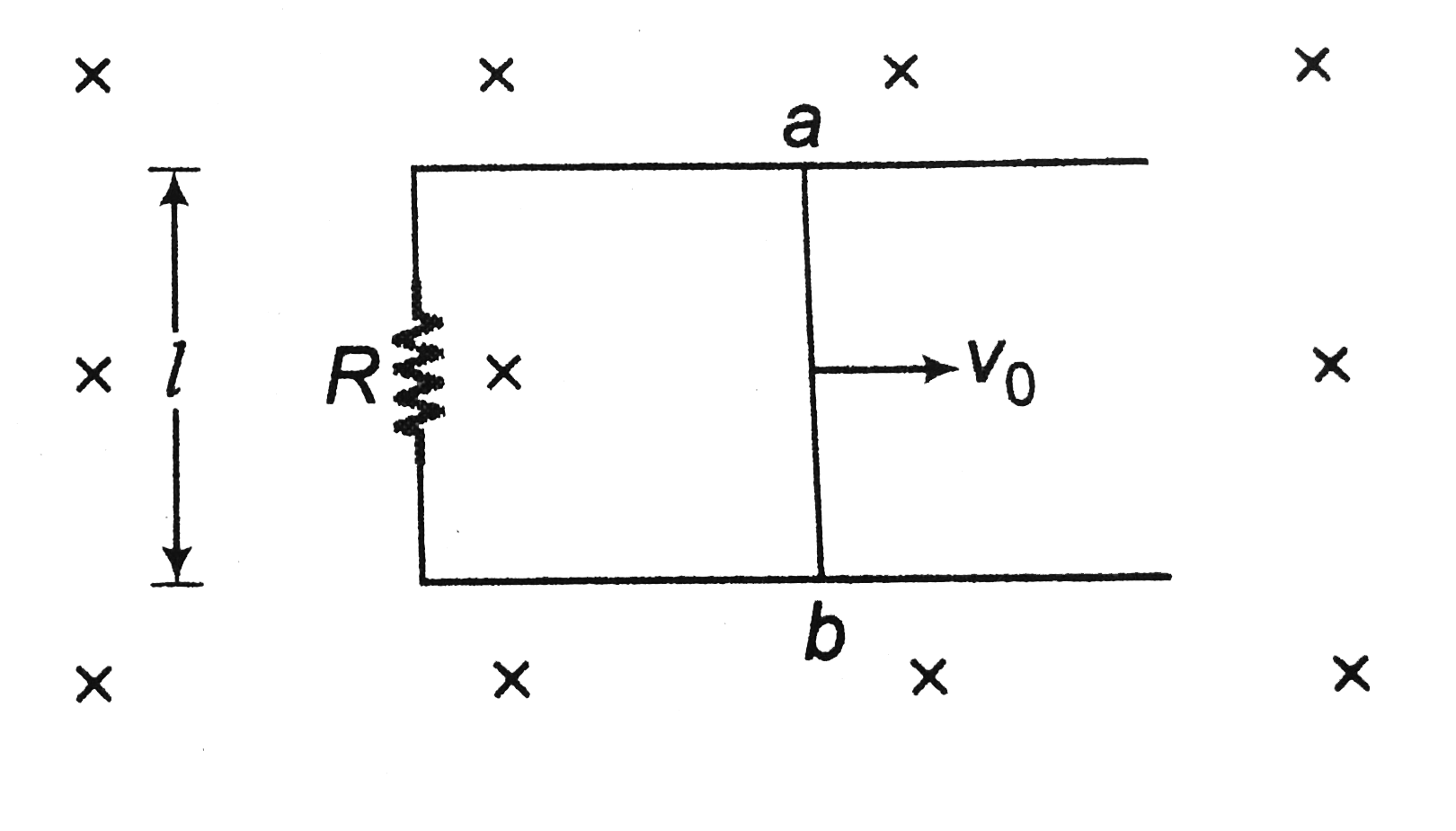
A conducting rod shown in figure of mass `m` and length `l` moves on two frictionless horizontal parallel rails in the presence of a unifom magnetic field directed into the page., The rod is given an initial velocity `v_0` to the right and is released at `t=0`. Find s a function of time
a. the volocity of the rod
b. the induced current and
c. the magntitude of the induced emf.

Text Solution

Verified by Experts
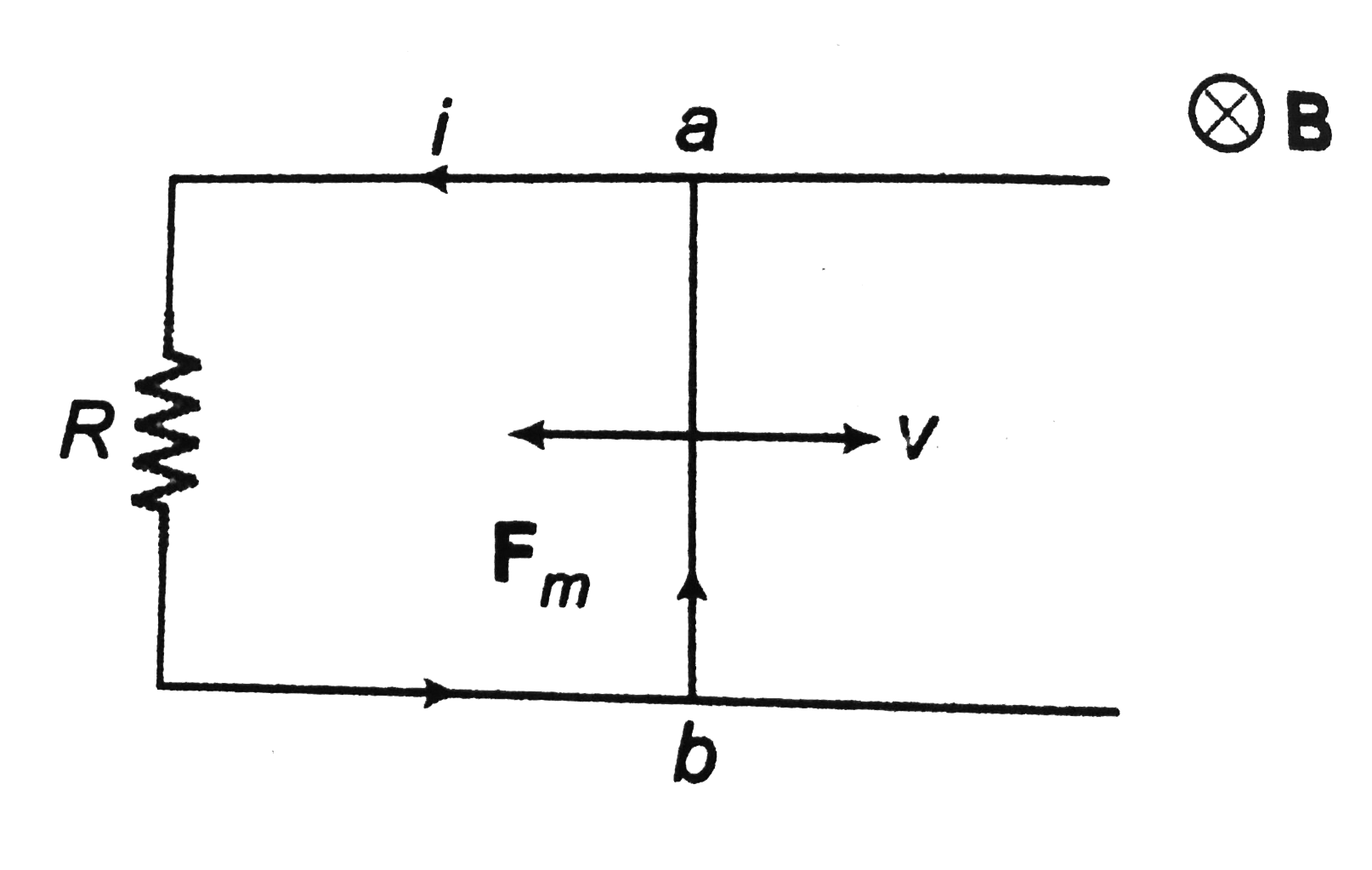
a. Let `v` be the velocity of the rod at time `t`
current in the ciruit at his moment is
`i=(Bvl)/R` …..i
From right had rule, we can see that this current is in counterclockwise direction.
The magnetic force is
`F_m=-ilB=-(B^2l^2)/Rv`
Hence, negative sign denotes that the force is to the left and retards the motion. This is the only horizontal force acting on the bar, and hence, Newton's second law applied to motion is horizontal direction gives
`m(dv)/(dt)=F_m=-(B^2l^2)/Rv`
`:. (dv)/v=-((B^2l^2)/(mR))dt`

Integrating this equation using the initial condition that
`v=v_0` at `t=0`, we find that
`int_(v_0)^v(dv)/v=(B^2l^2)/(mR) int_0^t dt`
Solving this equation we find that
`v =v_(0)e^(-t//tau)` ...........ii
where ,` tau=(mR)/(B^2l^2)`
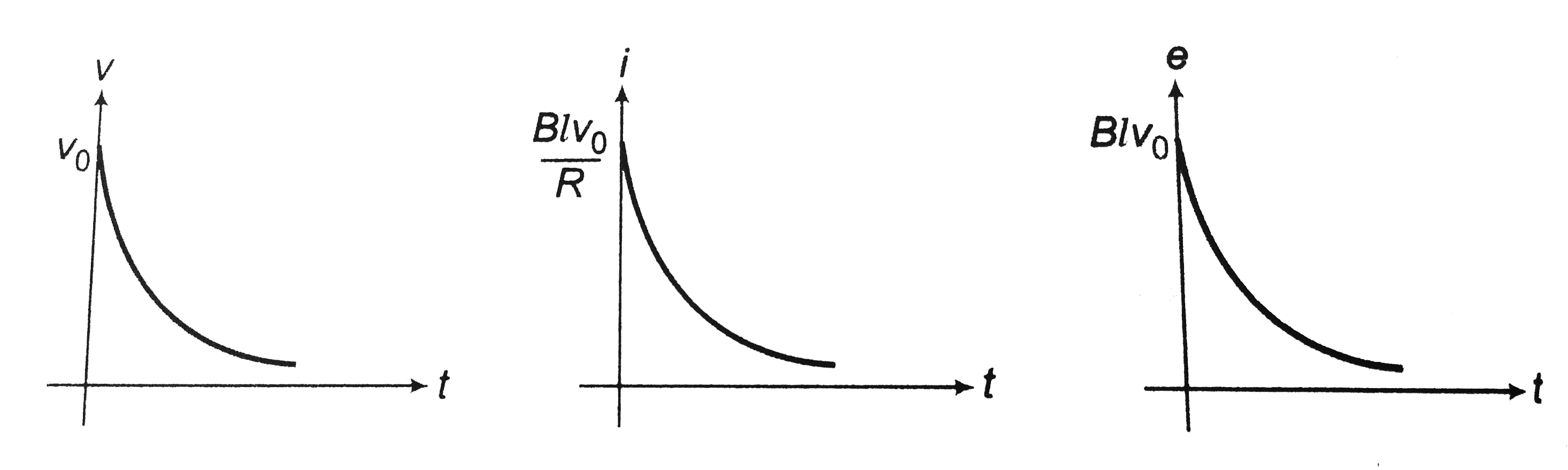
This expression indicates that the velocity of the rod decreses expnentially with time under the action of the magnetic retarding force.
b. `i=(Bvl)/r`
substituting the value of `v` from Eqn (ii), we get
`i=(Blv_0)/R e^(-t//tau)`
c. `eiR=Blv_0e^(-t//tau)`
i. and e both decrease exonentially with time v-t, i=t and e-t graphs are as shown in figure.

Alternate solution: This problem can also be solved by energy conservation principle. Let at some instant velocity of the rod is `v`. As no external force is present. Energy is dissipated in the resistor at the cost of kinetic energy of the rod. Hence,
`(-(dK)/(dt))=` power dissipated in the resistor
or `-d/(dt)(1/2mv^2)=e^2/R`
or `-mv((dv)/(dt))=(B^2l^2v^2)/R` (as `e=Bvl`)
`:. (dv)/v=(B^2l^2)/(mR)dt`
`:. int_(v_0)^v (dv)/v=(B^2l^2)/(mR)dt`
or `v=v_0e^(-t//tau),` where `tau=(mR)/(B^2l^2)`
Promotional Banner

Topper's Solved these Questions

  • ELECTROMAGNETIC INDUCTION

    DC PANDEY ENGLISH|Exercise Exercise 27.1|8 Videos
  • ELECTROMAGNETIC INDUCTION

    DC PANDEY ENGLISH|Exercise Exercise 27.2|4 Videos
  • ELECTROMAGNETIC INDUCTION

    DC PANDEY ENGLISH|Exercise Example Type 6|3 Videos
  • CURRENT ELECTRICITY

    DC PANDEY ENGLISH|Exercise Medical entrances gallery|97 Videos
  • ELECTROMAGNETIC WAVES

    DC PANDEY ENGLISH|Exercise Sec C|22 Videos

Similar Questions

Explore conceptually related problems

A bar of mass mand length I moves on two frictionless parallel rails in the presence of a uniform magnetic field directed into the plane of the paper. The bar is given an initial velocity v_(i) to the right and released. Find the velocity of bar, induced emfacross the bar und the current in the circuit as a function of time.

A conducting rod of mass m and length l is placed over a smooth horizontal surface. A uniform magnetic field B is acting perpendicular to the rod. Charge q is suddenly passed through the rod and it acquires an initial velocity v on the surface, then q is equal to

A glass rod of length l moves with velocity v in a uniform magnetic field B. What is the e.m.f induced in the rod?

A rod of mass m , length l and resistance R is sliding down on a smooth inclined parallel rails with a cinstant velocity v . If a uniform horizontal magnetic field B exists, then find thevalue of B .

A conducting rod of length l falls verticaly under gravity in a region of uniform magnetic field B . The field vectors are inclined at an angle theta with the horizontal as shown in figure. If the instantaneous velocity of the rod is v , the induced emf in the rod ab is

A conducting rod PQ of length l=1.0m is moving with a uniform speed v2.0m//s in a uniform magnetic field B=4.0T directed into the paper. A capacitor of capacity C=10muF is connected as shown in figure. Then

A conducting wire of length l and mass m can slide without friction on two parallel rails and is connected to capacitance C . Whole system lies in a magnetic field B and a constant force F is applied to the rod. Then

A conducting rod OA of length l is rotated about its end O with an angular velocity omega in a uniform magnetic field directed perpendicualr to the rotation. Find the emf induced in the rod, between it's ends.

A conducting rod AB of length l is projected on a frictionless frame PSRQ with velocity v_(0) at any instant. The velocity of the rod after time t is

A conducting rod AB of length l is rotated about point O with an angular velocity velocity omega in a uniform magnetic field (B_0) directed perpendicular into the plane of rotation as shown in the figure. The value of V_B - V_A is